Something was striking about the Congress in Pune over the past few days. The party was not merely preparing for Rahul Gandhi’s interaction with female students. It had turned the programme into a major organisational exercise, bringing leaders from across Maharashtra to Pune and putting its local machinery to work.
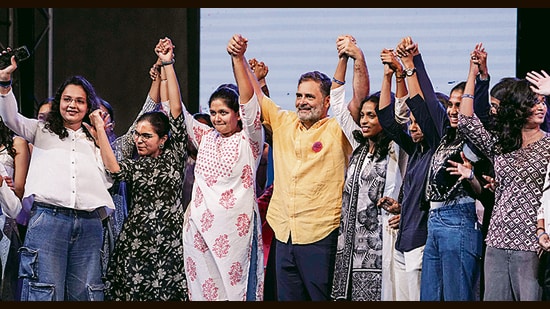
For three to four days, Pune became a temporary Congress camp. State Congress president Harshwardhan Sapkal was here reviewing arrangements, while senior leaders Satej Patil and Yashomati Thakur were involved in mobilising the organisation. Leaders Vijay Wadettiwar, Prashant Jagtap and others were also visible around the preparations. The party’s Delhi team arrived a day before the Chhatron ki Goonj programme, fourth in the series.
Meetings were held in different areas, workers mobilised and students contacted in large numbers. Leaders associated with educational institutions were also involved in bringing students to the programme. The effort was clearly greater than what would normally be required for a routine visit by a national leader.
By Saturday evening, Congress leaders were visibly pleased with the response to Gandhi’s ‘Chhatron Ki Goonj’ interaction at the AISSMS ground. The police had estimated a gathering of 8,000 to 10,000 people, although it crossed beyond this as per Congress leaders’ assessment. The programme itself was different from a conventional political rally, with Rahul interacting almost entirely with young women and listening to their concerns about education, competitive examinations, safety, careers and social pressures.
For Congress, therefore, there were two events taking place simultaneously — one on the stage and another behind it.
{{/usCountry}}For Congress, therefore, there were two events taking place simultaneously — one on the stage and another behind it.
{{/usCountry}}The stage was about Gandhi and the students. Behind the stage was the Maharashtra Congress organisation trying to demonstrate that it could put its entire machinery behind a single programme.
That effort became even more visible because Pune had already become a political battleground around student issues a day before the event.
The clash between National Students’ Union of India (NSUI) and Akhil Bharatiya Vidyarthi Parishad (ABVP) members at the COEP Technological University hostel on Friday night gave the Congress programme an unexpected build-up. The two sides gave sharply different accounts of what led to the confrontation. ABVP alleged that Congress workers were pressuring female students to register for Rahul Gandhi’s programme, while Congress leaders alleged that a female student who had supported the programme was threatened inside the hostel.
The incident brought student politics into the headlines just a day before Gandhi was to address students. Congress leaders, including Vijay Wadettiwar, rushed to the hostel. Police deployment was increased, and political leaders and activists were subsequently barred from entering the COEP campus and hostel for four days.
Whatever the competing versions of the incident, politically it ensured that the subject Congress had chosen — young students and their concerns — was already being discussed in Pune before Gandhi arrived.
There was another interesting development happening in Pune at almost the same time.
The Bharatiya Janata Party (BJP) was holding its own programme around Vande Mataram, with the party seeking to turn the national song into a larger political and ideological campaign. The BJP has been attacking the Congress over the latter’s position on the singing of Vande Mataram and has sought to present itself as the defender of the song’s full legacy.
So, in a city known for its educational institutions and student politics, two very different political messages were playing out almost simultaneously.
But it would be simplistic to reduce the weekend to another Congress-versus-BJP contest.
The more interesting question is why both parties are choosing Pune for such programmes.
Pune has a large student population, a sizable young workforce and a long tradition of political and social movements centred around education. It also has a concentration of colleges and educational institutions - Pune has over 25 universities, including three publicly funded ones - that gives political parties access to a politically aware young audience.
Congress made a deliberate choice in restricting Gandhi’s interaction to female students. The party had also linked the programme to Pune’s history of girls’ education, particularly Savitribai Phule. The idea was to move away from the conventional political rally and create a setting where students could speak directly to a national leader.
And students too did speak. Questions and personal experiences around examination irregularities, career uncertainty, social restrictions and women’s safety gave the programme a different texture from a normal political meeting.
For the Congress organisation, however, the response on Saturday may have been only one part of the satisfaction.
The other was seeing senior leaders from different parts of Maharashtra working together in Pune for several days. Leaders who normally operate in their own regions were suddenly coordinating with the city unit, the state leadership and the national team.
That kind of mobilisation is not easy for any political organisation.
It also explains why the Congress leadership was keen to make the programme bigger than just Gandhi’s appearance. The party had invested considerable time and resources in it. Police had imposed 30 conditions for the programme, which itself reflected the scale of the expected gathering.
A successful programme can generate enthusiasm for a day. The more difficult task is to maintain contact with the students who attended, follow up on the issues they raised and build a sustained engagement with young people.
For Congress, Saturday offered a useful organisational exercise as well as a political platform. For the BJP, the parallel Vande Mataram programme showed that it too is keen to keep its own political messaging active in Pune.
And for Pune, the weekend offered a reminder that the city’s students are increasingly becoming a constituency that political parties cannot afford to ignore.