PUNE: Flight connectivity at several smaller airports in Maharashtra has weakened in recent months, with some routes witnessing reduced frequencies or temporary suspensions as airlines juggle aircraft availability, operating costs and commercial viability.
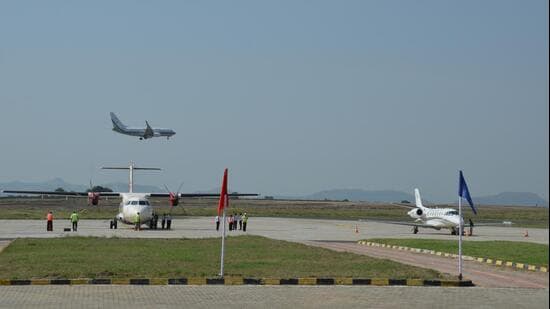
Shirdi airport has seen among the sharper reductions with the number of flights operating to and from the airport plunging from around 11 in 2024 to just four in May 2025. Airport officials have indicated that the number could fall further to two beginning November this year.
A senior Shirdi airport official said that the airport is making efforts to attract more flights, but airlines are facing constraints in deploying aircraft across regional routes. “We are making efforts to increase the number of flights from Shirdi. However, all airlines are facing a shortage of aircraft across the country due to which, the number of flights operating to Shirdi has declined,” the official said.
In turn, the reduction has affected businesses dependent on airport traffic. Prabhakar Gunjal, president of the Saitara Project Affected Persons Voluntary Organisation at Kakadi, said that the number of vehicles operating for airport passengers has fallen from around 500 to about 250.
“The decline in flights from 11 to four has put the taxi business at risk. Vehicle owners are struggling with loan repayments, while some vehicles face the possibility of repossession,” Gunjal said.
{{/usCountry}}“The decline in flights from 11 to four has put the taxi business at risk. Vehicle owners are struggling with loan repayments, while some vehicles face the possibility of repossession,” Gunjal said.
{{/usCountry}}Like Shirdi, Nanded airport too has seen a reduction in services with daily flights to destinations including Pune and Mumbai dropping from the earlier two to three to just one, according to passengers and other stakeholders.
“Earlier, there were two to three flight options to Pune and Mumbai, so passengers could choose a convenient time according to their work. With only one flight available now, missing it means either postponing the journey or spending several hours travelling by road,” said Varsha Mujumle, a passenger from Nanded.
Similar to Shirdi and Nanded, passengers in Kolhapur too have raised concerns over reduced options and uncertainty over regional flight schedules. “Air connectivity is important for people travelling for business, medical treatment and education. When flights are reduced or suspended, passengers are forced to depend on road or rail services, increasing both travel time and inconvenience,” said Aditya Mohite, a passenger from Kolhapur.
While airports across the rest of Maharashtra including Solapur, Jalgaon, Amravati, Nashik and Sindhudurg have also witnessed changes in the number of flights in recent months, the changes have been uneven across the state.
Solapur, for instance, got some respite this month with the restoration of its Mumbai service after a 35-day suspension. Star Air resumed the service on August 2 after it was suspended on June 28 due to technical reasons. The flight currently operates on Mondays, Wednesdays, Fridays and Sundays. The restoration followed efforts by chief minister Devendra Fadnavis and Solapur guardian minister Jaykumar Gore, who had sought resumption of the service citing difficulties faced by traders, entrepreneurs, professionals, patients and other passengers.
At Shirdi, airport infrastructure is another factor affecting the availability of convenient flight slots. Although the airport has completed 11 years of operations, its night-landing facility has not yet become fully operational at the required capacity. Stakeholders have said that the infrastructure and operating-hour limitations can restrict slots available to airlines.
A recent meeting involving airlines and officials from Shirdi, Nashik and Chhatrapati Sambhajinagar airports reviewed the flight schedules at these airports with stakeholders indicating that Shirdi could be left with just two flights from November.
Aviation expert Dhairyashil Vandekar said that the reduction in services at some airports reflects a combination of factors rather than a single statewide crisis.
“The present scenario is the result of a combination of national airline capacity constraints, aircraft availability, rising operating costs, airport infrastructure limitations, operating-hour restrictions and the commercial decisions of individual airlines,” he said.
The variation in connectivity is evident across Maharashtra. Currently, Chhatrapati Sambhajinagar airport has around seven flights, while the comparatively new Nashik airport has around three, according to stakeholders. Smaller airports are more vulnerable to fluctuations because airlines have fewer aircraft to deploy on regional routes and have to assess the commercial viability of individual services. The director of one of the smaller airports that has been affected, said on condition of anonymity that the changes are primarily linked to aircraft deployment and airline economics rather than the lack of passenger demand.
“Airlines are currently prioritising routes where aircraft utilisation and commercial returns are higher. Smaller airports are consequently more vulnerable when there is a shortage of aircraft. Restoring services will require additional aircraft as well as commercially viable operating slots,” the official said.
Vandekar said that the Indian airline industry continues to face capacity constraints linked to Pratt & Whitney GTF engine-related groundings, supply-chain and maintenance issues, and the earlier exit of Go First. These constraints have made airlines more selective about where aircraft are deployed. He said that airlines facing capacity pressures tend to prioritise routes with stronger yields, consistent passenger demand, and better aircraft utilisation. Thinner regional routes, particularly from tier 2 and tier 3 cities, can thus become vulnerable to frequency reductions or withdrawal when their economics is weaker. High aviation turbine fuel prices, maintenance costs, lease rentals, crew expenses and other operating costs add to the pressure, he said.