PUNE: A team of aerospace engineering students from a MIT Art, Design and Technology (MIT ADT) University has developed and successfully flown a large radio-controlled (RC) electric fixed-wing aircraft, which has now received entries in the India Book of Records and Asia Book of Records.
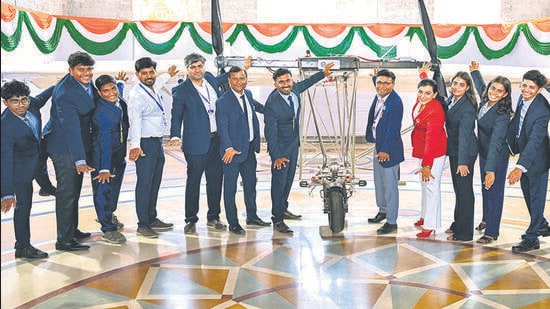
Named ‘Project GARUDA’, the aircraft was developed by ‘Team Skytrek’ from the Department of Aerospace Engineering under the School of Engineering and Sciences. According to the team, the aircraft has a wingspan of 9.25 metres and an all-up weight of 261 kilograms.
The aircraft received recognition in four categories — India’s heaviest RC airplane, India’s largest wingspan RC airplane, Asia’s largest radio-controlled electric airplane and Asia’s heaviest student-built RC electric airplane.
According to the university, the project received funding support of ₹48 lakh in three phases from its Centre for Research, Innovation and Entrepreneurship for Young Aspirants (CRIEYA).
Students involved in the project said the team designed, fabricated, assembled and tested the aircraft over nearly four years. The work included airframe design, aerodynamic analysis, flight-controller integration, electric propulsion systems, telemetry systems and remote piloting operations.
“The project began with just two people and gradually grew into a team of 30 members. We wanted to build a large radio-controlled aircraft and continued working on it through multiple testing phases,” said Sateesh Kache, team lead of the Skytrek UAV Project.
{{/usCountry}}“The project began with just two people and gradually grew into a team of 30 members. We wanted to build a large radio-controlled aircraft and continued working on it through multiple testing phases,” said Sateesh Kache, team lead of the Skytrek UAV Project.
{{/usCountry}}According to the team, the project faced several technical challenges during development, including propulsion failures, structural redesigns, flight-controller tuning issues and unsuccessful flight attempts during earlier testing phases in 2024.
The students said the aircraft underwent multiple redesigns and testing stages before achieving a stable take-off, controlled flight and landing on May 4, 2026, at the Dhule runway.
University officials said the project involved developing a scaled prototype for aerodynamic validation, along with upgrades to propulsion and telemetry systems during later testing phases.
Mangesh Karad from the university said the project reflected the institution’s focus on practical and research-based learning. “Our students converted classroom learning into a large-scale aerospace project through teamwork, experimentation and sustained effort,” he said.
The project also received mentorship from aviation personalities Shital Mahajan and Captain Amol Yadav, according to the university.
Following the successful flight tests, the student team plans to continue research in UAV and electric aviation technologies and explore possible startup opportunities linked to aerospace applications.