In January 1936, the GIP Railway decided to introduce dining cars on all trains connecting Bombay with Poona and some other cities. It also published a circular requiring all first-class passengers to dine in the separate dining cars instead of in their compartments.
Many of the older Anglo-Indians who had been accustomed to the privacy of compartments wherein tiffin baskets were utilised for refreshments were loud in condemnation of this “democratic installation”. According to ‘The Locomotive, Railway Carriage and Wagon Review’ (vol 42, 1936), a ‘high military officer’ who frequently travelled between Bombay and Poona wrote to the government, worried about “diluting the spirit of the Empire”.
Some objects become part of everyday life because a new way of living creates a need for them. The tiffin basket was one such object.
A tiffin basket, also known as a lunch basket or a luncheon basket, was a rigid carrying container, often made of cane, wicker, bamboo, or other woven material. It was designed to hold one or more tiffin carriers, food vessels, bottles, plates and other items. The basket might have a lid, handle, or shoulder strap, and could be quite substantial.
For British officers, administrators, and wealthy Anglo-Indians travelling to their favourite hill stations and army cantonments, going on shikar, or spending weekends at the racecourse, tiffin baskets were essential. They were fitted with compartments for flasks, porcelain plates, cutlery, condiments, and cold meats meant for outdoor picnics or long road journeys. In 19th-century India, the tiffin basket also functioned as a portable picnic or luncheon hamper.
{{/usCountry}}For British officers, administrators, and wealthy Anglo-Indians travelling to their favourite hill stations and army cantonments, going on shikar, or spending weekends at the racecourse, tiffin baskets were essential. They were fitted with compartments for flasks, porcelain plates, cutlery, condiments, and cold meats meant for outdoor picnics or long road journeys. In 19th-century India, the tiffin basket also functioned as a portable picnic or luncheon hamper.
{{/usCountry}}A tiffin bag, by contrast, was flexible, generally made of cloth, canvas, leather, or similar material. Its principal advantage was that it was easy to carry; it could be carried by hand or over the shoulder and would usually contain a tiffin carrier or other food vessels. The bag itself did not provide the structural protection of a basket.
“Tiffin” was used by the British in India as a synonym for lunch. In the West, it was usually thought of as an Indian word, whereas in fact it was an English upper-class abbreviation of “tiffing”, a verb in common use in England in the 18th century. “To tiff” meant to take a drink or to have a light meal.
The railway gave the tiffin basket one of its most important uses. A journey that might once have taken a day or two by road could now be made by train, but the traveller still had to eat along the way. A meal could be packed into a basket and carried into the railway compartment along with cutlery and other vessels.
On those lines where refreshment rooms were far apart, a tiffin basket was indispensable. E Reynolds-Ball in ‘The Tourist’s India’ (1907) was certain that nothing less than “cold chicken, biscuits, potted meats, Swiss milk, Brand’s Essence, and tea would assuage the hungry traveller”.
Paul Deussen wrote in his ‘Indian Reminiscences’ that no one would think of travelling in India without a tiffin basket and bedding. The arrangements for food on the railways were usually well regulated. The guard ordered breakfast, tiffin, and dinner by telegram beforehand at the appointed stations, where the train usually stopped for 15 to 20 minutes.
William Eleroy Curtis wrote a series of letters to ‘The Chicago Record-Herald’ during the winter of 1903-04, describing the lives of natives and Europeans in India: “Every European resident of India accustomed to travelling by train has an outfit always ready similar to the kit of a soldier or a naval officer. It is as necessary as a trunk or a bag, an overcoat or umbrella, and consists of a roll of bedding, with sheets, blankets and pillows, protected by a canvas cover securely strapped and arranged so that when he wants to retire, he need only unbuckle the straps and unroll the blankets on the bunk in the railway carriage. He also has a “tiffin basket” that has a tea pot, an alcohol lamp, a tea caddy, plates and cups of granite ware, spoons, knives and forks, a box of sugar, a tin of jam, a tin of biscuits or crackers, and other concomitants for his interior department in case of an emergency; and, never having had anything better, he thinks the present arrangement good enough and wonders why Americans are dissatisfied.”
The basket was useful wherever people wanted to eat away from home, be it shikar parties or picnics.
A bearer or another servant was often responsible for packing the food, carrying the basket to the railway carriage or campsite, and arranging the meal when it was time to eat. The basket was part of a larger system of travel in which food, servants and luggage moved together.
Most first-class passengers travelled with their servants in the lower classes. They would rush when the train stopped at the intermediate stations to serve food to their employers.
Some first-class carriages had compartments with small rooms for a servant. He served meals and drinks, made the beds and looked after the mountain of luggage that inevitably accompanied the passenger: portmanteaux, suitcases, dressing-bag, hat-box, helmet-case, a roll of bedding, and the tiffin basket.
Those who did not travel with a servant hired a tiffin coolie, who could be found on the railway station platforms.
Tiffin coolies were also employed during shikars. He did not carry an ordinary load and always accompanied his employer, carrying a small tiffin basket with his breakfast or lunch, a blanket to sit on, and any miscellaneous things, such as a newspaper or book, he might require. His duty was to remain beside his master when travelling or shooting and to help him put up the tent, make his bed, bring him his meals, etc. He had more miscellaneous duties than the other permanent coolies, but he carried a much lighter load.
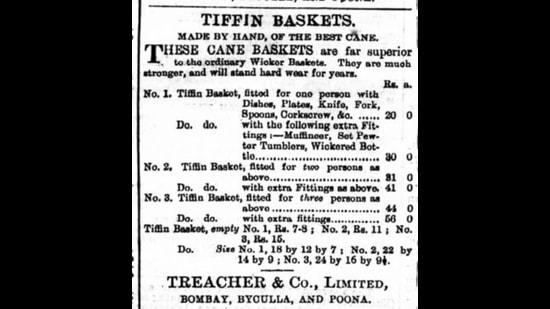
Treacher & Company sold tiffin baskets which it claimed were “far superior” to the “ordinary wicker baskets”. The “No 1 Tiffin Basket” was fitted for one person with dishes, plates, knife, fork, spoons, and corkscrews. It cost ₹20. A superior version came with a muffineer, a set of pewter tumblers, and wicker bottles. It cost ₹10 more. Tiffin baskets suitable for two to four people were also available. Empty tiffin baskets could be purchased too.
Kemp & Co sold corkscrews and ice breakers for tiffin baskets.
J Neubero sold “The Shikari”, a fitted tiffin basket, at its Meadow Street shop in Bombay. It was costlier than ordinary tiffin baskets. “Officers’ ‘service’ canteens were wicker baskets with straps and locks, containing everything necessary for the immediate cooking, serving, and consuming of a meal.
The tiffin basket was an object of a changing society. It became associated with the railway age, but not exclusively with it. It travelled in compartments, went out on picnics, accompanied shikar parties, and carried meals into the countryside.
Chinmay Damle is a research scientist and food enthusiast. He writes here on Pune’s food culture. He can be contacted at chinmay.damle@gmail.com