
 E-Paper



Toffee trail: From Britain to Colonial Poona’s streets
In December 1902, an unusual crowd began gathering every Sunday morning outside Treacher & Company’s store in Poona

 Prefer HTon Google


Food has long served as a tool of diplomacy, persuasion, and cultural exchange. New tastes have opened markets, forged commercial ties, and familiarised distant societies with one another.
In December 1902, an unusual crowd began gathering every Sunday morning outside Treacher & Company’s store in Poona. At eleven o’clock sharp, people arrived carrying coupons clipped from a Bombay newspaper. The promotion had been launched by the confectionery firm of John Mackintosh, the self-styled “Toffee King” who claimed to own the “largest toffee factory” in the world. Anyone presenting a coupon could claim two packets of toffee in flavours of their choice.
Toffees made by Mackintosh’s company of Halifax, England, had been available in Bombay since at least 1898. But this promotional offer announced its grand arrival in Poona. Mackintosh’s toffee was soft and chewy and stood apart from the other hard and brittle toffees sold at the time, offering something new to local consumers and helping to create a growing taste for British confectionery in the city.
Originally developed in Britain, toffee is a confection made by caramelising sugar or molasses with butter and occasionally flour. The word “toffee” was first recorded in the Oxford English Dictionary in 1825 as a dialectal variation of “taffy”.
American versions are often made with nuts, especially almonds, while traditional English toffees are usually nut-free. Till the mid-twentieth century, English toffee was sold in European stores, confectioneries and railway stations as a solid slab rather than in individual pieces. Customers were often provided with a small mallet, known as a toffee hammer, to break it into bite-sized chunks.
Before the nineteenth century, sugar was an expensive luxury reserved for the upper classes. The expansion of slave plantations in Britain’s Caribbean colonies dramatically increased sugar production and lowered prices. As sugar and treacle became more affordable, confectionery moved beyond elite tables and into everyday life. Among the many sweets that emerged from this transformation, toffee became one of the most popular.
Farrah’s Harrogate Toffee Shop, established in 1840, sold its toffees in Bombay in the early 1860s. In the early 1880s, Morena & Co, headquartered on Meadows Street in Bombay, imported a wide variety of confections from Europe. When shipments arrived, advertisements announced the arrival of a “great variety of confectionery”, and residents of Poona were encouraged to place their orders in advance. Boxes were then dispatched to the city in special railway carriages. Everton Toffee was among the most sought-after Christmas treats. Morena & Co also sold Raspberry and Black Currant Toffees.
Buncomb and Co, based in Allahabad, sold Almond Toffee, Everton Toffee, and Ginger Toffee alongside a variety of hardbakes, rocks, fruit drops, cream bars, and chocolates. Established in 1887, the firm boasted of selling 11,000 pounds of confectionery within its first three years. Advertisements published between 1890 and 1900 suggest that it enjoyed a substantial customer base across the Bombay Presidency.
In 1900, Philips & Co introduced Devonshire Cream Toffee in its Poona store. Manufactured by the American confectionery firm Murray’s, it was sold alongside Vanilla Toffee, priced at six annas per packet.
In the late nineteenth century, toffee became a favoured addition to the European dessert table in India alongside crystallised fruits, liquor comfits, peel chips, and brandy fruits. Toffee-making was also a popular winter pastime. Recipes appeared regularly in the domestic columns of Bombay newspapers, ranging from old-fashioned treacle toffee to more elaborate varieties. Among these, Caramel Toffee was especially popular.
Toffee did not remain confined to European stores and colonial households in India for long. By the early twentieth century, it was being sold through shops that catered to a much wider clientele than the European community alone. Indian customers were probably attracted by its rich, buttery sweetness and novelty. Unlike traditional Indian sweets, which were perishable and tied to festivals and rituals, toffee represented a new kind of everyday indulgence that was portable, individually portioned, and closely associated with modern industrial food culture.
As local confectioners began producing their own versions to make the toffee more affordable, toffee-making quickly transformed into a lucrative Indian enterprise. Recognising this rapidly expanding market, Rose Brothers Ltd of Gainsborough marketed its Rose Toffee Wrapping Machine. In 1920, the company organised a demonstration in Bombay for confectioners from across the Presidency. According to its promotional material, the firm’s “Triumph” Cutting and Wrapping Machine, used in conjunction with a Toffee Cooker and Cooling Slab, could produce more than 1,000 pounds of toffee a day, fully wrapped and ready for the market.
The growth of India’s sugar industry encouraged several domestic manufacturers to enter the confectionery trade. According to the Council of Scientific and Industrial Research’s 1951 report, “The Wealth of India: Industrial Products”, confectionery manufacturers used an estimated 15,000 tonnes of sugar annually before the Second World War. During the war, a large share of the country’s sugar supply was reserved for the armed forces and other essential needs, restricting civilian consumption. Nevertheless, demand for confectionery remained strong, and about 8,300 tonnes of sugar were allocated each year to 33 factories for the manufacture of sweets and confectionery. After the war, while some factories closed, others expanded their operations and invested in modern machinery, laying the foundations for a domestic toffee industry.
Agra’s GG Chocolate Factory, already known for its jams, marmalades, chutneys, and chocolates, promoted its GG Brand Toffees in Marathi newspapers like “Kesari” and “Dnyanapraksh”, and even announced a monthly free distribution of toffees to children in July 1945. This was met with resistance from irate parents and teachers. Letters of criticism were published in several Marathi and English newspapers when it was revealed that a few other confectioners had resorted to the same mode of publicity.
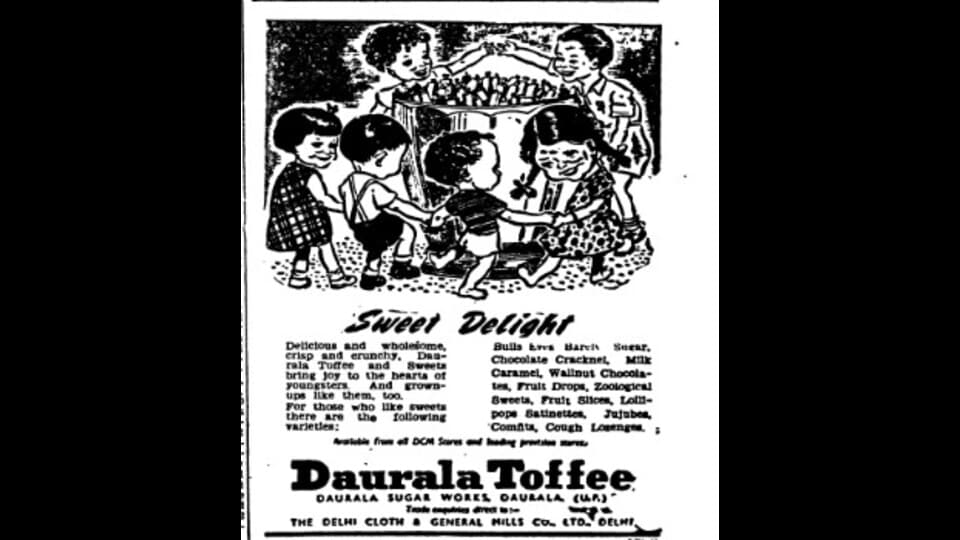
Bombay-based Personal Products marketed its Dairy Cream Toffees, made with full-cream condensed milk and sold in attractive tins, boxes, and cartons. Daurala Toffees, produced by Daurala Sugar Works in Uttar Pradesh, were widely advertised and enjoyed considerable popularity in Poona. The company opened a shop in Bhavani Peth in September 1946.
Kapurthala’s The Mahalakshmi Sugar Mills Co sold “Ashwini” Toffees in Poona through its shop in Somwar Peth. Bombay’s The Top-Rank Company manufactured and sold Dairy Milk and Turkish Toffees and operated a shop on East Street.
The manufacturers claimed that “Daurala” and “Ashwini” Toffees were produced in “completely automatic” machines. They presented automation as a mark of scientific progress, but the appeal of machine-made sweets also drew upon older concerns about caste and ritual purity. While automation promised an abundance of sweets for the masses, it also catered to a fractured social order. For a section of consumers, a machine-led process guaranteed that food had bypassed human hands altogether. The phrase “untouched by hand” functioned as a sanitised marketing code, assuring upper-caste customers that the sweets were insulated from the physical touch of marginalised communities. Modern automation thus became a means of reinforcing older anxieties surrounding ritual pollution and purity.
No longer an exotic symbol of distant imperial trade, the toffee became an everyday Indian commodity. It evolved from a soft, chewy novelty imported from Europe and the United States into a battleground for domestic marketing, industrial ambition, and social friction. It was a mirror to a modernising India.


