
 E-Paper



Tribal languages & culture exhibition at Pune Book Festival creates Guinness World Record
The exhibition – organised by Rushimela Indigenous Knowledge and Scientific Education (RISE) Foundation in association with National Book Trust (NBT) and Pune Book Festival; and commemorating the 150th birth anniversary of Bhagwan Birsa (Munda) – showcases 1,678 posters

 Prefer HTon Google


The Pune Book Festival 2025 has created a Guinness world record for the ‘largest display of posters’ showcasing indigenous tribal languages and cultural heritage. On display are 1,678 posters, surpassing the previous record of 1,365 posters held by the United States. Adjudicator Swapnil Dangrikar officially validated the Guinness world record.
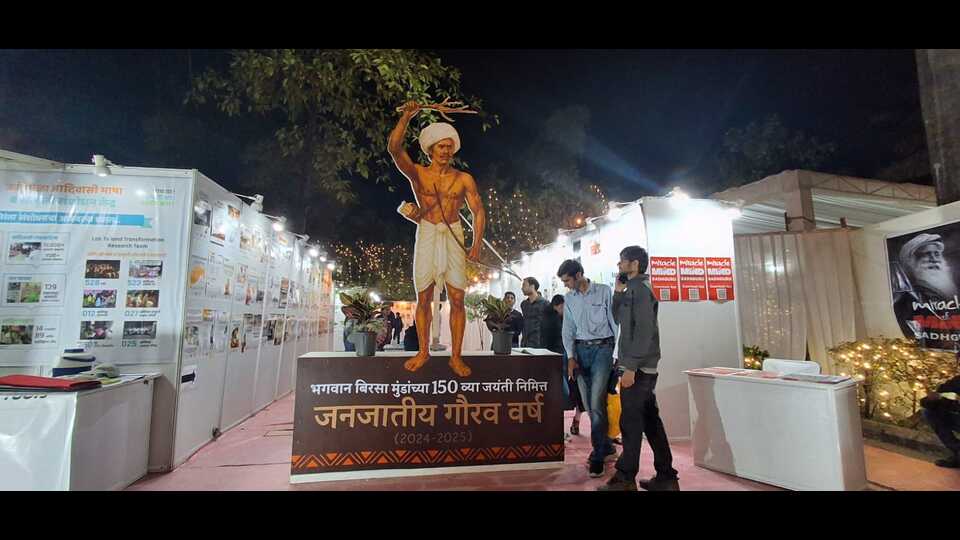
The exhibition – organised by Rushimela Indigenous Knowledge and Scientific Education (RISE) Foundation in association with National Book Trust (NBT) and Pune Book Festival; and commemorating the 150th birth anniversary of Bhagwan Birsa (Munda) – showcases 1,678 posters; each poster documenting vocabulary from India’s tribal languages, presenting original tribal words along with their meanings in Marathi, Hindi and English. The exhibition aims to preserve endangered languages and make them accessible to a wider audience. Beyond language documentation, the posters highlight the oral histories, customs, rituals, folk traditions, festivals, ecology and material culture of tribal communities, particularly from Maharashtra and the surrounding regions.
RISE Foundation has conducted extensive research over the past 15 years which includes: documentation of over nine lakh words from 15 tribal languages; compilation of over 2,000 folk tales and 10,000 folk songs; publication of dictionaries of tribal dialects namely Korku, Pawri, Nihali, Vaghari, Kolami and Bhilali; and documentation of 139 traditional vegetables from the Satpuda region, 23 varieties of indigenous millets, and 753 ethnomedicinal plants.
Stressing that the loss of language threatens not only cultural identity but also traditional knowledge systems, RISE Foundation founder Rushikesh Khilare shares, “The journey began in 2010 with tribal youth in Melghat, and has now evolved into a collective movement of tribal communities across Maharashtra and India.” Melghat was chosen due to its diversity with 317 villages spread across three districts and five talukas in the state; and because it is home to five-six tribal communities including Korku, Pawara, Bhilal, Nihal and Pardhi.
Khilare says documentation of tribal languages wasn’t planned but took place accidentally during the implementation of a library project for tribal children, supported by funding from Sevagram Charitable Trust. The libraries got a positive response to begin with but were shut down within nine months as children could not understand the material due to language differences. After analysing 250 villages, the team identified education as the core issue affecting tribal communities, with language emerging as the biggest barrier. To address this challenge, several language research institutes across India were approached. Eventually, Deccan College, Pune offered support with professor Shubhangi Kardile providing training in linguistic concepts and methodologies. “She trained both the team and tribal members in linguistic documentation, recording techniques, and phonetics, and guided the validation of collected data,” Khilare says.
Currently, a 50-member team is working on the language project, supported by tribal teams with expertise in tribal languages, music, medicine, farming, forests, birds, stories, and songs. Research has been conducted extensively in the Gondwana and Satpuda ranges, while work in the Sahyadri range is yet to begin. “Between 2010 and 2025, the initiative has documented 15 tribal languages, 11 lakh words and sentences, and more than 10,000 songs,” Khilare says. There are nearly 250 tribal groups with 700 to 800 artists currently associated with the project. As part of the documentation effort, 25,000 Chitrakathi paintings created by tribal artists have been collected; each painting narrating a complete story.
“Stories depicted in Gond-style paintings are documented in the Gondi language and then translated into Marathi, Hindi, and English. While Warli paintings are widely known, many other tribal art forms remain largely unseen. These artistic skills, passed down through generations, are now being given a platform to generate employment and global recognition. As part of this effort, 137 storytelling posters based on tribal paintings have been displayed,” Khilare says.
Khilare shares that 15 tribal languages have been documented district-wise, representing nearly three crore people across India. The objective, he says, is to digitise these languages and link them with state languages, enabling live translation into 180 global languages using modern technology. Khilare points out that though tribal communities constitute nearly 10% of India’s population and 9.83% of Maharashtra’s population, their languages remain largely undocumented and underrepresented. The exhibition posters document tribal lifestyles, animals, birds, trees, academic concepts, planets, days, and weapons; and they have been acknowledged by Guinness, he says.


