E-Paper



You cannot skip education for acting; we need educated actors: Naseeruddin Shah
Veteran actors Naseeruddin Shah and Paresh Rawal attended the inaugural session of the first Shri Ram Lagoo National Theatre Festival in Pune

 Prefer HTon Google


Pune: Veteran actor Naseeruddin Shah on Monday stressed that education is essential for actors, saying theatre demands observation, imagination and intellectual depth beyond performance skills alone.
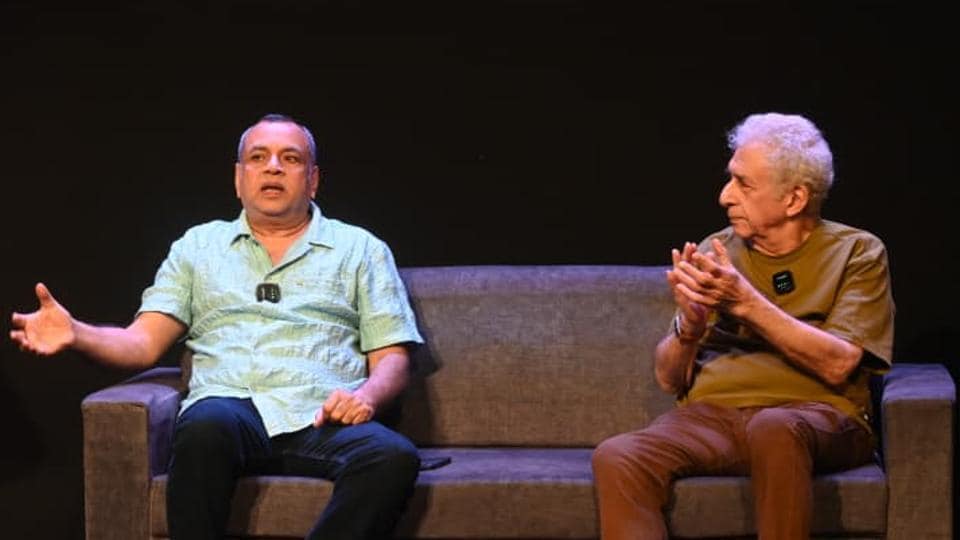
Speaking at the inaugural session of the first Shri Ram Lagoo National Theatre Festival organised by the Maharashtra Cultural Centre and the Lagoo family in Pune, Shah and veteran actor Paresh Rawal reflected on theatre, acting, education and the future of performing arts during a conversation moderated by noted director Vijay Kenkre.
Encouraging students to engage seriously with theatre, Shah said acting should never come at the cost of education. “Becoming an actor does not mean escaping education. We need educated actors. Education helps performers understand human behaviour, imagination and observation, all of which are essential to acting,” he said.
A key highlight of the interaction was Rawal’s strong pitch for greater institutional support for theatre. He said theatre festivals should be organised more frequently and backed by both governments and industrialists to create more performance spaces for young artistes.
“I see a very bright future for theatre. Even with AI, theatre will evolve and audiences will continue to enjoy it. Theatre will never diminish,” Rawal said. Shah echoed the sentiment, saying that despite repeated predictions of theatre’s decline, audiences continue to fill auditoriums for live performances.
Maharashtra Cultural Centre president SP Kulkarni, festival director Prasad Vanarse, Anand Lagoo, Mohan Agashe, Amol Palekar, playwright Satish Alekar and actor Dilip Prabhavalkar and others attended the inaugural event.
Recalling their early journeys, both actors spoke about discovering their passion for acting through school and college competitions. Shah shared memories of studying at the National School of Drama (NSD) and later at the Film and Television Institute of India (FTII).
“At FTII, I realised that an actor may or may not be formally trained, but must certainly be educated,” Shah said. He added that Shakespeare’s plays, which once seemed dull in classrooms, appeared magical when experienced on stage.
Shah credited FTII for giving him artistic direction and helping him understand the difference between training and education. “Training provides facilities and an environment, but life itself teaches you the most,” he said.
Rawal reminisced about his early years in Gujarati theatre and praised the Marathi counterpart for its richness and depth. “Gujarati theatre had performances, but not always the finer nuances. Marathi theatre has been culturally rich from the beginning and continues to be so,” he said.
Sharing an anecdote, Rawal said he was unaware of NSD in his younger days but eventually went on to become chairman of the institution. He also highlighted the importance of preserving spaces like Prithvi Theatre despite rising real-estate pressures, crediting late actor Shashi Kapoor for protecting the venue.
The two actors also praised each other’s work. Rawal described Shah’s performances as truthful and timeless, while Shah called Rawal an “excellent actor” whose talent he recognised through works such as ‘Khel’ and ‘Firaaq’.
Speaking later to the media, both actors stressed that strong writing remains central to meaningful performances. Rawal said he focuses on understanding a character rather than intellectualising the process, while Shah emphasised that thought and action must come together organically in acting.
Shah described the festival as a fitting tribute to late actor Shreeram Lagoo. Recalling his first encounter with Lagoo’s work in 1972 in Delhi, Shah said he was stunned by the actor’s voice projection and emotional control despite the absence of amplification systems at the time.
“The way theatre is alive and flourishing in Pune makes me very happy. Young people need support. Theatre has always depended on patronage,” Shah said.
Responding to a question on film adaptations of plays, Shah said some adaptations fail to retain the emotional power of the stage version. Referring to ‘Party’, he said he personally found the original play more impactful than the film adaptation.
Rawal also spoke about his project, ‘The Taj Story’, saying he approached the subject with caution and extensive research. “I examined the subject properly and even consulted historians. There is no Hindu-Muslim angle in the film. My conscience was clear while doing it,” he said.
Shah concluded by praising Marathi theatre and Pune’s vibrant theatre culture. “Marathi theatre has always been dynamic. It consistently produces strong writing and powerful performances. Pune especially has no shortage of new writers, actors and enthusiastic young talent,” he said.