Emphasising that the country could become developed only when states were empowered, Jharkhand finance minister Radhakrishna Kishore on Saturday reiterated the Jharkhand government’s demand to restore the authority to levy cess on mining, which was removed through an amendment in the Mines and Minerals (Development and Regulation) Amendment Act during the last monsoon session of Parliament.
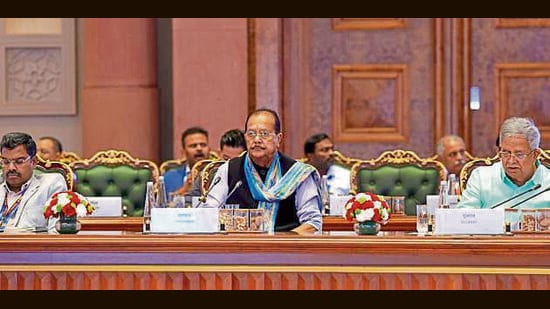
The amendment is expected to cause an annual revenue loss of around ₹14,000 crore to the state in this financial year. Putting forth the state’s views on the second day of the two-day conference “Financing the Journey to a Developed India” in New Delhi, Kishore put three key demands before the Centre: restoring the authority to levy a cess on mining, compensating for GST-related losses, and reinstating the 90:10 funding ratio for the G-Ram-G scheme.
“To transform India into a developed nation, it is imperative to rise above partisan politics and extend special support to economically backward states,” Kishore said at the conference chaired by Union finance minister Nirmala Sitharaman.
“The goal of a ‘Developed India’ by 2047 should not be limited merely to a strong economy; rather, creating an equitable and empowered society must also form its foundation. The metrics such as per capita income, GDP, manufacturing output, and financial data lack true significance unless the actual economic and social conditions of society are properly assessed,” the minister added.
Expressing concern over the current political climate, he noted that divisions based on caste and religion hindered the country’s overall development. India’s per capita income remained significantly lower than that of leading nations, and income inequality posed a major challenge, he said. Citing NITI Aayog data, he asserted that claims regarding poverty alleviation needed more effective results at the grassroots level.
{{/usCountry}}Expressing concern over the current political climate, he noted that divisions based on caste and religion hindered the country’s overall development. India’s per capita income remained significantly lower than that of leading nations, and income inequality posed a major challenge, he said. Citing NITI Aayog data, he asserted that claims regarding poverty alleviation needed more effective results at the grassroots level.
{{/usCountry}}Emphasising the agricultural sector, the minister noted that 70% of the country’s population resided in rural areas, with half of the farming activity dependent on rainfall. Consequently, increasing funding in sectors such as irrigation, dairy production, fisheries, and animal husbandry was essential. He also underscored the need to prioritise investments in the health and education sectors.
Regarding Jharkhand, the minister said the state faced a potential economic loss of ₹20,000 to ₹22,000 crore due to the Centre’s policies.
“Amendment in the mining sector and taxation policies have adversely affected the state’s revenue. Despite that, the state falls under NITI Aayog’s ‘Achiever’ category; revenue collection is robust, fiscal deficit is under control, and capital expenditure remains high,” he added.
The delegation attending the event included Jharkhand finance secretary Prashant Kumar, additional secretary Karan Satyarthi and joint secretary Chandrabhushan Prasad.