He’s frail, and not someone you’d call tall. But he stands ramrod straight at 90. He is busy, so more on that later.
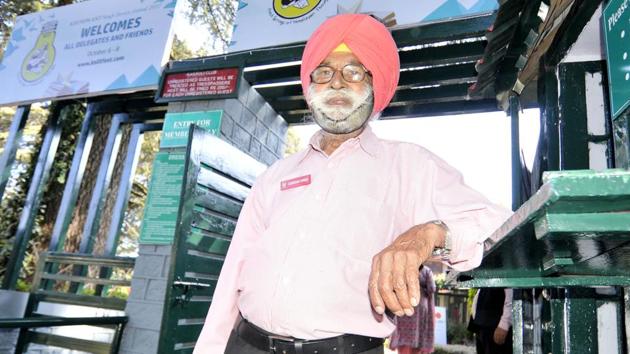
First, tell me, what’s common between Capt Amarinder Singh, Kanhaiya Kumar, Omar Abdullah, and Om Puri? They’ve all faced Gurdass Singh and lost. He is the man who has stopped the ceremonial maharaja of Patiala who is now the chief minister of Punjab; a comrade whose beard these days looks like Che Guevera’s; a political scion who tweets a lot and sports an Instagram pout constantly (in a good way, of course); and a legendary actor who was known to possess brilliance and bad temper in equal measure, to first ensure their shirt has a collar and is tucked in, and that their trousers and shoes leave no skin showing.
Fellow employees call him ‘daadu’, the grandfather, and he decides whether you get to enter Kasauli Club or not, no matter if you’re a special invitee to the Khushwant Singh Literature Festival that’s held here every year in memory of the ‘Sardar in a Light Bulb’.
But Gurdass Singh is the Sardar in the spotlight here. “Step back a little,” he tells me as I approach for a chat at the appointed hour before his lunch break. “Right, theek hai!” he mutters to himself, after running a quick scan of my attire. (Socks I am wearing, but would he allow them to be orange, I wonder.) He’s done, and permits, “Now, you tell me.”
Are you really 90 years old? “I was born in 1927. Calculate.” That means 90, right? “Yes. You can indeed count, great!” he chirps out some sarcasm. “I will soon be 91. January the 12th, 2018.”
And then he slouches, shedding the posture. A burly younger man has come to take his spot for a while. “I have 15 minutes now. Tell me, why do you want to talk to me? I only do my job,” he smiles, turning friendly, slightly. “Don’t you think people should wear proper shirts and pants and shoes? A tie even, though that’s no longer compulsory here. Club rules have been slightly relaxed over time.” Kurtas are allowed with churidar, not pyjama; and women have to dress “decently”. The club in the British-era cantonment town dates back to 1860, and Gurdass was born a year before it got its first Indian member.
{{/usCountry}}And then he slouches, shedding the posture. A burly younger man has come to take his spot for a while. “I have 15 minutes now. Tell me, why do you want to talk to me? I only do my job,” he smiles, turning friendly, slightly. “Don’t you think people should wear proper shirts and pants and shoes? A tie even, though that’s no longer compulsory here. Club rules have been slightly relaxed over time.” Kurtas are allowed with churidar, not pyjama; and women have to dress “decently”. The club in the British-era cantonment town dates back to 1860, and Gurdass was born a year before it got its first Indian member.
{{/usCountry}}How did he end up here? “I am from right here. My ancestors are from Bilaspur, also in Himachal Pradesh, but I was born here in Kasauli. My house is a little downhill from here.” He worked 30 years as a barman for the air force. “I don’t drink. I don’t eat non-veg food. Write that if you write about me,” he takes a pause to ensure we take note. “But I have served all kinds of drinks, you name it!”
A non-combatant he was, we underline. “We’ve served the armed forces for generations. Keeping their spirits up! That’s quite important, I am sure,” he retorts, combatively.
A week after he retired from the air force, he was given a job at the club. “I was good, so I was back!” He waited tables before he came into his own on guard duty, where he does 8-10 hours a day. His sons too work for the air force, and a grandson is now the club receptionist. When does he retire? “What for?” he shoots back.
Rahul Singh, Khushwant’s son who organises the fest, testifies, “Gurdass-ji does not make exceptions. Maybe once, or twice, after the commander intervened.” The brigade commander at the local cantonment is the club chairman by default.
“This year we’ve got some shoes stocked at the reception just in case someone needs to rent a pair to get Gurdass-ji to allow them in,” Rahul informs.
“I did not even allow that Maharaja of Patiala in once! Look, they can change the club rules and I will change accordingly. Else, nothing doing,” says Gurdass, and then gets restless, “You can ask the others about me. I am not very good at this. By the way, is that photographer with you? Ask him to click properly.”
But we have one last question about the maharaja’s alleged graciousness. Regulars in the club’s bridge room are fond of narrating how Amarinder Singh, “ever the gentleman officer”, gave his watch to Gurdass for his discipline when he disallowed him without closed shoes.
We ask Gurdass to show us the watch. “I have heard about it. But it’s never reached me.” He flaunts instead the one his wife has given him. “She got it as a gift, but did not like it much, so handed it down to me. It tells the time right. That’s quite enough.”
Thank you, say the photographer and I. “You’re welcome, sirs. Oh, but that doesn’t mean you can break the code, at least not till when I am here.”
Writer can be contacted at aarish.chhabra@hindustantimes.com | Tweets at @aarishc
(Views expressed are personal)