The United States (US) presidential election has gone down to the wire — the final verdict may now be settled in the courts — but one thing is undeniable: Whatever the eventual result, US President Donald Trump has once again confounded the media and pollsters with his strong showing. So why did so many seasoned commentators and pollsters who were predicting a blue wave for Democratic candidate and former Vice-President, Joe Biden, get it so wrong for the second time in a row? Quite apart from the hazards of forecasting electoral behaviour in uncertain times, there is an X factor that deserves examination: Let’s call it the echo chamber bias of the chattering classes.
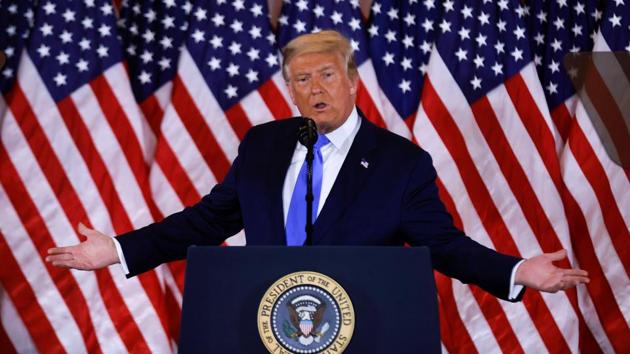
As an unapologetic egotist, Trump divided public opinion sharply. Which is why the spectre of defeat for the incumbent raised hopes among liberal groups in the US and across the world that his exit would mark a significant blow to the Right-wing project of divide and rule and restore civility and decency as core values. A nation bruisingly separated by race and class desperately needed a healing touch. As the great polariser, Trump was seen as singularly unfit for this crucial task. But while this viewpoint was widely shared by people like us, it was frowned upon by “people like them”. Elections, after all, aren’t decided on WhatsApp groups of like-minded voluble people, but among the multitude of so-called silent voters.
In a sense, the more Trump was lampooned and vilified by his critics, the more his core base got solidified. Where his personalised style of leadership was criticised for being anti-democratic, it boosted his appeal among those who are impatient with traditional political elites. Trump is part of a global trend of leaders who thrive on their larger-than-life personality cult, a trend that spans both autocracies and democracies: From Narendra Modi to Turkey’s Recep Erdogan, from the United Kingdom (UK)’s Boris Johnson to Brazil’s Jair Bolsanaro, from Russia’s Vladimir Putin to China’s Xi Jinping, these leaders are propelled forward by their carefully-sculpted image of political muscularity. Their narrative is similar too: Heavy doses of populist nationalism where the promise of national rejuvenation lies at the heart of the allure of the tough-talking demagogue. But even among these leaders, Trump has always been a bit of an outlier. He is the showman-businessman who views politics as another Apprentice-like reality TV spectacle where he alone decides the rules of the game. He is sui generis even in the nature of his narcissism. While all strongmen leaders are guilty of short-circuiting institutional processes, Trump is arguably the most brazen.
{{/usCountry}}In a sense, the more Trump was lampooned and vilified by his critics, the more his core base got solidified. Where his personalised style of leadership was criticised for being anti-democratic, it boosted his appeal among those who are impatient with traditional political elites. Trump is part of a global trend of leaders who thrive on their larger-than-life personality cult, a trend that spans both autocracies and democracies: From Narendra Modi to Turkey’s Recep Erdogan, from the United Kingdom (UK)’s Boris Johnson to Brazil’s Jair Bolsanaro, from Russia’s Vladimir Putin to China’s Xi Jinping, these leaders are propelled forward by their carefully-sculpted image of political muscularity. Their narrative is similar too: Heavy doses of populist nationalism where the promise of national rejuvenation lies at the heart of the allure of the tough-talking demagogue. But even among these leaders, Trump has always been a bit of an outlier. He is the showman-businessman who views politics as another Apprentice-like reality TV spectacle where he alone decides the rules of the game. He is sui generis even in the nature of his narcissism. While all strongmen leaders are guilty of short-circuiting institutional processes, Trump is arguably the most brazen.
{{/usCountry}}The Covid-19 crisis, in particular, has brought out the worst in Trump’s erratic approach to governance. That the occupant of the White House could so recklessly disregard the fallout of a global pandemic and refuse to wear a mask, despite all the medical and scientific evidence, suggests an irrational mindset unfit for public life.
And yet, on the other big concern of 2020 — the economic slowdown — Trump was successful in sending out the message that he was far better-placed than his rival to get the growth curve back on track. The US’s Covid-19 death count may be unconscionably high, but the country has been able to pull out of a recessionary spiral faster than expected. With the economy reviving and unemployment levels declining, Trump was able to spread optimism that the spirit of free enterprise would triumph eventually.
The strongman image is both an asset and a liability. People are attracted to leaders whose buoyant persona exudes a sense of self-confidence in getting the job done. At times, their demeanour displays false bravado rather than concrete action, and yet they retain an aura of indestructibility. Trump’s shrill rhetoric and openly divisive campaign are dangerous for a plural society. But this also allows a canny politician to prey on the fears and xenophobic prejudices of a white US.
To what extent these diverse popular sentiments can be captured with objectivity is critical while judging the mood of a nation. The tech-driven, social media bubble in which many of us live has created the possibility where we may actually be carried away by only tracking those who reinforce our ideological beliefs above all else. In his latest best-seller, Rage, journalist Bob Woodward of Watergate fame, decodes the Trump presidency in telling fashion: “Trump has enshrined personal impulse as a governing principle of his presidency. When his performance as a president is taken in its entirety, I can reach only one conclusion: Trump is the wrong man for the job!” Woodward is not wrong in his assessment: It’s just that in a deeply-polarised nation not every American shares his view. Unfortunately, pollsters and a partisan media never reconciled to this stark reality of a divided country. And hence got their predictions wrong yet again.
Post-script: In the first week of May 2019, after criss-crossing the country for weeks, I did a video blog forecasting 300-plus seats for the Bharatiya Janata Party in the general elections. A senior editor called to say, “So you too have sold out, can’t you see the anti-Modi mood in the country?” After the results, I sent the journalist a pointed message: “The mood of the country is not decided in your WhatsApp groups but in the dusty tracks of real India.” Ditto with America.
Rajdeep Sardesai is a senior journalist and author
The views expressed are personal