Find ball 18.2 of India’s innings against Pakistan and watch Virat Kohli charging back to the danger end for a risky second run, paying absolutely no heed to Deepak Hooda’s fervent calls to turn back. Now wind back to the last delivery of the 18th over where Kohli shuffles slightly across his stumps, gets in line with Mohammad Hasnain’s 149 kph overpitched ball and whips it over deep midwicket for a six. Not that we needed any fresh corroboration of Kohli’s intense genius, but these two vastly differing moments once again abundantly summed up the energy and the intent Kohli aims to bring every match.
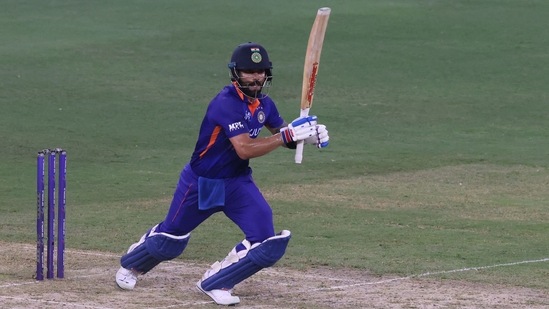
In a week Kohli has gone from hesitating to assuring. His Asia Cup scores—35, 59* and 60 at an overall strike rate of 126.22—aren’t exactly earth-shattering but once you add context these numbers reveal more than what meets the eye. That 34-ball 35 against Pakistan was a chase-steadying effort after India had lost KL Rahul in the first over. Against Hong Kong, he was once again trying to play anchor while Suryakumar Yadav took off. But on Sunday, Kohli’s game awareness was tested every ball because India chose to go in without designated slog overs specialist Dinesh Karthik but found themselves five down anyway with more than five overs to go.
Kohli was going great guns till that point, scoring 40 off 28 balls—with a strike rate of over 142—but had to dial down after Pandya’s dismissal. "Today I was making a conscious effort to strike at a higher pace," Kohli said in the post-match press conference. "When we lost wickets, there was communication (from the dugout) and our plans changed, where I had to bat till the 18th over with Hooda. If there were a couple of batters, I would've gone with the same tempo and tried to hit more boundaries and more sixes. I ended up being in a situation where I had to go deep."
It was a scenario India must be preparing for, considering their new all-out approach towards batting, something India captain Rohit Sharma too indicated at. “Wickets of Hardik and Rishabh were not needed at that time. But we want to play with an open mindset. While taking that approach you’ll not always have success,” he said.
{{/usCountry}}It was a scenario India must be preparing for, considering their new all-out approach towards batting, something India captain Rohit Sharma too indicated at. “Wickets of Hardik and Rishabh were not needed at that time. But we want to play with an open mindset. While taking that approach you’ll not always have success,” he said.
{{/usCountry}}There is no better salvager in such scenarios than Kohli. He knew as long as Hooda could take a few risks—which he did—his job had changed from being the middle-overs enforcer to a stabiliser. That forced Kohli to buckle down and score his next 20 runs off 16 balls. He couldn’t score a boundary but that six off Hasnain was a timely reminder that tempering a T20 innings need not mean looking for singles, or converting ones into twos, but waiting for the right ball to score off. It remains to be seen how Kohli builds on this confidence but as of now, this string of scores must be a heartening change of pace to him. It came at a price though. Realising that he was “faking his intensity a bit”, Kohli consciously sought time away from the game, not picking up the bat for a month.
"I didn't think I'd go a month without touching my bat, but the situation became such that I had to take a break," he said. "More mentally than physically. Then you realise when you bat again after a month why you started playing the game. That (realisation) is lost at times, the way people look at you, cheer for you when you're at the ground, at such times you can lose that realisation. That drive and purity for the game, that joy dissipates. It was important to rediscover that again. When I'm happy in my space, then I know what I can do for the team. Me being in a bad space is neither good for the team nor for me. I think no one should run away from this, if someone is feeling negative or low, taking a break isn't a bad thing."
Kohli added: "And I hope people will derive strength from that and address whatever they are feeling. We're all human, everyone can feel this way. But to recognise that and care about it is important. If you ignore it, you will get more frustrated. This is something I realised and I got a lot of help. I'm happy, I'm excited and having fun playing cricket again, which was the most important thing for me."
That happy space took time to come. And according to Kohli, not many had reached out to help him during this time. Except MS Dhoni. "I can tell you one thing: when I left Test captaincy, I got a message from only one person, with whom I have played previously—that was MS Dhoni," Kohli said. "Many people have my number. On TV, lots of people give suggestions, people have a lot to say, but whoever had my number, no one sent me a message.
"That respect, that connection you have with anyone, when it is genuine, it shows in this fashion because there is security at both ends. Neither does he need anything from me, nor do I need anything from him, and neither was he insecure from me or I was insecure from him. I can only say, if I want to say anything to anyone, I reach out to that person individually even if you want to help me.
"I mean, if you give the suggestions in front of the world, it has no value for me. If it is for my improvement you could talk with me one-on-one that I genuinely want you to do well. I live life with a lot of honesty, so I see such things. I am not saying that it doesn't matter to me, but you see the real thing. I can only say that. When you play for such a long time and with honesty, who gives is the almighty. Until I play, until I am worthy of playing, I will play like this only."