Think of the best contemporary players who play across formats, and Harry Brook’s name springs to mind. Some would think of Travis Head. Jofra Archer among fast bowlers. It is impossible to forget Jasprit Bumrah, but the Indian pacer’s fitness and workload concerns have turned him into a special-purpose entity.
England has a few others, like Ben Duckett and Will Jacks, who are seen on the international circuit year-round. South Africa has Aiden Markram, Marco Jansen and Kagiso Rabada. Among leading nations, there’s also Australia’s Cameroon Green. But what about the Indian team?
Over the last two years, India has had no single player with a sizable all-format presence. A marked difference from the past, where there was a known core of proven performers seen as all–format safe bets.
How and when did this change come about? Is it by design?
With a calendar so congested, bowlers breaking down frequently under its burden, rest and rotation of players so common, one may be persuaded to believe the separation of India’s squads is a natural consequence. True. But, not entirely so.
A strategic pursuit of T20 firepower and a conscious effort to identify characteristic Test batters have contributed heavily to India’s Test and T20I squads separating away from each other. Even the ODI team has developed a distinct identity. Piecemeal retirements of batting stalwarts Virat Kohli and Rohit Sharma: first from T20Is, then Tests with a nudge from the selectors have acted as catalysts.
{{/usCountry}}A strategic pursuit of T20 firepower and a conscious effort to identify characteristic Test batters have contributed heavily to India’s Test and T20I squads separating away from each other. Even the ODI team has developed a distinct identity. Piecemeal retirements of batting stalwarts Virat Kohli and Rohit Sharma: first from T20Is, then Tests with a nudge from the selectors have acted as catalysts.
{{/usCountry}}Head coach Gautam Gambhir received a reality check quite early in his job, when New Zealand blew India away at home. That’s when he first spoke of the need to “identify solid red-ball batters”. Opportunities to the likes of Devdutt Padikkal, Sai Sudharsan, Dhruv Jurel, Sarfaraz Khan followed. The selectors moved away from experimental selections such as Bazball-inspired Test cap to Suryakumar Yadav in 2023.
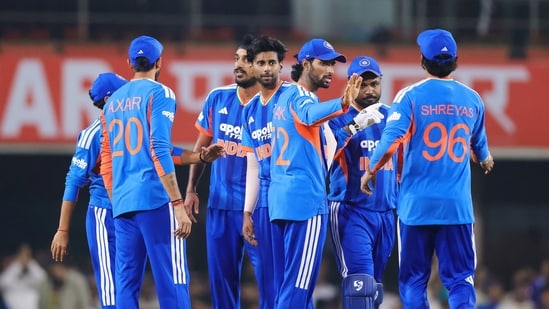
Concurrently, the T20 team took shape, developing even stronger selfhood. As India’s T20I calendar became busier, the selectors identified a set of T20 specialists: the likes of Abhishek Sharma, Shivam Dube, Tilak Varma, Varun Chakravarthy, among others, who clocked international air miles from Ireland, England, and Japan before returning for the home leg. Axar Patel and Arshdeep Singh also feature in the ODI team. Bumrah and Hardik Pandya are not regulars on the white-ball bilateral treadmill.
Strategic cycles
Strategic outlooks in sport, though, function in circles. Once India’s team transition fully sets in, new avenues may open up for some players. Tilak Varma has given evidence of being a rounded batter. Rinku Singh has the tools to find success beyond T20s. Vaibhav Sooryavanshi is still finding his feet in T20Is, but he is tipped to branch out to other formats, if his growth curve is consistent.
Team set ups can’t do without all-format players altogether for too long. “Ideally, for any coach, the more all-format players we have, it’s better because continuity is very important in international cricket,” Gambhir recently told Star Sports. “But no matter how hard the coach and selectors try, you will have few three-format players in future because you will have to keep rotating your players.”
To give players a greater chance to push for all-format efficiency, to begin with, India’s cricket calendar needs to become less punishing and better planned. Shubman Gill, who captains the Test and ODI team has on more than one occasion been short changed with inadequate time to prepare for red-ball action.
Despite that Indian cricket calendar post 2024 T20 World Cup still shows Gill to have played most matches across formats (22 T20Is, 26 ODIs, 18 Tests). Even after losing his T20I place on the road, Gill’s all-format presence remains healthy in the current WTC cycle (11 Tests, 15 ODIs, 15 T20Is). With a more spaced-out schedule, a generational talent like Gill may not take long to find his T20 peak.
Among other players to have featured with some regularity across formats post the 2024 World Cup are Washington Sundar (22 T20Is, 15 ODIs and 14 Tests) and Kuldeep Yadav (16 T20Is, 21 ODIs and 7 Tests). Nitish Reddy ranks next in players to have played international cricket across formats (8 Tests, 8 ODIs and 10 T20Is).
Washington and Reddy’s all-round offerings give them an extended run despite mixed returns. Kuldeep remains an unlikely starter in away Tests. But the likes of Gill and Jaiswal are itching to maximise their full potential. By donning the wicket-keeping gloves during Ranji practice, Jaiswal may have sent a cryptic message to push towards that goal.