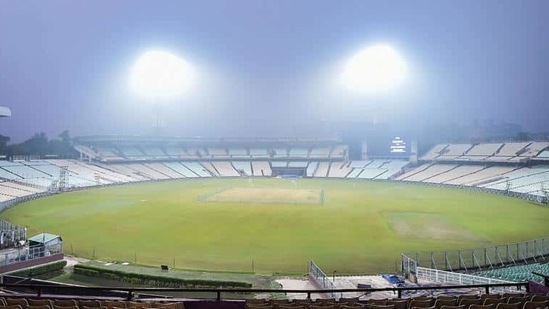
On Sunday, 10 days after it was a quarantine centre for Covid-19, Eden Gardens will host a T20 tournament named after a man with whom the stadium has a deep connection --- Syed Mushtaq Ali. It was at Eden in 1945 that the flamboyant batsman was inducted in the India team on popular demand. “No Mushtaq, no Test” banners came up at Eden forcing the selectors, Duleepsinhji among them, to bring Ali back for the unofficial Test against Australian Services.
That wasn’t Ali’s only connect with this magnificent amphitheatre, one of the venues for the resumption of domestic cricket after over 10 months. Nearly 50 in 1962, Ali had stood outside his crease to fearsome West Indian fast bowler Roy Gilchrist and flicked him to the square-leg fence. “It was a combination of raw courage, superlative coordination of hand and eye and sense of adventure,” was how Raju Mukherji, the former Bengal and East Zone captain, narrated the first-hand experience of seeing Ali in a 2016 blog post. Ali was playing in a fund-raiser for the war against China, wrote Mukherji. In the same post, he wrote of Ali powerfully square-cutting an off-spinner, one of Bengal’s under-16 players being coached by Mukherji, in the indoor training centre in the Eden complex. This was in 1993 when Ali was almost 80.
Ali was then a guest for a blood donation camp organised by Cricket Association of Bengal (CAB). Beginning in the 1980s, it is an annual fixture on February 3, former West Indies captain Frank Worrell’s birthday, to mark his donating blood after India’s Nari Contractor was hit by a bouncer during the 1962 tour of West Indies. Donors get certificates signed by a famous sportsperson. “The first time CAB crossed 1000 donors was when (former India football captain and coach) PK Banerjee was the signatory. This was in the 1990s and he went with me outside Eden to exhort people to be donors. Those seeking an autograph or even wanting to touch his feet were told, “you will get your wish but only after you have given blood,” said Mukherji, speaking separately.
Through the flu pandemic in 1918, World War 2, wars against Pakistan and natural disasters, Eden hadn’t been used as a temporary public health utility since it was established in 1864, said Mukherji who has written a book on the stadium.
Also Read | India players complain of racial abuse at the SCG
That changed last July when it joined sports cathedrals such as Rio’s Maracana, Brasilia’s Mane Garrincha stadium, Madrid’s Bernabeau and the Billie Jean King National Tennis Center in New York as a Covid-19 facility. “Sourav Ganguly (BCCI president) had mentioned making the stadium available and after that, Kolkata Police asked if they could,” said CAB president Avishek Dalmiya. Space under galleries in five blocks was used to set up a 375-bed quarantine facility exclusively for police personnel. It continued till December 31 with winding up operations finishing this week, said Dalmiya.
Before being repurposed for Covid-19, Eden escaped the wrath of Cyclone Amphan in May that killed at least 84 people in West Bengal and Bangladesh and left large parts of Kolkata waterlogged, with uprooted trees and days-long power outage.
Through the hard lockdown from March to May and Amphan, Eden had nearly 17 staff, including security, staying on the premises. “There were around 10 groundstaff who ensured that the park was tended to. CAB sent rations every five-six days which would be dropped off at the stadium gates,” said Dalmiya.
It was regular maintenance of the Eden turf --- rated better than Lord’s in the 1920s by former England captain Arthur Gilligan --- that helped CAB hold a T20 club meet last month in preparation for the Syed Mushtaq Ali Trophy. “We could do that by segregating areas so that the quarantine centre, CAB’s offices and cricket did not get in each other’s way,” said Dalmiya.
Kolkata’s experience with organising bio-bubbles --- there are two for this meet, including one in a hotel also hosting teams of the I-League that began in a sanitised environment on Saturday --- makes it a frontrunner for games in the Vijay Hazare Trophy too, said a CAB official. The official requested anonymity as he is not authorised to speak to the media.
When on March 3, 2020, Bengal beat Karnataka at Eden to enter the Ranji Trophy final, bio-bubbles and the eerie emptiness of closed-door games were not part of sport. No one knows when fans will again tailgate into Eden but with six teams including Bengal, national cricket’s back. In silence.