


 Live Score
 Teams
Teams Players
For Punam Raut “what is out is out” after “walking” in the pink-ball Australia Test
The India No. 3 didn’t show a moment’s hesitation though the faint nick, with no DRS to fall back on, was not spotted by the umpire in the Test on the Gold Coast

 Prefer HTon Google


She had never done it before. Yet, the moment Punam Raut got a feather touch off left-arm spinner Sophie Molineux on the second day of India’s pink-ball Test against Australia at Carrara, she walked though the umpire didn’t give it out. “It was purely instinctive,” Raut said. “My soul told me, ‘it’s out, just walk’.”
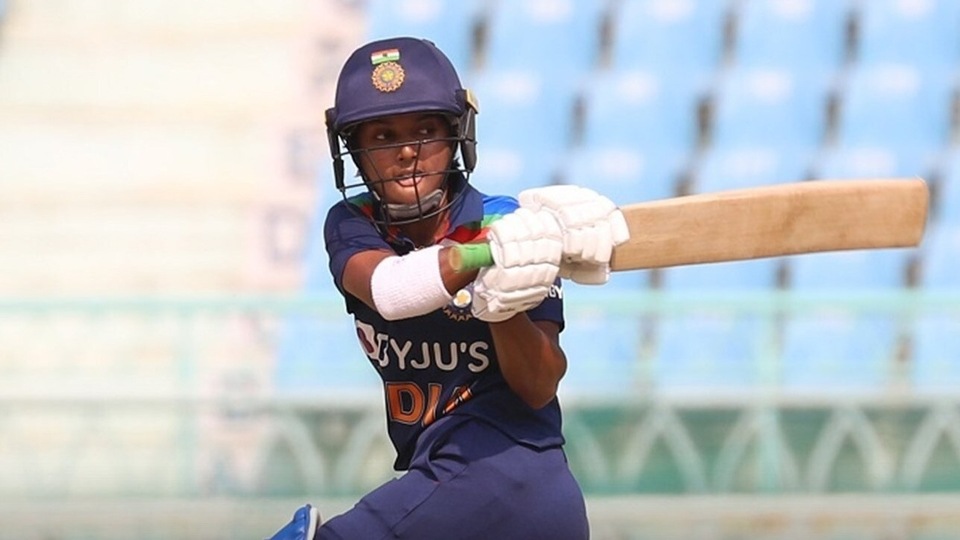
The Decision Review System (DRS) was not in use. So, had she stood her ground, Raut would have continued an innings that ended at 165 balls and 36 runs. She had lunged forward to defend and there didn’t seem any deviation en route to wicketkeeper Alyssa Healy. The Australians were not vociferous, but Raut, head down, began walking as umpire Phillip Gillespie at the other end shook his head to turn down the gentle appeal.
“It has never happened in domestic or international cricket that I was out and the umpire didn’t give it,” Raut said in a chat on her return to Mumbai from Australia. “So it’s like a habit. If you’ve edged, you walk. And that was out. So I walked off. I thought the umpire will give it out, and it was only when I saw on the screen while walking back that I realised the umpire had not given it. But what is out is out, that’s about it.”
It earned the 31-year-old from Mumbai plenty of praise though it divided opinion outside and within her dressing room. After the day’s play, teammate Smriti Mandhana, who hit 127 and shared a century partnership with Raut told the media that the India No. 3 “earned a lot of respect from us”, adding “I don't know how many people would actually do that in cricket at the moment”. Australia’s Beth Mooney replied “no chance” when asked if she too would have walked, in a chat with the Australian broadcaster.
Raut said some of her team-mates weren’t too happy initially, especially given that it was Raut’s first innings on the multi-format Australian tour after warming the bench for the ODI series. “Some team-mates were a bit upset. Of course, no one is happy when the team loses a wicket. I was also seeing some stuff on social media, how this (Test) was my only chance in Australia,” said Raut, who is not part of the T20s. “But I didn’t let it affect my thinking in that moment (on) how I feel the game should be played. When it comes to the spirit of the game, we have to play fair. At the end of the day, it’s just a sport. You have to be true to yourself.”
The “spirit of cricket” debate crops up now and then. It is often as hazy as it is controversial, more so if the IPL (or R Ashwin) is around. So, what does that term mean to Raut?
“I believe spirit of cricket is an essential part of our game. Nowadays, players are getting too competitive on the field. Everyone thinks about themselves—that I’ve got an opportunity and I have to make use of it. Of course, that is human nature, but at the same time one shouldn’t forget the spirit with which the game should be played. When it comes to sport, we should look to compete, not find ways to cheat. Compete fairly and win. And if you lose after that, no problem.”
Pink-ball experience
India didn’t just compete, they bossed the rain-marred, day-night Test on the Gold Coast. They notched up 377/8 declared in the first innings and restricted the Aussies to 241/9 declared. That despite just two days of nets and zero days of match practice with the pink ball under lights.
“It was a different experience altogether playing a Test under lights for all of us,” said Raut, who added 41* off 62 balls in the second innings before skipper Mithali Raj declared. “At first we thought it would be difficult to sight the seam on the pink ball, which plays a little differently to the red one. But we managed to tackle it well.
“Playing the ODIs was an advantage. If we were playing the Test first, it would have been more difficult. We knew the conditions and how the wicket would play. We were mentally strong, thinking that we have to just face the ball no matter if it’s pink or white. All the players were positive, eager to do well in the historic event.”
More Tests, please
The Indian women’s team marked its return to Test cricket this year after a hiatus of seven years, playing out a gritty draw in England in June before taking on Australia. The last time Raut donned the whites before the two Tests was in November 2014 in Mysore, where she scored 130 against South Africa to help India win by an innings. The lone Test of that series was only her second after making her debut in the longest format three months earlier. Her third Test, as it turned out, took seven years in the making.
“It’s challenging when you’re asked to adapt to a format after such a long gap. But we wanted to play as many Tests as possible, not only for us but for the generation after us. That is why we had been asking BCCI for a long time. We’re grateful they are giving us this opportunity now. An India-Australia Test is big. The girls were excited and happy ki yeh mil raha hai wohi bahut badi baat hai (that we’re getting the chance itself is a big deal).”
Raut hopes the number of Tests for Indian women increases from here on. “Look at Australia and England and how frequently they play the (women’s) Ashes. The more we play Test cricket, the stronger our basics will become. Our men’s team is so strong because they play a lot of Test and Ranji Trophy cricket. I hope we have as many Tests as possible because that’s how women’s cricket will develop.”
It was in ODI though that Raut made her international debut, in 2009. The 73-ODI veteran has of late drifted out of the playing XI, featuring in just one game on the England tour and none in Australia. Concerns have been raised about her strike rate (58.26), though she scored an unbeaten century against South Africa in Lucknow in March. Raut believes not every batter in the top six should play one way.
“It can’t just be aggressive, aggressive, aggressive. If each of the pure batters plays aggressively, who will stay at the crease and carry the team?” she asked. “I don’t think too much about strike rate. I believe I can change my game plan according to the situation. My strength is to play a long innings. Yes, there should be aggression, but it should be calculative. The ultimate goal is to take responsibility and help the team win.”


