
At the rear of the eastern stands at the Basin Reserve ground is a monument, resembling a Victorian classical Grecian temple. It has a circular dome supported by eight round pillars. It’s a memorial in honour of William Wakefield, who was the principal agent of the New Zealand Company.
If it was the East India Company that acted as Britain’s front to colonise India, in New Zealand it was the 19th century New Zealand Company. It was established in 1839. A year later was signed the Treaty of Waitangi between British crown representatives and Maori chiefs. The two parties differed in their interpretation of the pact, but most of New Zealand territory passed from Maori to British ownership. Imperialism invariably leads to a degree of plunder. With the adoption of the Statute of Westminster in 1947, New Zealand became independent.
Plunder returned to its soil on Saturday, not commercial but in cricket terms. This time, the plunderers were not British, but Indians.
Indian batsmen pillaged 327 runs in a day’s play for the loss of just three wickets, boosting their side’s total to 486/4 at stumps on the third day of the first Test against New Zealand in the qualifying stage of the World Test Championship. They lead by a significant 118 runs, with two recognised batsmen still to come.
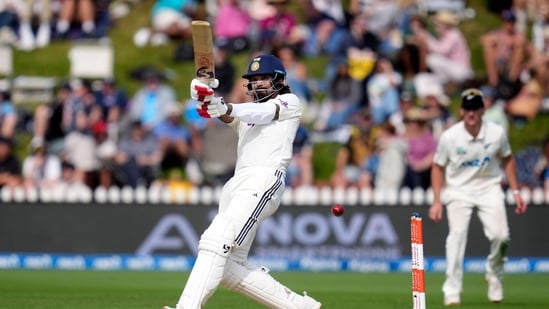
Karnataka’s KL Rahul, 52 not out overnight, duly completed his century – the 13th of his now fully blossomed Test career. Since becoming India’s senior specialist batsman after the retirement of Virat Kohli and Rohit Sharma, he has scored five 100s and four 50s, including innings of 82 and 90, in 13 Tests as opener. He explained his success by saying he now has ‘a lot of Test cricket’ under him. He ultimately perished playing on to the right-arm fast-medium Nathan Smith.
{{/usCountry}}Karnataka’s KL Rahul, 52 not out overnight, duly completed his century – the 13th of his now fully blossomed Test career. Since becoming India’s senior specialist batsman after the retirement of Virat Kohli and Rohit Sharma, he has scored five 100s and four 50s, including innings of 82 and 90, in 13 Tests as opener. He explained his success by saying he now has ‘a lot of Test cricket’ under him. He ultimately perished playing on to the right-arm fast-medium Nathan Smith.
{{/usCountry}}Rahul drove and pulled the fast bowlers – and there were four of them - with characteristic correctness. Jacob Duffy was particularly punished. The Black Caps’ thinking seemed to be that the wicket might turn a bit. So, all-rounder Glenn Phillips was introduced with his off-spinners in the very first session. Rahul milked him to start with, then trapezed down the track to effortlessly cart him for six over long on. Later he created room to cut Duffy for six over point.
The piece de resistance by way of stroke play emanated from the flashing blade of the Indian skipper Shubman Gill. If a pull for six at the expense of Duffy wasn’t enough audacity, he retreated affirmatively to the legside to lash the same bowler through the covers. Finally, he danced down the wicket to hoist Glenn Phillips against the spin to long-off for six. But a ton was not in the script. As he approached the milestone, he untypically retreated into a shell and was finally castled through the gate. Duffy had at last made amends. Gill and Pant put on exactly 100 runs for the 4th wicket.
Not to be left behind, Pant joined the party. He pulled Duffy for six off consecutive balls and immediately followed it with what can only be described as a double-handed forehand of startling ferocity past the bowler. And with a wristy, improvised half-drive, half-pull to the midwicket fence he heralded his half-century. Duffy was again the sufferer. He had over a-day- and-a-half conceded 180 runs in 29 overs.
Earlier, 26-year-old left-hander Devdutt Padikkal unfurled an attractive 80, having pegged hundreds in his last two Tests, against Sri Lanka. Compact and calm, with effective use of his long legs, he looks like the answer to India’s need for permanence at number three. He was eventually bowled by a worthy delivery from the six-foot eight-inch Kyle Jamieson, which straightened after being angled in. Paddikkal and Rahul realised a second successive three-figure partnership of the innings.
New Zealand captain Tom Latham went on the defensive from the very resumption of play. Conditions were undoubtedly suitable for batting and India were poised to take a grip on the match. But a solitary slip meant no pressure on Rahul and Padikkal when they were getting their eye in. The tactics neither bottled the runs, nor did it elicit error. Wicketkeeper Tom Blundell standing up to the stumps to the fast bowlers did not do the trick either.
On the third day of the Test, a spring sun drenched the turf from morning to evening, as it had done the two previous days. The breeze was slightly chilly, but dry. That made for a perfect day for the willow. The intimidating green pitch of the first day had turned to an inviting brown. It was also a crucial day in terms of the prospects in the Test. So, it proved to be a day of plunder, with the Indians in command at the end of it, but not conquerors yet.