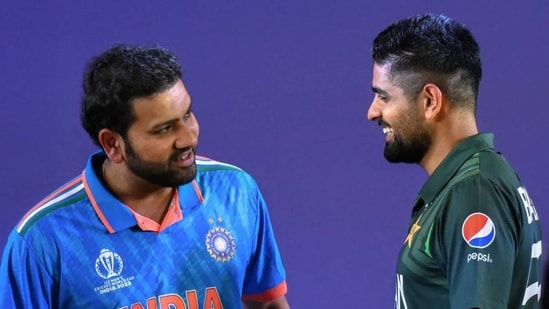
The ICC 2023 World Cup it appears will have an opening ceremony after all – nine days after the event started. India versus Pakistan on October 14 will feature a rangarang karyakram (colourful programme). The timing is uncertain: it could be before the toss. Or between the toss and the first ball, maybe between innings. Film stars will also be present maybe involved in the programme. There’s a 50-50 chance that accredited Pakistani reporters could race across the border and into the press box in time. The chance of more than a dozen Pakistanis turning up or Pakistan flags being waved is close to zero.
India versus Pakistan at the World Cups is frenetic, tense and electrifying, yes, but also accompanied by a generous smattering of the absurd, buoyant, tearful. (Getty Images)
I remember every Indo-Pak World Cup match from 1992, reporting from two of the 50-over variety – (Centurion 2003 and Mohali 2011) plus Wanderers 2007. I found the Mauka Mauka adverts mean and disrespectful because had that been directed at Indians in the 1990s, I know what that would have felt like. As the years wore on, the media build-up to each successive Indo-Pak match escalated to overheated nonsense, now amplified by soc-med.
In contrast to what we are told the Rivalry means and stands for, as the only cricketing touch points between India and Pakistan these World Cup matches are our reassurance-building measures. Which reinforces the fact that no matter how physical and palpable our separation due to geographical borders or how entrenched psychological distances through governments and real politik, what the majority of Indians and Pakistanis will always share is cricket.
The sport’s appeal we are told comes from the sub-continent’s heart, but it starts, I believe, from our palate. How we find in it an expression of our unique flavours, freed from western trimmings. It is rooted in our gullies, maidans, school corridors, flatlands, hills and beaches. It is played all year around, day and night, in endless, unstoppable season.
No matter how high the Rivalry is cranked up, the dignity and composure of our players on and off the field has become its own stellar message. As is the engagement between the fans. Like the men wildly dancing together to Ali Sethi’s Pasoori outside the MCG after the 2022 ICC T20 World Cup. Or side by side talking about cricket and life, like in my photograph from the Asia Cup in Kandy this year.
India versus Pakistan at the World Cups is frenetic, tense and electrifying, yes, but also accompanied by a generous smattering of the absurd, buoyant, tearful. The snapshot album of my memory, around Indo-Pak World Cup matches (along with the cricket) features a dining-room skirmish, 85 busloads, 200 sniffer dogs, 1,100 security guards, rushed exchanges of gifts and giggles over gossip, NH44 and a photograph that should have been taken.
The dining room skirmish came in Centurion '03 over a rude exchange from one player to rival adversary. Teammates rushed over to separate them. It wasn’t the bust-up I was astonished by (too much testosterone, etc.) but the fact that they had to be at the same room at the same time to eat. After going at each other for three-and-a-half hours, India and Pakistan lined up for food together, sat on separate tables but close enough to maybe chuck cutlery over what had happened on the field?
The 200 sniffer dogs were in Mohali 2011. The match began at 2pm, we were told to get there early as security was going to be filthy as Prime Ministers from both countries and their entourages would be attending. It was 1030 am but dogs got priority over humans and went through the single gate that led not just to the press box but also the uber-VIP sitting area. One at a time all 200 beautiful Labradors at their own relaxed pace. As a journo, you couldn’t wangle a special squeeze past the canines nor could you complain – too many uniformed, armed folk around.
The 85 bus loads were fans heading to Centurion 2003 – the biggest influx of Indians and Pakistanis into what used to be Afrikaaner heartland, Pretoria, Transvaal. There was going to be 200 extra security to the normal 900 and as I was told, “This is not India, this is a country where people have permits to carry guns.” Gulp.
The CEO of Northerns, the team whose home ground it was, was having none of this. Relaxed, smiling with enough time to offer a cup of rooibos to a dazed foreign journalist, Elise Lombard was one of the rare women in cricket administration. She knew that India versus Pakistan would be emotional, loud, and while potentially a tinder box, she was confident essentially there would be no trouble – alcohol consumption was not going to hit the danger mark, you see.
NH44 is the highway from Chandigarh to Delhi, the route I took with my ESPNCricinfo colleagues Osman Samiuddin and Nagraj Gollapudi after the 2011 semi-final. On preview day, Osman and I switched teams: he wrote about MS Dhoni and I celebrated the joyous abandon of Pakistan cricket. After the match, we had spent the better part of the night writing reports. We worked out of a ‘suit’ in a fairly non-flash hotel called Towns Pride. The ‘suit’ side was tiny, windowless, crammed with sofa, coffee table and slice of desk attached to mirror. To us, it was heaven. The very nice hotel where Osman and I were booked by the office booted us out after one night. In an act of miracle resourcefulness, Nagraj extracted the ‘suit’ from his own hotel - Rs.5000 for the night. (Towns Pride is still around and I will love it forever)
On the NH44 to Delhi, we marvelled at technology as I booked a flight to Mumbai via laptop and dongle. Lunchstop at a dhaba was hot tandoori rotis, kaali daal, saag, paneer, plus laughter, jokes, ribbing. Phone cameras were not what they are these days or I could have taken a picture – the road to Delhi and fellow travellers, Indian, Pakistani. In the sunshine of a sub-continental World Cup.


 Live Score
 Cricket Teams
 Cricket Players