


 Live Score
 Cricket Teams
 Cricket Players
India vs Pakistan, T20 World Cup: The big preview, head-to-head record, key battles and recent form guide
In the upcoming T20 World Cup clash, India holds a narrow advantage due to better team balance.

 Prefer HTon Google


India vs Pakistan is cricket’s loudest room, even when both teams whisper. In a World Cup group, it is rarely just two points: it is selection logic put to the test, match-ups weaponised, and one pressure moment that follows captains for months. This time, the tension has a new tactical centre - Pakistan’s off-spin option Usman Tariq staring straight at India’s left-hand tilt, while India’s pace depth still gives them the game’s most reliable skill switch.
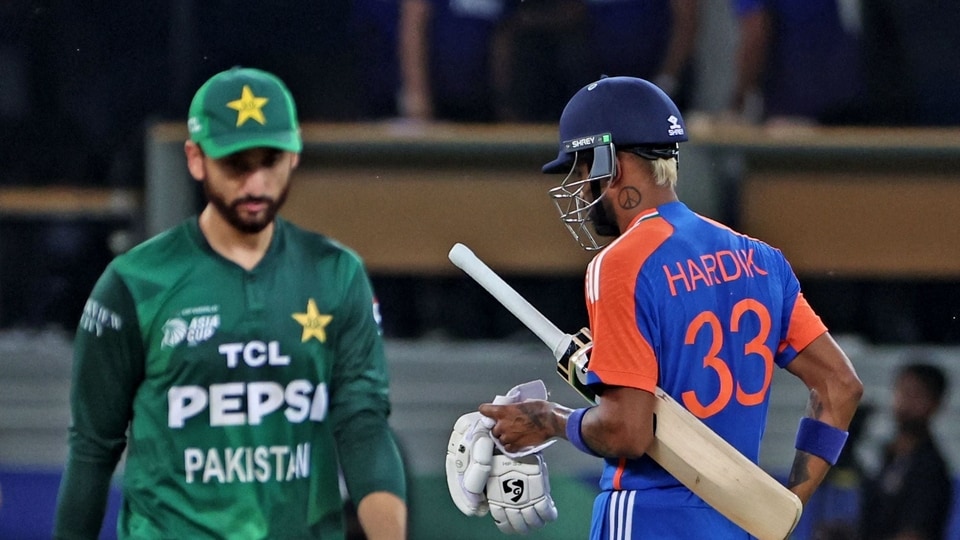
It also feels like a match of roles more than names: can Pakistan’s top-order absorb India’s new-ball chaos and still keep wickets for the end overs? And can India’s left-hand heavy engine avoid getting paused in the middle overs by off-spin that doesn’t chase wickets, but steals time? If this game turns, it will turn on tempo - who controls the 7-15 phase without blinking.
Also Read: Suryakumar Yadav breaks silence on whether India players would shake hands with Pakistan in T20 World Cup
India vs Pakistan: Head-to-Head
India and Pakistan have met 16 times in men’s T20Is: India lead 13-3.

At the men’s T20 World Cup, the rivalry has been even more one-sided: 8 meetings, India have 7 wins, Pakistan 1.
That is the macro picture. The micro picture - match-ups, surfaces, and role clarity - is where the game will actually be decided.
Key matchups that will decide the game
Abhishek Sharma vs Shaheen Afridi
This is a predominantly India-friendly match-up. Abhishek Sharma has scored 36 runs off 19 balls against Pakistan’s premier fast bowler at a strike rate of 189.50 and has not been dismissed yet. If Abhishek wins even one Shaheen over early, Pakistan’s script gets forced off-road.
Sahibzada Farhan vs Jasprit Bumrah
Sahibzada Farhan’s been unusually comfortable against Bumrah: 51 runs off 34 balls, at a strike rate of 150 and not dismissed yet. That is the most “uh-oh” number-set India can’t ignore because it directly attacks their biggest edge.
Saim Ayub vs Hardik Pandya
Hardik Pandya has already found a way to break Saim Ayub. The Pakistan batter has scored 4 runs off 4 deliveries while being dismissed once by Pandya. If India can use Hardik as the disruptor the moment Saim looks set or is in the initial stages of his innings, its is a cheap wicket window for the Men in Blue.

Hardik Pandya vs Shaheen Afridi
Shaheen Afridi has removed Hardik Pandya twice in ODIs while conceding just 13 runs off 15 balls. Although it is not T20I data, it is still a role-relevant warning. If Shaheen is introduced when Hardik arrives and if the game is stuck at that position, this face-off becomes key in deciding the momentum.
Babar Azam vs Jasprit Bumrah
In T20Is, Jasprit Bumrah has dismissed Babar Azam once with Babar scoring 18 runs off 14 balls. In ODIs, the control pattern is even clearer - Babar’s 22 off 39 with 27 dot balls. Different formats but the same signal: Bumrah can squeeze Babar’s scoring options and force risk.
Babar Azam vs Varun Chakaravarthy
This is a small yet very clean sample. Babar Azam has scored 17 runs of 13 balls against Varun Chakaravarthy at a strike rate of 130.80 while never being dismissed. That matters because Varun is India’s main middle overs chaos lever - if Babar can play him without panic, Pakistan’s innings stays stitched.
The puzzle named Usman Tariq
Usman Tariq has a small T20I sample but it is eye-catching: 11 wickets in 14.4 overs at an economy of 5.93 with a dot-ball percentage of nearly 45%.
The more useful split is his broader T20 record vs different type of batters:
- vs left-handed batters: 10 wickets, economy 6.30, average 14.90, SR 14.2, dot 44.4%
- vs right-handed batters: 26 wickets, economy 7.66, average 17.40, SR 13.7, dot 44.2%

He has been more economical against left-handers, while his efficiency against both types has been similar. If India roll in with a left-heavy top/middle, Tariq’s presence can become a genuine handbrake, because he can stall momentum without leaking the release ball.
Also Read: The Usman Tariq problem: India’s left-hand heavy batting meets Pakistan’s new trap
India vs Pakistan: Probable XIs
India: Abhishek Sharma, Ishan Kishan(wk), Suryakumar Yadav (c), Tilak Varma, Hardik Pandya, Shivam Dube, Axar Patel, Kuldeep Yadav, Varun Chakaravarthy, Jasprit Bumrah, Arshdeep Singh
Pakistan: Sahibzada Farhan, Saim Ayub, Salman Ali Agha (c), Babar Azam, Mohammad Nawaz, Shadab Khan, Faheem Ashraf, Usman Khan, Shaheen Afridi, Abrar Ahmed, Usman Tariq
Form Check: Look at strengths and weaknesses
India
Strengths
- Powerplay ceiling: Abhishek Sharma and Ishan Kishan can take the game away before the nerves settle for Pakistan.
- Bowling variety: Bumrah (elite death over skill) + Arshdeep (left-arm angle) + Varun (mystery spin) - this is a rare mix
- Middle-overs control: Varun, Axar and if Kuldeep plays can turn par totals into defendable ones or restrict the oppositions to below par.
Weaknesses
- Left-hand clustering risk: A left-heavy run of batters can let Pakistan stick to a bring-in the off-spinners kind of plan.
- One-dimension finishing: If grip is high and the ball holds, you need strike rotation plans, not just boundary hitting.

Pakistan
Strengths
- New-ball strike threat: Shaheen can shape the match with early wickets.
- Spin match-ups vs India lefties: Usman Tariq and even Saim Ayub can be effective against an Indian batting line-up loaded with left-handed batters.
- Farhan’s match-up value: Sahibzada Farhan can blunt India’s biggest weapon - Jasprit Bumrah.
Weaknesses
- Batting can still swing between clinical and chaotic. If early wickets fall, the middle order can be forced into rebuild mode against India’s spin squeeze.
- Over-reliance on pace at the death if dew neutralises grip for the spinners.
Prediction: who’s ahead, and why
If the surface is slow-ish with some grip and the ball holds up, this becomes a Pakistan-style game: Usman Tariq’s dot-ball pressure + Shadab’s match-ups + a powerplay wicket or two from Shaheen can drag India into a 150-ish scrap.
If there is significant dew and the pitch skids under lights, it tilts towards India: Abhishek’s match-up vs Shaheen, Tilak’s presence in the middle, and Bumrah’s ability to delete set batters late gives India the cleaner path.
Lean: India, narrowly - because their team covers more game states.


