India’s bowling finally found a measure of control just when New Zealand were beginning to threaten to make the third T20I a more uncomfortable evening than the visitors would have liked. With the batting now looking more than sorted, India’s only challenge ahead of Friday’s fourth T20I in Auckland is to turn that late resistance into a more complete performance.
India have already taken an unassailable 3-0 lead with their six-wicket victory in Wellington. Yet the scorecard, dominated by Abhishek Sharma’s extraordinary 113 from 38 balls in the chase, risks obscuring a more instructive contest—the one India’s bowlers had to negotiate before their batters made short work of the target.
Also Read: Tilak Varma explains his approach at different batting positions for India
At 146 for three after 15 overs, New Zealand were primed to cross 200, or even more. But India’s composure at the death was partly the reason their openers didn’t go onto the chase battling the psychological barrier of 200.
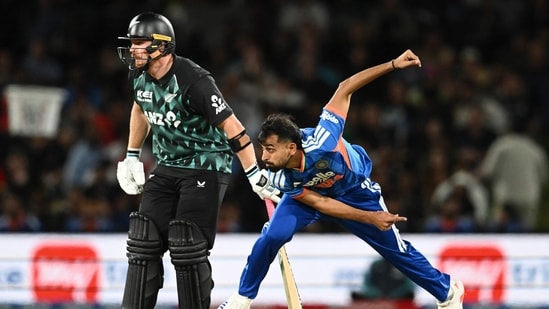
Standing out in that phase was a particularly telling final over. Prince Yadav conceded only nine runs, denying Mitchell and Jacobs the explosive finish they had threatened to produce. Bowling full and wide, he kept checking the runs till his final delivery was too full for Jacobs to get underneath to find the boundary. India had limited the damage when the momentum seemed to be moving against them.
{{/usCountry}}Standing out in that phase was a particularly telling final over. Prince Yadav conceded only nine runs, denying Mitchell and Jacobs the explosive finish they had threatened to produce. Bowling full and wide, he kept checking the runs till his final delivery was too full for Jacobs to get underneath to find the boundary. India had limited the damage when the momentum seemed to be moving against them.
{{/usCountry}}That recovery offers a blueprint for Auckland, where the task is not simply to execute the right lengths in the final over but also to prevent opposition batters from dictating terms for long periods beforehand.
Shreyas Iyer acknowledged the same after the Wellington match—that India needed to rethink once New Zealand began exploiting their lengths. “After 10 overs I realized that anything half volley or hard length was going into the stands, so we were looking to bowl wide yorkers,” he said.
The adjustment was sensible. On a surface where batters were able to line up deliveries that offered pace and length, persisting with conventional good lengths risked playing into their hands. The wide yorker offered a different problem, asking Mitchell and Jacobs to reach for the ball rather than swing freely through the line.
India’s improvement, however, cannot be judged solely by the last six balls. Nitish Kumar Reddy conceded 15 in the 19th over, while Bhuvneshwar Kumar’s 18th over was more economical, conceding nine. But the larger lesson was the importance of varying pace, length and angle without sacrificing control.
At this level, the distinction between a useful variation and a scoring opportunity can be marginal. Prince’s final over also illustrated the value of support from the field. India’s bowlers need to be able to trust their fielders to convert marginal chances into singles, while avoiding the untidy overthrows and fumbles that can turn a manageable finish into a costly one.
Iyer had already stressed the importance of adapting quickly to changing conditions. That principle will matter again in Auckland. The venue brings different boundary dimensions and demands fresh calculations over which lengths can be defended safely.
At the top, Arshdeep Singh has already laid the marker with this tight bowling against New Zealand’s openers. But India must also be alert to how New Zealand use the crease in the middle overs, particularly if Mitchell and Jacobs continue to target full deliveries and exploit anything offered in their hitting arc.
With the next T20 World Cup still two years away, India can afford to try, falter and still learn from those lessons. Which is why there is little reason for India to overhaul a largely young bowling attack that has helped deliver a series victory.
But there is every reason to insist on greater consistency through the middle overs and sharper anticipation of New Zealand’s preferred scoring areas. That final over in Wellington showed that India can close an innings with composure under pressure. In Auckland, India would love to make that composure a feature of the entire spell, rather than a quality summoned only when the risk is at its highest.