On 19 April 2002, Sachin Tendulkar had equalled Don Bradman’s record of 29 Test hundreds in Port of Spain. Twenty one years later, Kohli achieved that feat at—coincidence of all coincidences—the same venue. That was Tendulkar’s 93rd Test by the way, against a West Indies side which ultimately won the five-match series 2-1. And this was Kohli’s 111th Test, against a rudderless West Indies that struggles in nearly every format.
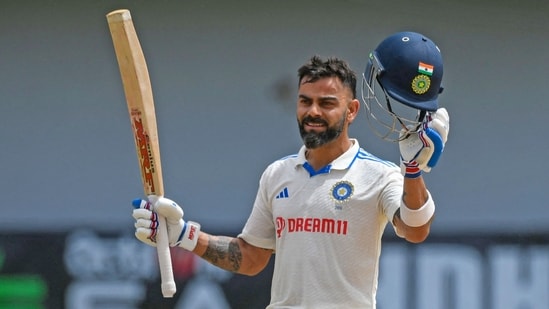
A Test hundred is still a Test hundred. It can never be clubbed under the ubiquitous category of ‘international hundreds’ because here, unlike in the other two formats, you play across five days, on a deteriorating pitch, in constantly changing overhead conditions, with no fielding restrictions whatsoever and the best bowlers going at you without worrying about conceding wides.
But the quality of opposition wavers. Form too can be temporary. Take Kohli for example. When he raced to 24 Test centuries in 123 innings, second only to Bradman’s 66 and ahead of Tendulkar’s 125 and Sunil Gavaskar’s 128 innings, Kohli was quickly hailed as the greatest batter of modern times. No one could have envisaged then that the next five hundreds would require 64 innings.
Nearly all top-order batters to have featured in at least 100 Tests have ended with 20 or more centuries. But can all of them be called great? Probably not. It only intensifies the need to deeply analyse these records, to find more perspective, bind them to a cause and by extension, a more meaningful narrative. On the individual front, how prolific were these top-tier batters? More significantly, how many of those hundreds actually mattered?
{{/usCountry}}Nearly all top-order batters to have featured in at least 100 Tests have ended with 20 or more centuries. But can all of them be called great? Probably not. It only intensifies the need to deeply analyse these records, to find more perspective, bind them to a cause and by extension, a more meaningful narrative. On the individual front, how prolific were these top-tier batters? More significantly, how many of those hundreds actually mattered?
{{/usCountry}}It’s quite evident now that Tendulkar’s record of 51 centuries will never be matched, because appearing in 200 Tests is virtually physically impossible and no current batter has the conversion rate to race to that mark in the next two World Test Championship cycles.
Bradman retired with an astonishing conversion rate of a hundred every 2.75 Test innings, one every three innings in layman terms. With Kohli, 16 batters have now equalled Bradman’s 29-century record, everyone taking nearly twice the time to get there. Only three of them are still active Test players—Joe Root averages a hundred every 8.1 innings, Kohli one every 6.44 innings and Steve Smith every 5.59 innings.
That puts Smith not only above the rest of the contemporary pack but also ahead of Tendulkar (6.45), Ricky Ponting (7), Kumar Sangakkara (6.13), Younis Khan (6.26), Gavaskar (6.29), Brian Lara (6.82), and Matthew Hayden (6.13).
All were top-order batters, and most captained their respective sides at some juncture of their career. Only one genuine allrounder finds a unique place in this pantheon of legends—Jacques Kallis. To finish with 45 Test hundreds at a conversion rate of 6.22 innings, topping it off with 292 wickets makes Kallis a truly great cricketer of all time. But those numbers don’t necessarily make him a better batter, because numbers don’t always give us the full picture. Which is why context becomes more paramount.
The most obvious parameter is the role a Test century may have played in the outcome of that match. Of all batters with at least 20 hundreds in Test wins, Ponting tops the list with 30 centuries—most of them scored during Australia’s two 16-match winning streaks in 1999-2001 and 2005-08—meaning 73.17% of his 41 hundreds came in wins.
Bradman’s hundreds again have the best win percentage—79.3—but making a surprise entry at second, pushing Ponting to third is Steve Waugh, who has to his name 32 centuries, 25 of which came in victories. Waugh’s batting was rarely a sight to behold, but its effectiveness is highlighted by this data. To give you a bigger picture, Kallis’s hundreds have a winning percentage of 48.88. Kohli? 44.82%. Tendulkar? 39.21.
Making Waugh’s record look even more formidable is the fact that 13 of those 25 hundreds were scored away from home, nine of them being scores of 150 or more, with six unbeaten finishes. His weakest—and this is going purely by statistics and the then ICC rankings—opposition was a 1999 Zimbabwe bowling attack comprising Heath Streak, Henry Olonga, Bryan Strang, Neil Johnson, Guy Whitall and Grant Flower. The rest were scattered across England, West Indies, South Africa and New Zealand—all intimidating hosts in their own right throughout the 90s and the early 2000s.
Till date, only four batters have scored at least 10 hundreds in away wins. Younis Khan is the only Asian among them. But three of those 10 hundreds by Khan came in Bangladesh (rarely a competitive Test team), the fourth against a dilapidated Zimbabwe in 2013 and a fifth against a 2015 Sri Lanka side coping with the retirements of Sangakkara, Mahela Jayawardene and Muttiah Muralidharan. Ponting too scored one in Bangladesh (2006) and against a declining West Indies in 2008. As did Smith, in the West Indies in 2015. But unlike Ponting and Waugh, he has a hundred in a win in India, during the Pune Test in 2017. Four years later, Root joined that elite club when he swept his way to a double hundred on a crumbling Chennai pitch.
If a match-winning hundred in India is the ultimate high for a non-subcontinent batter, the subcontinent equivalent is to achieve the same at least in Australia and England. Cheteshwar Pujara was singularly responsible for steering India to that 2018 series win in Australia with hundreds in Adelaide and Melbourne but England hasn’t been kind to him.
The 2018 win in Nottingham was all about Kohli (97 & 103) but the closest he could come to in Australia was an 82 in that Melbourne victory. Only Ajinkya Rahane has ticked that vaunted box—at Lord’s (2014) and Melbourne (2020)—even though he doesn’t possess what usually qualifies for bragging rights in a world influenced largely by generic records.