


 Live Score
 Cricket Teams
 Cricket Players
Virat Kohli vs Sachin Tendulkar after 15000 ODI runs: Why the gap between them is more complex than it looks
Virat Kohli reached 15,000 ODI runs far quicker than Sachin Tendulkar, but a deeper statistical look shows why the comparison goes well beyond surface numbers.

 Prefer HTon Google


Virat Kohli did not merely cross 15,000 ODI runs in Thiruvananthapuram. By the time he walked off unbeaten on 139 from 88 balls against the West Indies, he had provided perhaps the perfect innings through which to understand why his journey to the landmark has been so different from Sachin Tendulkar’s.

India were chasing 296 and Kohli turned the pursuit into another exhibition of his control over the format. He reached 15,000 during the innings, went on to complete his 55th ODI century and eventually finished unbeaten as India cruised home by eight wickets with 50 deliveries remaining. It left Kohli with 15,080 runs after 303 ODI innings.
Tendulkar, the only other batter to enter the 15,000-run club, reached the landmark against South Africa in Belfast in 2007. His 93 that day took him to 15,043 runs after 377 innings. The difference between the two journeys is therefore not marginal. Kohli has effectively compressed a Tendulkar-sized body of ODI runs into 74 fewer innings.
Kohli's 15,000-run journey is built on extraordinary efficiency
Deep Dive

Strip away not-outs and batting averages for a moment and simply divide runs by innings. After their respective milestone innings, Kohli had produced 49.77 runs every time he went out to bat; Tendulkar stood at 39.90. Kohli's output per innings was therefore almost 25 per cent higher.
Batting average makes the separation even greater. Kohli, having finished unbeaten in his 303rd innings, has now been dismissed 255 times while scoring 15,080 runs, giving him an average of approximately 59.14. Tendulkar had 37 not-outs after 377 innings and averaged 44.24 when he finished the Belfast game on 15,043.
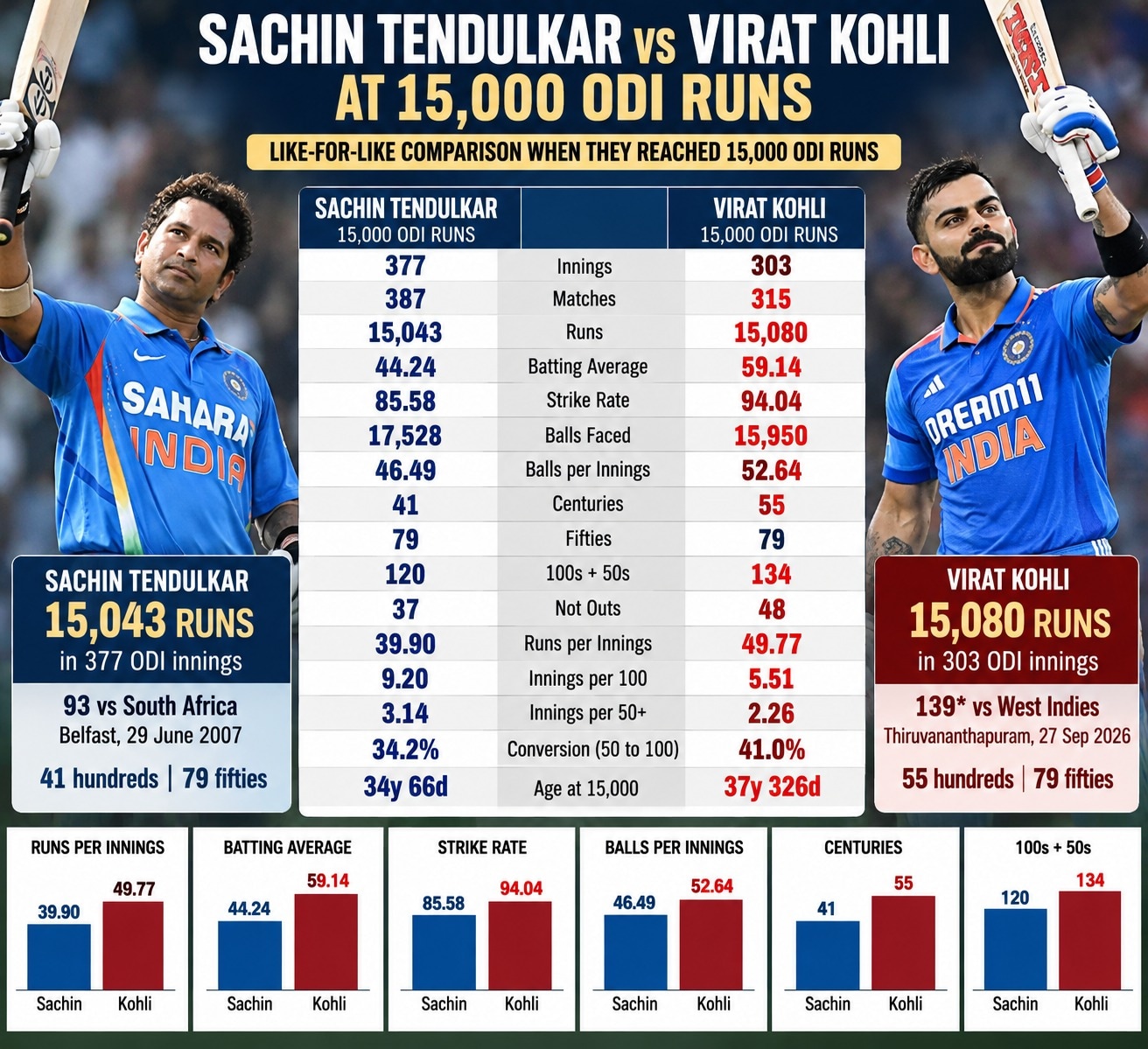
There is a legitimate qualification here. Kohli's higher proportion of unbeaten innings helps his average: roughly 15.8 per cent of his innings have ended not out at this stage, compared with about 9.8 per cent for Tendulkar. But the runs-per-innings figure removes that advantage and Kohli still leads enormously. This is not simply mathematics generated by not-outs; he has extracted significantly more runs from each batting opportunity.
The century numbers reveal the same pattern even more brutally. Kohli now has 55 hundreds after 303 innings, compared with Tendulkar's 41 after his 377th. That works out to a hundred approximately once every 5.5 innings for Kohli, against once every 9.2 innings for Tendulkar.
Their fifty counts make the contrast even more fascinating. Kohli had 79 ODI fifties entering Sunday's game and, after converting this innings into another hundred, remains on 79. Tendulkar had 79 fifties alongside his 41 hundreds after reaching the landmark.
That means Kohli has 134 scores of fifty or more across 303 innings, compared with Tendulkar's 120 across 377. Kohli has reached fifty once every 2.26 innings; Tendulkar did so once every 3.14. More importantly, Kohli has converted approximately 41 per cent of his fifty-plus scores into centuries, compared with about 34 per cent for Tendulkar at the corresponding stage.
The delivery count adds another layer. Kohli required around 15,950 balls to score his first 15,000 ODI runs, while Tendulkar needed 17,528. Kohli therefore consumed 1,578 fewer deliveries — more than 263 overs — to reach exactly the same landmark.
Yet this is where the comparison needs historical context. The difference in balls faced, roughly nine per cent, is considerably smaller than the nearly 20 per cent difference in innings required. Kohli has not reached 15,000 simply by batting faster; he has done it by making individual innings last longer and extracting more from them.
Tendulkar also operated through a substantially different ODI environment. Before he was promoted to open in 1994, he had already played 69 ODIs, scoring 1,758 runs at 30.84 without a century. India had spent the opening years of his career using him largely through the middle order rather than maximising his ability against field restrictions.
Once Tendulkar became an opener, his ODI career transformed. That early period is embedded within his 377-innings journey to 15,000, whereas Kohli established his defining No.3 role much earlier in his career. The raw 74-innings difference therefore measures both batting efficiency and two very different career trajectories.
Era must also temper any straightforward strike-rate comparison. Tendulkar's journey began in 1989, through an age of one new ball, softer balls at the death, different fielding restrictions and substantially lower scoring rates. Kohli has spent most of his career in the modern ODI environment, where 300-plus totals and far more aggressive batting have become routine.
There is another statistic that reverses the story completely: age. Tendulkar was only 34 when he reached 15,000; Kohli is 37. Despite needing 74 additional innings, Tendulkar reached the landmark at a considerably younger age because India played an enormous volume of ODI cricket during his prime.
That distinction matters. Kohli is the fastest to 15,000 when measured by batting opportunities, which is the conventional and arguably most meaningful cricketing measure. Tendulkar reached it sooner in terms of age and slightly sooner in elapsed time from debut.
Sunday's 139 not out nevertheless captured why Kohli's numbers look the way they do. He did not stop when the milestone arrived. He did not stop at fifty, or even at a hundred. He remained there until the chase was finished.
That has been the statistical signature of his ODI career. Tendulkar accumulated 15,000 runs across more innings and across a radically changing format; Kohli has packed essentially the same mountain into far fewer opportunities through an extraordinary combination of survival, conversion and repeatability. The number 15,000 puts them in the same room. How they arrived there tells two very different stories.


