Till a few years back, Aravalli Biodiversity Park housed a number of ponds. However,a walk here this summer yields dry water bodies, signalling a sharp decline in the region’s water table.
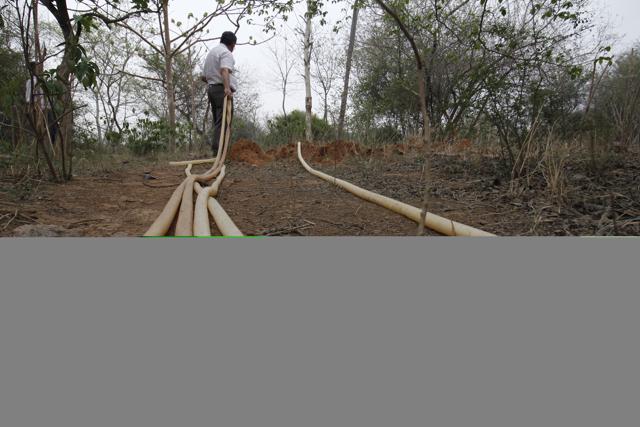
These ponds were formed due to the deep depressions left by mining in the park region and used to brim with water throughout the year. Now, with the decline in water table the biodiversity park is dependent on water from private tankers. Several pipes can be seen running all through the forest.
“A biodiversity park means that the natural diversity should be so rich that it should not be dependent on water from tankers or other sources. If this is the condition of a biodiversity park, one can assume what would be the condition of the groundwater level in residential areas,” said environmentalist Anil Sood.
The Aravalli Biodiversity Park is located on the South Central Ridge and spreads over an area of 692 acres. The area is surrounded by JNU (Nelson Mandela Marg), Mehrauli-Mahipalpur road and southern boundary of Vasant Vihar. The landscape is undulating with gentle slopes and dotted with numerous clay mined pits of different sizes, depths and shapes.
The park was created with the purpose of conservation and preservation of the ecosystem of Aravalli hills, conserve keystone species and other threatened plant and animal species, preserve the biodiversity of any habitat , develop mosaic of wetlands that sustain the rich aquatic flora and fauna of the Yamuna and monitor short- and long-term changes in the ecology of Delhi region.
{{/usCountry}}The park was created with the purpose of conservation and preservation of the ecosystem of Aravalli hills, conserve keystone species and other threatened plant and animal species, preserve the biodiversity of any habitat , develop mosaic of wetlands that sustain the rich aquatic flora and fauna of the Yamuna and monitor short- and long-term changes in the ecology of Delhi region.
{{/usCountry}}The website of the park claims that the biodiversity park enhances groundwater recharge and augments fresh water availability, acts as sinks for CO2 and other pollutants, ameliorates local weather conditions and buffers ambient temperatures, promotes eco-tourism and social connectivity across the urban community, serves as gene pools and represents unique ecological models possessing not only wildlife and natural values but also aesthetic, environmental and educational values.
Diwan Singh, of Ridge Bachao Aandolan, said till few years back the water bodies in the park were brimming. But the construction of several hotels and malls nearby has led to a steep fall in groundwater level. “These new structures were using borewells (to augment flow of water) to extract water,” he said.
The condition of the water table in south Delhi is alarming and a recent report by Central Ground Water Board found that between November 2013 and November 2014, 53% of all wells in the city showed a drop in the water level. Of these, the drop was up to 2m in 40% of wells and more than that in the rest.
A recent study by the earth sciences department of Delhi University also found the rate of decline in water levels to be as high as 1.7 to 2 metres per year in some areas of south and southwest Delhi. The water level in localities like Tughlakabad and Pushp Vihar has gone down to below 60m.
Water activist Vinod Jain said, “One of the prime reasons behind creation of these parks is to enhance groundwater recharge of the area. I, however, since the beginning of the creation of this biodiversity park, believe that the best way to allow greenery to prosper is minimum interference of human beings.” There has been over-extraction of groundwater in south Delhi as Delhi Jal Board pipelines have not reached several colonies and farmhouses, he said.
However, ecologist and the scientist in charge of the park, M Shah Hussain, has a different take on the issue. He said, “One needs to understand that from a barren piece of land in 2004 this park has been converted into a lush green sanctuary hosting birds, mammals, reptiles, rare ayurvedic plants, butterflies and other insects. The pits used to be filled with water earlier because there was no greenery to act as water shed; but, now as there are so many plants here, these act as water sheds. As a reason, water does not flow all the way to the water bodies.”
Hussain also said that the reason why pipes and water tankers are being used to water plants is because young saplings need water for at least two years before they are self-dependent upon ground water, he said. “In some years from now when we will plant more native trees here replacing the weeds, this forest would be self self-sufficient and one would not need any tanker water,” he added.
Stay updated with all top Cities including, Bengaluru, Delhi, Mumbai and more across India. Stay informed on the latest happenings in World News along with Delhi Election 2025 and Delhi Election Result 2025 Live, New Delhi Election Result Live, Kalkaji Election Result Live at Hindustan Times.
Stay updated with all top Cities including, Bengaluru, Delhi, Mumbai and more across India. Stay informed on the latest happenings in World News along with Delhi Election 2025 and Delhi Election Result 2025 Live, New Delhi Election Result Live, Kalkaji Election Result Live at Hindustan Times.