Much of the focus on Russian President Vladimir Putin’s visit to India on October 4-5 for the annual summit between the two countries has centred round the impending multi-billion dollar deal for S-400 Triumf air defence systems. This is understandable, because of the way defence and military collaboration has underpinned bilateral relations for many decades, and the concerns caused by US threats of secondary sanctions under the Countering America’s Adversaries Through Sanctions Act (CAATSA), which seeks to punish Russia for its activities in Ukraine and involvement in the Syrian war. Although top US officials have pushed for an India-specific waiver, President Donald Trump has given no indication of how he intends to tackle this issue.
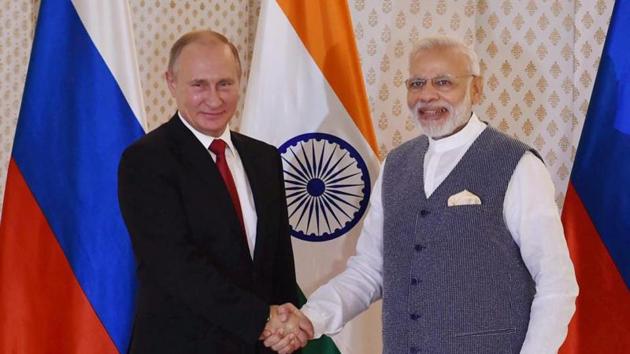
That New Delhi has opted to go ahead with the signing of the deal during Mr Putin’s visit despite the uncertainty arising from the US threat of sanctions is an indication of the importance it attaches to defence and strategic ties with Moscow. The two-day meet is also significant as it follows an informal summit in May between Mr Putin and Prime Minister Narendra Modi in the Russian city of Sochi, where the two sides attempted a reset of their relationship, which has been strained by various factors in recent years. Despite the robust military cooperation, there was a drift in the ties as Russia remained silent during the 2017 Doklam standoff with China, worked for a larger role in Afghanistan and even began selling arms to Pakistan.
India is going into this year’s summit from a position of economic strength — the country is ranked by the IMF among the world’s ten biggest economies of 2018 — while Russia is grappling with a host of economic woes brought on by the lack of reforms and the impact of Western sanctions. Russia’s GDP growth forecast for this year and the next is below the global average and India’s GDP is 70% larger than Russia’s. The summit is also being held at a time when Mr Putin is in need of friends, after the growing anger in Europe against Russia for its role in global hotspots such as Syria and its perceived meddling in European elections. A more robust relationship with India will also help dispel fears in New Delhi that Moscow has drifted closer to Beijing. India and Russia also have the option of working more closely through multipolar forums such as the Shanghai Cooperation Organisation and Brics. Clearly, both sides will have to bring fresh ideas to the table to build on and transform what is looking like a largely transactional relationship.
{{/usCountry}}India is going into this year’s summit from a position of economic strength — the country is ranked by the IMF among the world’s ten biggest economies of 2018 — while Russia is grappling with a host of economic woes brought on by the lack of reforms and the impact of Western sanctions. Russia’s GDP growth forecast for this year and the next is below the global average and India’s GDP is 70% larger than Russia’s. The summit is also being held at a time when Mr Putin is in need of friends, after the growing anger in Europe against Russia for its role in global hotspots such as Syria and its perceived meddling in European elections. A more robust relationship with India will also help dispel fears in New Delhi that Moscow has drifted closer to Beijing. India and Russia also have the option of working more closely through multipolar forums such as the Shanghai Cooperation Organisation and Brics. Clearly, both sides will have to bring fresh ideas to the table to build on and transform what is looking like a largely transactional relationship.
{{/usCountry}}