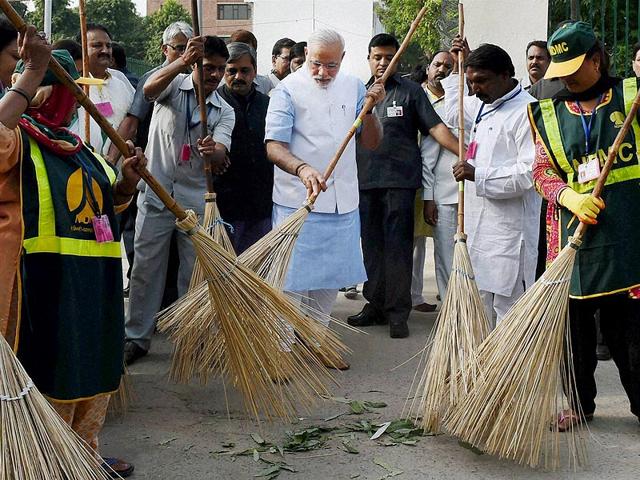
I am known to be a Hindutva leader... My real thought is — Pehle shauchalaya, phir devalaya (toilet first, temple later),” said Prime Minister Narendra Modi shortly before taking office. The solution came in the form of Swachh Bharat Abhiyan, which, like many of his ambitious projects, Mr Modi launched on a massive scale. Everyone from ministers to the common man participated in the cleanliness and sanitation campaigns. But forgotten in all the photo-ops were those who have to live a life of indignity cleaning human excreta, India’s manual scavengers.
The medieval period practice of cleaning human excreta with bare hands has been legally banned in India since 1993. But 1.8 lakh households earn their livelihood doing this as per the Socio-Economic Caste Census (SECC) data released recently. The practice is most prevalent in Maharashtra (63,713) and Madhya Pradesh (23,093), followed by Tripura, Uttar Pradesh, Karnataka, Daman and Diu and Bihar. Once employed to clean human excreta from houses not connected to sewerage lines, generations of mostly Dalit women have been forced to inherit this dehumanising profession.
Parliament had enacted the Employment of Manual Scavengers and Construction of Dry Latrine (Prohibition) Act in 1993, banning manual scavenging of household toilets and requiring state governments to rehabilitate the workers. The act stipulated a year’s jail and a fine of Rs 2,000 for anyone engaging manual scavengers or building dry (non-flush) toilets. But the states hardly enforced the law as seen from the fact that a 2006 report points out that in the 13 years after the act came into force, there wasn’t a single prosecution. The act also left out the workers who were sent down manholes, sewage pits and storm drains and spared the law’s biggest violator: The Indian Railways, which employed them to clean waste on the tracks.
As a result of this, in 2013, Parliament passed the Prohibition of Employment as Manual Scavengers and their Rehabilitation Bill, widening the definition of manual scavenging to include the manual removal of excreta from sewers and railway tracks. It also increased the punishment to five years in jail. Another ray of hope came from the provisions aimed at rehabilitating the people working as manual scavengers. It should be understood that years of humiliation has left many scars, both physical and mental. The government, with its thrust on technology and its ambition of providing a toilet for every household, could end this practice if it made up its mind to do so. If the spirit with which the Swachh Bharat Abhiyan was launched continues, we may well see an end to this medieval institution.
{{/usCountry}}As a result of this, in 2013, Parliament passed the Prohibition of Employment as Manual Scavengers and their Rehabilitation Bill, widening the definition of manual scavenging to include the manual removal of excreta from sewers and railway tracks. It also increased the punishment to five years in jail. Another ray of hope came from the provisions aimed at rehabilitating the people working as manual scavengers. It should be understood that years of humiliation has left many scars, both physical and mental. The government, with its thrust on technology and its ambition of providing a toilet for every household, could end this practice if it made up its mind to do so. If the spirit with which the Swachh Bharat Abhiyan was launched continues, we may well see an end to this medieval institution.
{{/usCountry}}