E-Paper



Four questions that are set to shape the election verdicts
Here are four data points which will hold the key to results in West Bengal, Assam, Kerala and Tamil Nadu

 Prefer HTon Google


Election results for the states of Assam, Kerala, Tamil Nadu and West Bengal and the union territory of Puducherry will be declared today. Here are four data points which will hold the key to results in four major states.
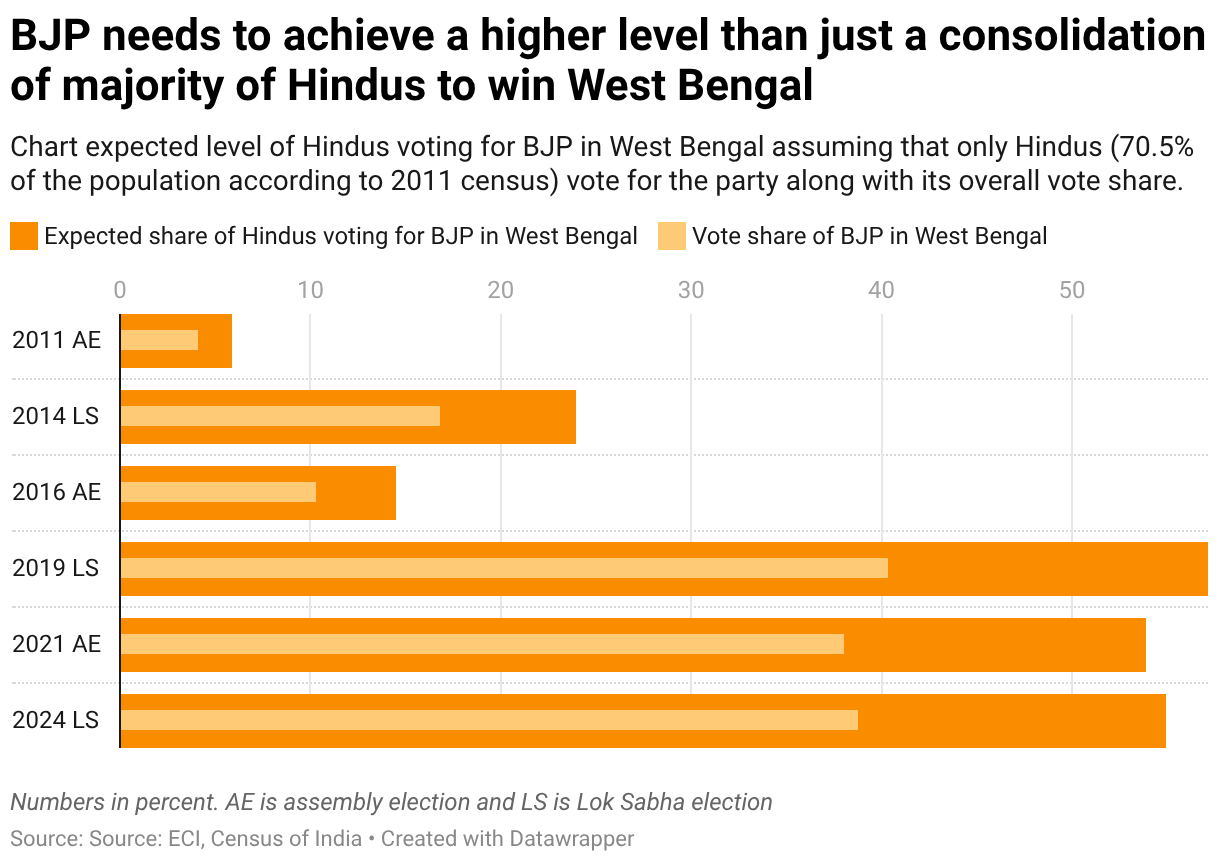
Can BJP’s Hindu consolidation in West Bengal cross a critical threshold?
This is the crudest and yet the most effective way to look at the political competition in West Bengal. The Trinamool Congress has won every election in the state since 2009. In the last three, 2019 Lok Sabha, 2021 assembly and 2024 Lok Sabha, the Bharatiya Janata Party (BJP) has been the main opposition party with a vote share in the ballpark of around 40%. Now, if one can justifiably assume that the BJP does not receive any Muslim votes, then its prospects of taking over the TMC depend on consolidating its already existing lead over the TMC among Hindu voters. For the BJP to reach about 45% vote share – which is what the TMC has currently – it will have to consolidate close to two-thirds of the state’s Hindus.
Will Congress be able to break growing Muslim ghettoisation in Assam?
Congress’s legislative strength has shrunk significantly in Assam in the two post-2014 assembly elections. What is equally significant is the fact that while it has seen its overall number of MLAs come down, number of Muslim MLAs from the Congress has actually increased. This number is likely to increase even further given the fact that the Congress pretty much decimated the All-India United Democratic Front (AIUDF) in the 2024 Lok Sabha elections in the state. However, unless it can regain its mojo outside the Muslim majority parts of the state, Congress cannot hope to dislodge the BJP there.

Will the LDF retain its average vote share in Kerala?
Power changing hands was a four-decade norm in Kerala until the Communist Party of India (Marxist) or CPI(M) led Left Democratic Front (LDF) managed to buck the trend in 2021 elections by retaining power. A loss this time, therefore should not be really surprising in a state prone to anti-incumbency, even though it will mean that communists, for the first time in 50 years, would not be in a state government in India. What will be more critical, however, is whether the LDF manages to retain its close to 45% vote share. Its lowest vote share, in any election since 1980 has been 43.35%. This matters a lot because a significant erosion in the LDF’s vote share could mean that some of its core voters have left it for the BJP, which polled 16.8% votes in the 2024 Lok Sabha election.

Will Vijay break the Dravidian duopoly in Tamil Nadu’s politics?
When the All India Anna Dravida Munnetra Kazhagam (AIADMK) allied with the BJP in Tamil Nadu in April 2025, the contest was expected to be more bipolar than the one-way dominance Dravida Munnetra Kazhagam (DMK) led alliance has enjoyed since 2019. However, the entry of a greenhorn politician but a superstar actor Vijay and his party Tamilaga Vettri Kazhagam (TVK) has made the electoral waters so turbulent that some exit polls are already seeing it as a player to reckon with. The DMK-AIADMK duopoly has enjoyed close to an 80% vote share in the state since 1990. What also remains to be seen is whether TVK’s support comes at the cost of one of the Dravidian giants of the one-fifth of the electorate which has been fence sitting in the state.