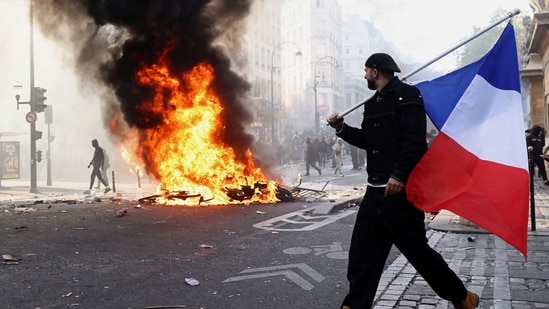
France has been rocked by protests, some of which mutated into large-scale arson last week. While this is not the first instance of large-scale protests or even violence in France, the scale and spread make them noteworthy. What exactly is to blame ? Here are some numbers that put the larger picture in context.
- Barring the US, most G7 countries have seen a stagnation in living standardsFrance is one of the countries in the elite club of G7, the largest developed economies in the world. While France’s per capita incomes are still much higher than most non-developed economies, what is also true for France and the G7 (except the US) is that mass incomes have experienced a prolonged economic stagnation. This is best seen in real per capita GDP for G7 countries which, barring the US, have almost stopped growing since the 2008 Global Financial Crisis. Add to this the income inequality, squeeze on things such as real spending on education and inflation, and the economic pain is real.
- France has among the highest dissatisfaction levels vis-à-vis democracyWith the economy stalling regarding mass well-being, politics could not have remained unaffected in most advanced economies. The first shock came in 2016 with the Brexit vote in the UK and Donald Trump becoming the US President. France dodged a right-wing political coup when Emmanuel Macron defeated right-wing leader Marine Le Pen in the 2017 elections. While Macron has managed to prevent a right-wing takeover of the French government, the casualty has been France’s faith in democracy itself. Findings from a 2025 Pew Survey show that France had among the lowest satisfaction levels with how democracy was functioning. What was even more worrying was that a large number also thought that things could not be changed for the better. The protests are only a kinetic manifestation of the French losing faith in the political system, the disillusionment and perhaps even hopelessness are deeply ingrained now.
- Anarchy before a coup d’état?Under Macron, France has managed to preserve its political centre despite a growing squeeze from both the right and the left. Because the French constitution limits presidents to two terms, Macron cannot run in the elections to be held next year. Polling numbers suggest that neither Macron’s chosen protégées nor the left is likely to prevent Marine Le Pen from taking the presidency this time. Le Pen is likely to have a large lead in the first round and will perhaps sail through the run-off as well. A recently released survey after the protests shows that Le Pen has gained in popularity in the polls. Many reports on the French protests have accused the hard left led by Jean-Luc Melenchon of stoking the protests although Melenchon has denied any responsibility for violence. However, many commentators see in the protests a complete emaciation of centrist politics in France and a growing polarisation between the hard right and the hard left. With the centrists unable to maintain even basic order and the hard right trying to outflank it as a force for stability rather than disorder, France could be headed for a situation where so-called progressive politics mutates into protests against a state that will likely see a right-wing takeover in the near future.
Unlock a world of Benefits with HT! From insightful newsletters to real-time news alerts and a personalized news feed – it's all here, just a click away! -Login Now!
Unlock a world of Benefits with HT! From insightful newsletters to real-time news alerts and a personalized news feed – it's all here, just a click away! -Login Now!
Advertisement
{{/htLoading}}{{#usCountry}}