E-Paper



Muslims in Assam’s labour market | Number Theory
Here is what an HT analysis of the latest Periodic Labour Force Survey (PLFS) data shows

 Prefer HTon Google


Assam has the largest share of Muslims in its population among all Indian states. It is also a state which sees shrill communal rhetoric in its polity. The current chief minister of the state has often been in the news for making incendiary remarks about the state’s Bengali-speaking Muslims. A lot of the state’s public discourse in this regard hinges on the question of migration from Bangladesh. This is an issue that goes back a long time, even before the country became independent. However, what is often ignored in this discourse is the intersection of class and communalism in the state. How are Assam’s Muslims placed in the state’s labour market vis-à-vis Hindus? How is this different from other Indian states with a large share of Muslim population? Here is what an HT analysis of the latest Periodic Labour Force Survey (PLFS) data shows.
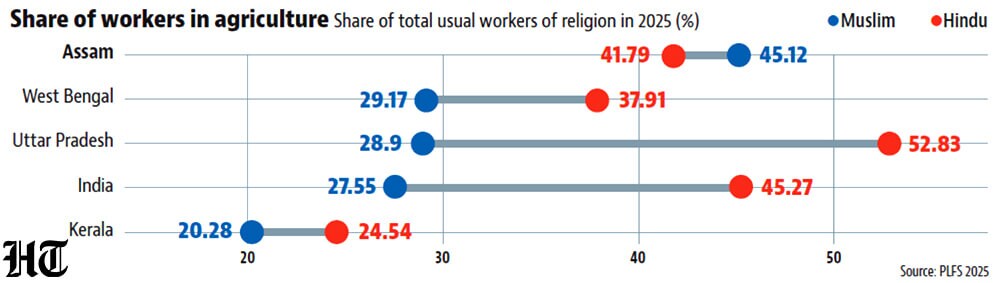
 Unlike nationally, Muslims are overwhelmingly farmers in Assam43% of Indian workers are employed in agriculture according to the 2025 PLFS. Muslims (27.5%) show a significantly smaller employment share in agriculture than Hindus (45.3%) at the all-India level. In Assam, the situation is drastically different, where Muslims report a higher employment share in agriculture than Hindus. This is also different from other states where Muslims have a population share which is greater than one-fifth. Anybody who is acquainted with the history of migration in Assam will appreciate the difference. Migration in Assam happened primarily in the first half of the last century from what is today Bangladesh but was not a separate country back then. It involved settlers moving in from a land scarce region, clearing forests, and taking up farming.
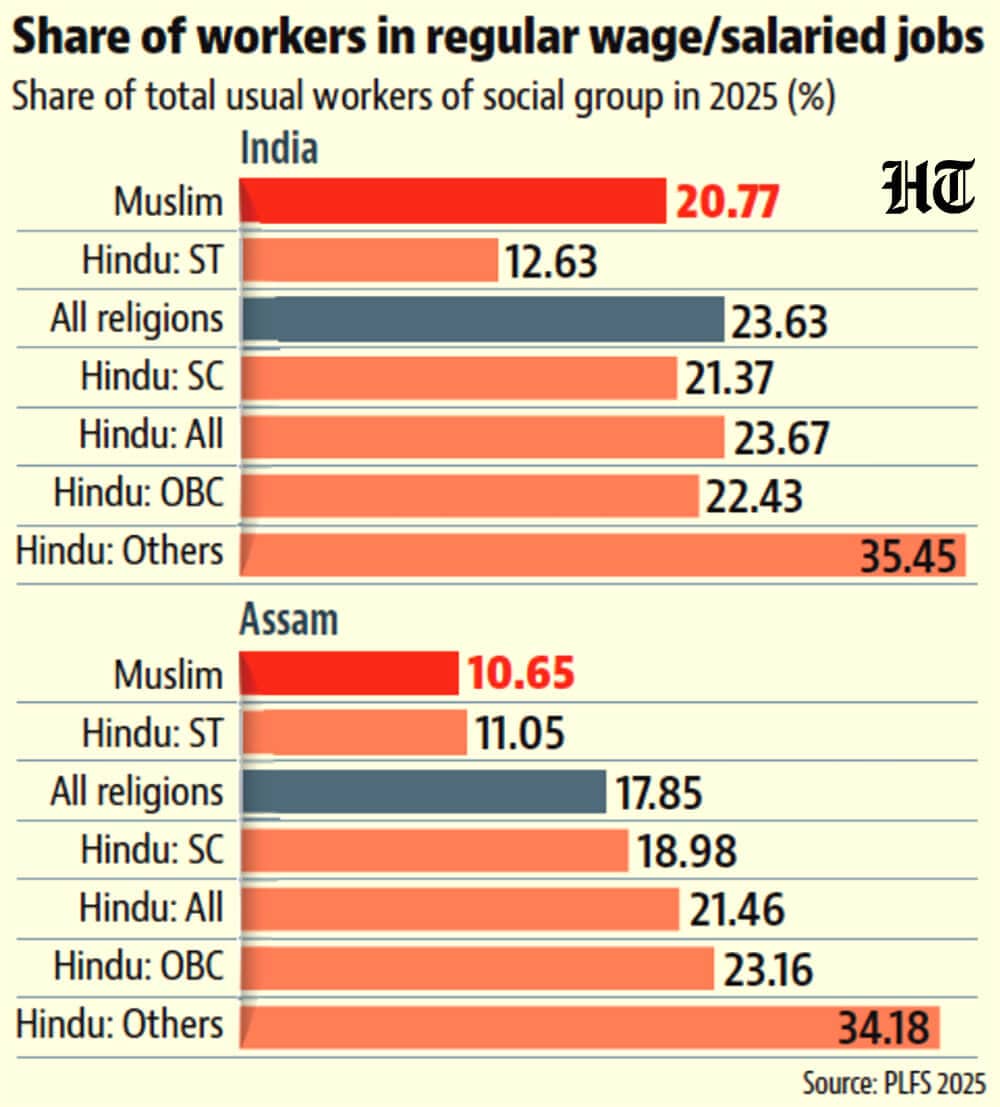
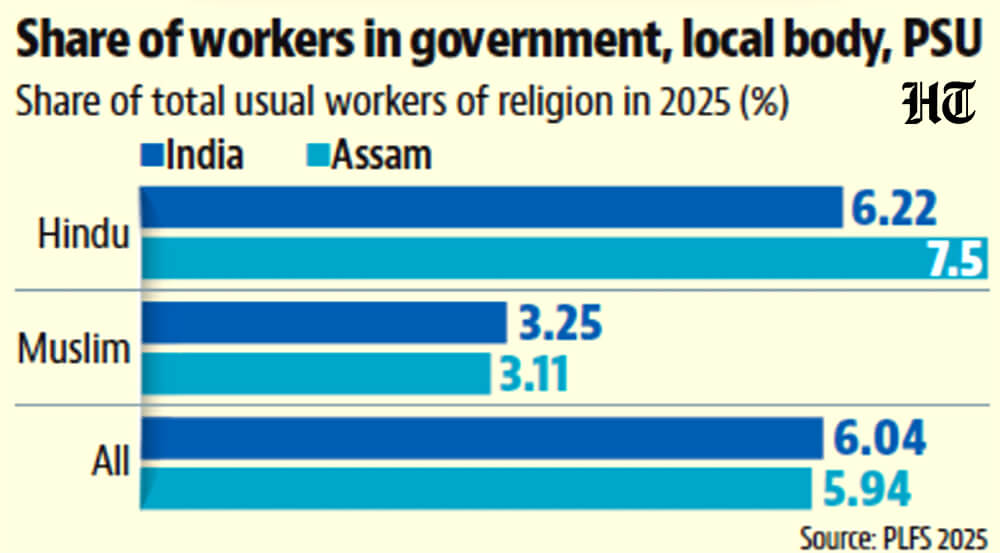
- Nationally, Muslims are at par with Hindu SCs in terms of access to salaried jobs. In Assam they fare worseThat Muslims fare badly on a crucial qualitative front in Indian labour markets – access to salaried jobs which offer the highest average incomes – is well known. Nationally, only 20.8% of Muslim workers had salaried jobs, not just below the all-India, and Hindu, average of 23.6% and 23.7%, respectively, but also below what this share is (21.4%) for Scheduled Caste (SC) workers. The latter have and continue to face social discrimination in labour markets. In Assam, the Muslim disadvantage is even bigger. Only 10.7% of Muslims had a regular job compared to 21.5% for Hindus overall and 19% for SCs. Government employment, or lack of it, plays a role in the relative backwardness of Muslims in salaried jobs in Assam, where they lag Hindus by a greater distance than at the all-India level.
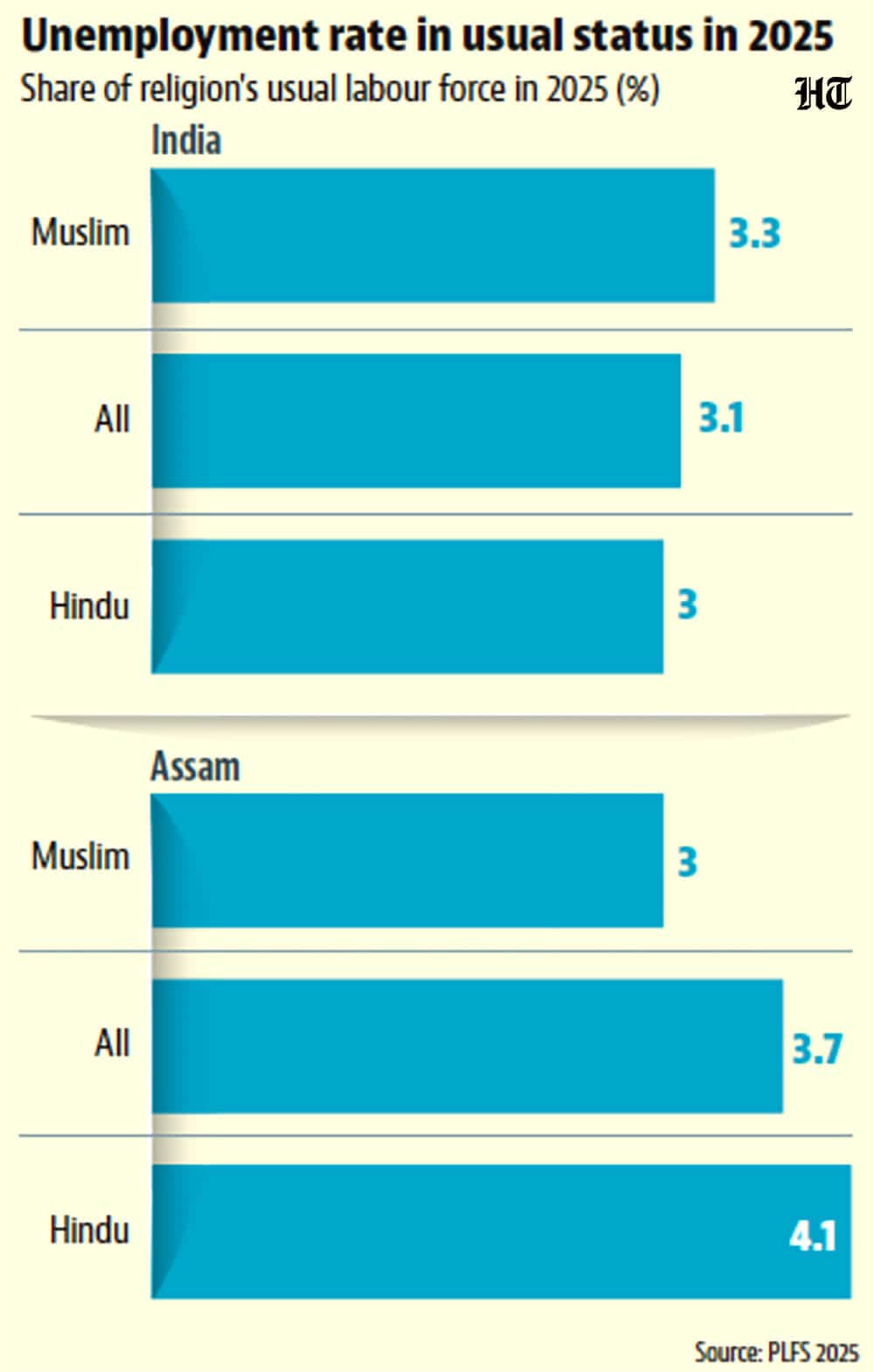
- In keeping with the eccentricities of Indian labour market, Muslims report a lower unemployment rate than Hindus in AssamMuslim unemployment rate in Assam was 3%, lower than the state average of 3.7% and much lower than what it was for Hindus at 4.1%. This is in contrast to the situation at the all-India level, where Muslims report a higher-than-average unemployment rate. An intuitive inference of these statistics, if they were being read without the context provided above, would be that Muslims are better placed in Assam’s labour markets than Hindus. However, what these numbers actually suggest is that a larger share of Muslim workers in Assam are engaged in sectors such as farming rather than looking for better quality jobs. This is something which ought to be kept in mind even while reading India’s overall unemployment rate. Unemployment, more often than not, is a luxury which only the relatively well-off can afford in the country.
- Vilifying some Muslims could be helping cover Assam’s larger backwardness vis-à-vis the country Assam is one of India’s poorer states when it comes to per capita GSDP (76% of national average in 2024-25 in nominal terms) or monthly per capita consumption expenditure (83% of national average in 2023-24 in nominal terms). Even the PLFS data shows that the state lags behind on average earnings of both salaried and self-employed workers. Hindu salaried workers earn more on average than their peers in Assam, although by a smaller margin than the all-India situation. Among self-employed, Muslims earn marginally more than Hindus in Assam in contrast to the marginal advantage Hindus have at the all-India level. In an ideal world, Assam, should be focusing on bridging its gap vis-a-vie the rest of the country than communal rhetoric.