E-Paper



Number Theory: 2024 — The year Earth breached the 1.5°C threshold
.

 Prefer HTon Google


The year 2024 will perhaps be remembered as the year when the contradiction in humanity’s approach to dealing with the climate crisis reached its peak. Donald Trump, who is a climate denier , is back in the White House as the first US President to win a non-consecutive presidency in 127 years. It is likely that the US under Trump will renege on its commitments vis-à-vis international climate treaties. The world, meanwhile, is the warmest it has ever been and nearing the critical threshold that scientists had long warned about.
This two-part data journalism series will explain how the planet is likely to end up as the warmest ever this year (2024) in terms of both air temperature and sea surface temperatures. The first part will explain how the world will cross the 1.5°C threshold for the first time this year in at least two datasets and for the second time in another. The second part of the series will explain why 2024 is likely to be warmest in terms of sea surface temperatures.
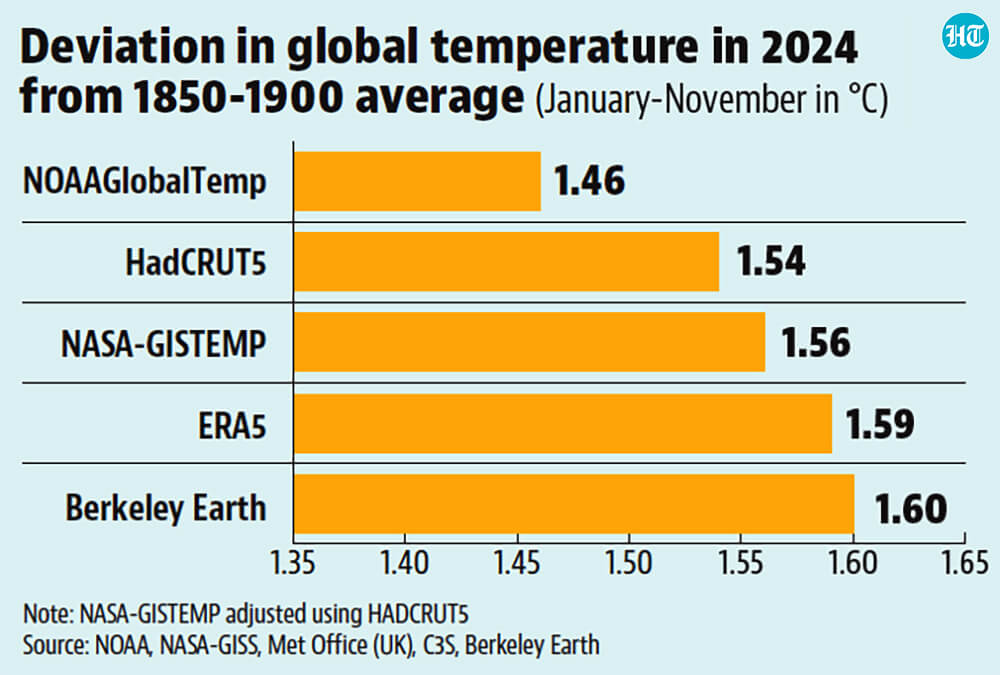
 Four out of five global temperature data sets show higher than 1.5°C warming up to NovemberThe 2015 Paris Agreement set itself the goal of limiting long-term global warming (the current trend of changing climate) compared to pre-industrial average to under 1.5°C because this level of warming is expected to lead to some irreversible, abrupt, and catastrophically adverse changes. Of five prominent global temperature datasets analysed by HT, the average deviation from the pre-industrial average in the year so far is more than 1.5°C in all but the data produced by the National Oceanic and Atmospheric Administration (NOAA), which generally shows a lower level of warming compared to other datasets.
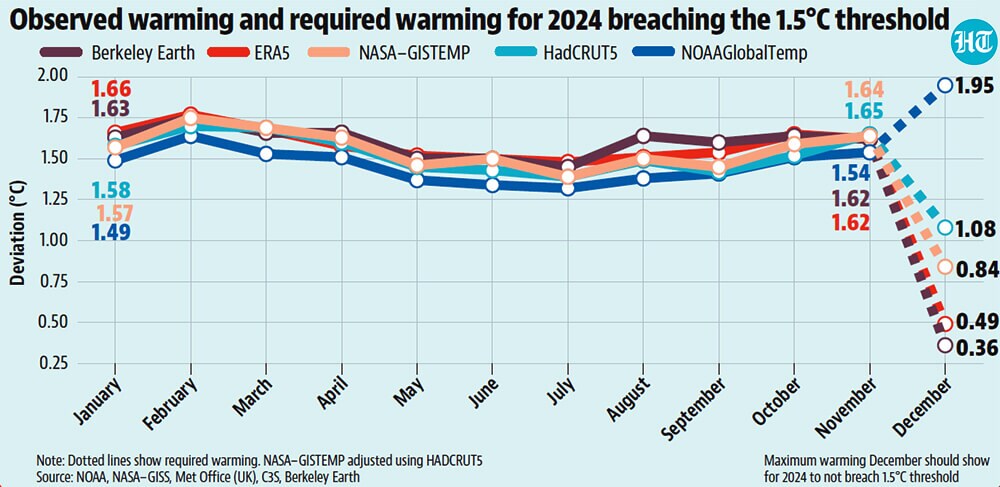
- And December will have to be abnormally less warm for annual average to not cross the 1.5°C warming thresholdThis is borne out by a simple calculation. For 2024’s overall warming level to climb below 1.5°C from an average of more than 1.5°C up to November in the four datasets, December temperatures will have to show a warming between 0.36°C and 1.08°C. Three of these four datasets have not seen this low level of warming since at least 2014, and the trends this year make it is next to impossible that this will happen in 2024. To be sure, one of these three datasets (that produced by Berkeley Earth, US-based non-profit), which shows generally higher levels of warming, had crossed the 1.5°C threshold also in 2023.
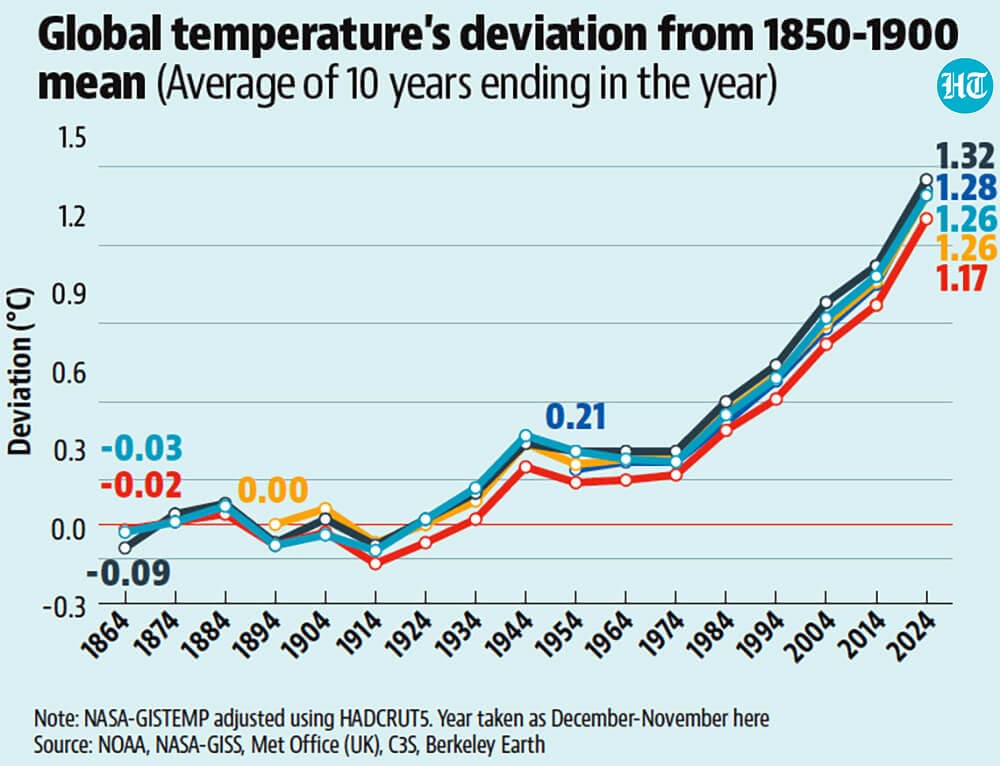
- The decade ending 2024 is the biggest leap towards long-term breach in all datasetsTo be sure, the Paris Agreement goal is for the long term, and not for one-year changes in Earth’s temperature. Since there is no universally accepted definition of what long term is, HT has looked at 10-year averages. This shows that the decade ending 2024 (a year was taken as running from December to November, because that is the latest data available for 2024) warmed by at least 0.30°C compared to the decade ending 2014, the fastest decade-on-decade warming in all datasets. Going forward, even a slower pace of long-term warming will be enough to breach the 1.5°C threshold in the decade ending 2034. Except NOAA’s dataset, all datasets are just 0.18-24°C away from the 10-year average breaching that goal.
- Only greenhouse gas emissions explain why even 2025 might breach 1.5°COne reason why 2023 came close to breaching the 1.5°C threshold and 2024 has done so is cyclical. On a monthly timescale, El Nino – a periodic warming of the equatorial Pacific Ocean – conditions took hold in June last year and lasted up to April this year. Expectedly, all months from June 2023 to April 2024 broke the earlier records for those months. However, El Nino cannot be the only reason for these record-breaking temperatures. For example, 2023 and 2024 are the warmest years on Earth despite the El Nino that began in November 2014 and lasted up to April 2016 being a stronger and longer one. Clearly, the planet was the warmest in 2024 more due to the structural reason of greenhouse gas emissions than cyclical factors such as El Nino. Yet another proof of this is that the UK’s Met Office has forecast that 2025 will likely end up among the top three warmest years with 2024 and 2023, although there are no El Nino forecasts up to the August-October season of 2025. There is only one takeaway from all this: Earth is on its way to crossing what scientists have defined as a potentially catastrophic threshold.