The 2024 monsoon season – it officially runs from June to September – appears rainy enough by most accounts. Country-level rain in the season so far has registered a surplus and, even at the disaggregated level, only 23% of India’s total area has a deficit. However, there is one point of concern. The dry areas are mostly those where the monsoon is drying up long-term, where most of India’s rice is produced, and where workers are concentrated in the farming
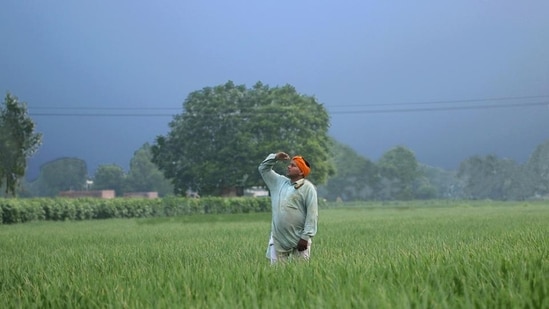
A farmer looks at the sky from his a paddy field in Bathinda, Punjab. (Sanjeev Kumar/ HT File Photo)
Dry monsoon in the Indo-Gangetic plains is a long-term trend
It is a rainy monsoon season at the country level
According to India Meteorological Department’s (IMD) gridded data, India has received 719mm rain from June 1 to August 26. This is the 20th highest rainfall since 1901 and 9.5% more than the 1971-2020 average for this part of the year. IMD currently uses the 1971-2020 average – called the Long Period Average, or LPA – for measuring the rain performance. Clearly this is a rainy monsoon at the country level by any metric. Even daily rain at the national level has not had many days of a big deficit since June. This has helped cumulative rain remain in surplus on every day from July 2.
But large parts of Indo-Gangetic plains are still deficient in rain
At the local or state level, if the departure from LPA is within 20%, rain is classified as “normal”. It is classified as “excess” if there is a surplus of 20% or more and as “deficient” if there is a deficit of 20% or more. As expected from country-level trends, a relatively small part of the country -- 23% of total area – is deficient. However, the deficient area is very concentrated regionally: 41% is located in seven states that account for just 23% of India’s total area, Odisha, West Bengal, Jharkhand, Bihar, Uttar Pradesh, Haryana, and Punjab. More than one-fourth the total area of each of these states is still deficient.
The monsoon season is also drying up long-term in the Indo-Gangetic plains
A dry monsoon in the Indo-Gangetic plains this year is not an isolated event. For example, this is the third consecutive year when the four states of the Gangetic plains (Bihar, Jharkhand, Uttar Pradesh, West Bengal) have a deficit for the June 1-August 26 period. To be sure, this year only Bihar meets the 20% threshold for the deficit to be classified deficient at the state level. However, there is little doubt that monsoon rain is decreasing long-term over the Indo-Gangetic plains. As HT reported on July 1, dry patches (less than light rain for seven consecutive days) have increased during the June-August period in these states. Even cumulative monsoon rain has decreased in these states, as can be seen in the accompanying map. Using more detailed tests, scientists have also found this region to be drying up. “The summer monsoon precipitation (June to September) over India has declined by around 6% from 1951 to 2015, with notable decreases over the Indo-Gangetic Plains and the Western Ghats,” says a 2020 report by the ministry of earth sciences that collated and assessed research on climate change over the Indian region.
This could create economic distress in the future
The long-term decline in monsoon rainfall over the Indo-Gangetic plains has economic implications. The seven states listed above accounted for 59% of the rice output in the kharif (monsoon crop) seasons from 2017-18 to 2021-22, according to data from the ministry of agriculture & farmers welfare. Five of these seven states – all except Haryana and Jharkhand – are the top producers of rice during the kharif season. To be sure, state-level paddy sowing for the past four years does not show a correlation with monsoon rain’s departure from LPA in these states. This could be because of several reasons. For example, if deficient rain did not affect paddy growing regions within those states or if the rain was good during a region’s particular sowing period or if the affected farmers invested in irrigation during the dry patches. If the reason is investment in agriculture, it can hurt farm incomes. This does not bode well for the four states of the Gangetic plains where 48% of the workers are in agriculture compared to the national average of 46%. This is just one of the many aspects which underline the increasing challenge to food security and farm livelihoods from the climate crisis.
Abhishek Jha is Assistant Editor-Data at Hindustan Times. He uses statistical programming to generate newsworthy insights from large datasets. He is part of the team that produces Number Theory, a daily data story feature of the paper’s print edition. Since March 2024, he has been writing Weather Bee, a weekly column for the Hindustan Times website. He is a chemical engineer by training, who specialises in stories related to weather, climate, and the environment. Jha has been at HT since 2018, where he offers data-driven perspective and analysis on politics, environment, weather, climate, economy and society. His work includes data coverage of elections in India and abroad, including the 2019 and 2024 Lok Sabha elections; the disasters and extreme weather resulting from changing climate, such as floods, droughts, heat waves, cold waves, and dwindling snow cap in the Himalayas; the factors that drive poor air quality in northern India; the changing patterns of land use; the Covid-19 pandemic and its impact on labour market conditions; the changing pattern of consumer spending seen in the new consumer spending surveys; and social norms seen in the surveys such as the National Family Health Survey.
Unlock a world of Benefits with HT! From insightful newsletters to real-time news alerts and a personalized news feed – it's all here, just a click away! -Login Now!
Unlock a world of Benefits with HT! From insightful newsletters to real-time news alerts and a personalized news feed – it's all here, just a click away! -Login Now!
Home/Editors Pick/Number Theory: Dry monsoon in the Indo-Gangetic plains is a long-term trend
{{^htLoading}}
Advertisement
{{/htLoading}}
SHARE THIS ARTICLE ON
{{#usCountry}}{{/usCountry}}
Notifications
Get breaking alerts directly from the newsroom
Notifications are on!You'll be notified when news breaks