E-Paper



Number Theory: What explains BJP’s massive victory in Maharashtra?
.
Published on: Nov 28, 2024, 09:46:10 IST

 Prefer HTon Google
Share via


Copy link

The 2024 Maharashtra election results have given the Bhartiya Janata Party (BJP) -led Mahayuti a massive 81.6% seat share in the 288-member assembly. This is the second largest victory ever for any party or pre-poll alliance in Maharashtra. The BJP’s tally of 132 is also its best ever in the state. What explains the BJP’s unprecedented success in these elections? Here are four charts which put the results in perspective for the BJP.
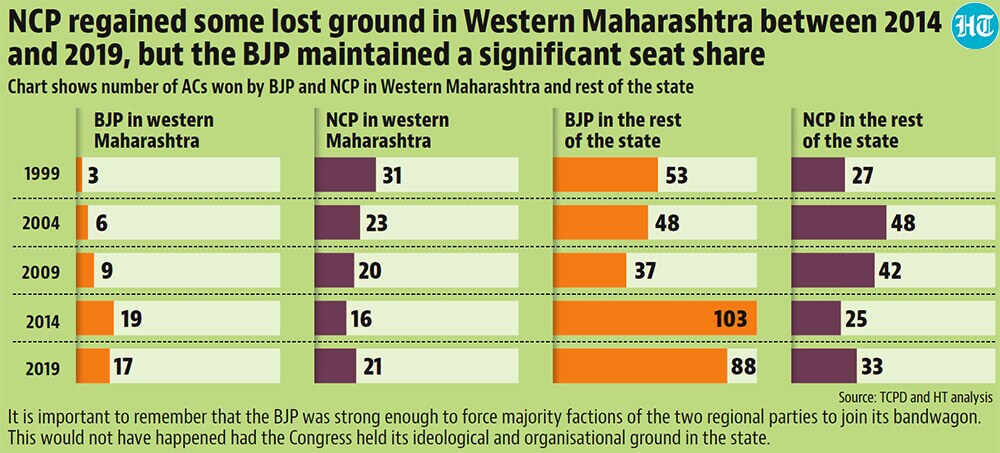
It is important to remember that the BJP was strong enough to force majority factions of the two regional parties to join its bandwagon. This would not have happened had the Congress held its ideological and organisational ground in the state.
What explains the BJP’s massive victory in Maharashtra?
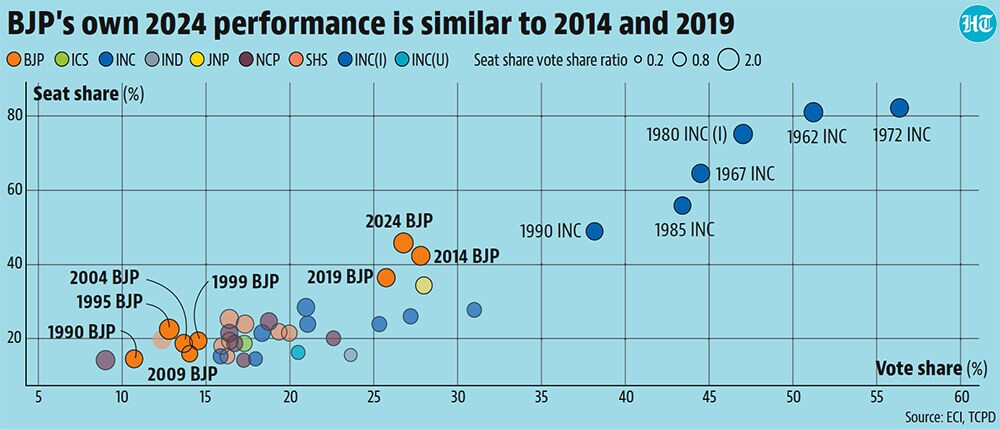
 On face value, there is nothing new about the BJP’s performance in 2024 electionsThere are three critical indicators about a party’s performance in a first-past-the-post (FPTP) electoral contest: vote share, seat share and seat share to vote share ratio. The first measures a party’s popular support and the second its legislative strength. The third shows its ability to convert the first into second and is mostly a reflection of a party’s tactical prowess in a FPTP contest which also includes building effective alliances. The following chart plots all of these three metrics for every party which has managed a seat share of 10% or more in Maharashtra assembly elections since 1962, the earliest period for which we have data in the Trivedi Centre for Political Data (TCPD) database. As the chart shows, the BJP’s 2014, 2019 and 2024 performances are not very different on all these fronts. While the BJP’s seat share is its highest ever in 2024, it still does not have a majority of its own in the assembly, although, given its performance, it may well have crossed the halfway mark had it contested more seats than the XXX it did. Still, the BJP benefited from its alliance partners.
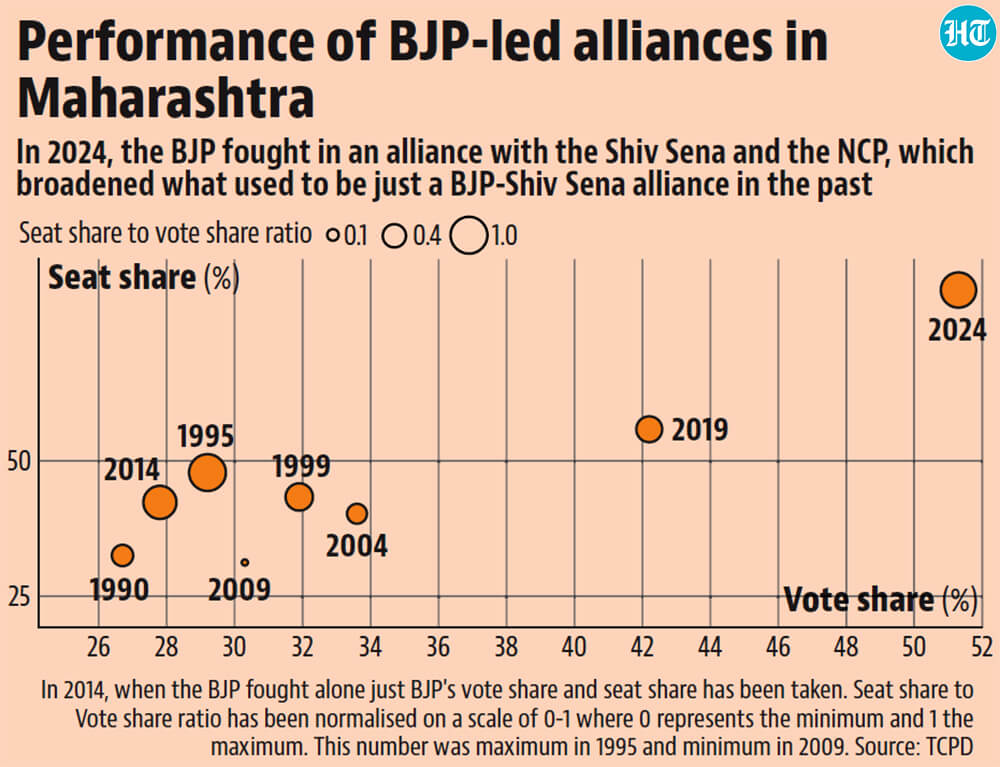
- The NCP going over to the BJP alliance made the difference in 2024The numbers show it clearly. The BJP’s second-best performance in terms of seats was in the 2014 assembly elections when it contested on its own and won 122 assembly constituencies (ACs). It later formed a post-poll alliance with the Shiv Sena which had won 63 ACs, giving the NDA a majority of 185 in the assembly. If one were to add the seats of the BJP and the Shiv Sena in 2024, the number would 189, not very different from 2014. However, what has made the difference to the Mahayuti’s majority is the fact that the Nationalist Congress Party (NCP) also contested as part of the alliance this time and has added another 41 ACs to the alliance’s tally. Simply speaking, the Mahayuti benefitted from an addition of the NCP’s support to its fold rather than some drastic jump in seat share to vote share ratio. If one were to add, NCP’s seats to the BJP and Shiv Sena tally in 2019, it would increase from 161 to 225, only 10 short of what the BJP, Shiv Sena and the NCP have now. These numbers also pretty much clinch the debate on the identity of the real NCP and Sena after splits in the party.
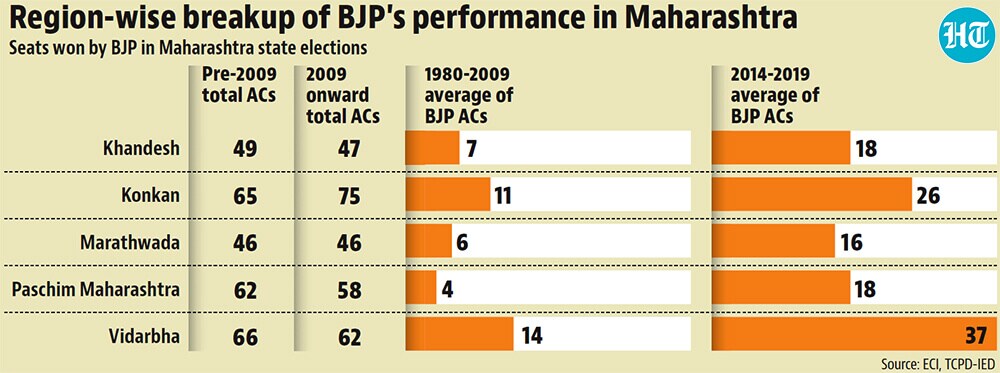
- BJP’s expansion in western Maharashtra from 2014 made the NCP insecureThis is the most important aspect of the Maharashtra political realignment story.The BJP’s political life in Maharashtra can be divided into two parts: 1980-2009 and 2009-2024. In the first, it never crossed the one-third seat share mark in the assembly and in the second, it has crossed the one-third mark in every election, whether or not in an alliance. A comparison of average number of ACs won by the BJP in various sub-regions of Maharashtra in these two periods (1980-2009 and 2014-2019) before this year’s Lok Sabha and assembly elections shows that the BJP has improved its performance in every part of the state. However, the region which saw the highest proportionate increase in the number of BJP seats was Western Maharashtra. Western Maharashtra is the home ground of Sharad Pawar and his extended family which led the NCP until the split.
- And the NCP may have bought peace to protect its bastion and share powerNCP’s seat share in Western Maharashtra has always been higher than its overall seat-share in the state. It has always won the highest seat share in the sub-region except in 2014, when the BJP edged past it. While the NCP became the largest party in the region again in 2019, this was of little use given the BJP’s consistent performance in the state from 2014 onwards which made the formation of a Congress-NCP government impossible. Ajit Pawar’s decision to break away from the old NCP patriarch Sharad Pawar and join hands with the BJP may have been driven by a pragmatic need to protect political salience and share power, even if from a relatively weaker position.