E-Paper



Number Theory: Why Maharashtra’s agrarian politics is complicated and different
An HT analysis of relevant statistics shows that agriculture in Maharashtra is very different from large parts of the country
Updated on: Nov 15, 2024, 10:30:17 IST

 Prefer HTon Google
Share via


Copy link

Maharashtra, in many ways, emerged as the epitome of India’s post-reform agrarian distress with its farmers’ suicides setting a compelling narrative. How much of a role will agriculture play in the Maharashtra elections? Does agriculture really matter in what is one of India’s richest states?
An HT analysis of relevant statistics shows that agriculture in Maharashtra is very different from large parts of the country but it could still play a big role in shaping the electoral outcome.
 Agriculture is a big source of employment in MaharashtraThe share of agriculture and allied activities in Maharashtra’s GSVA was just 10.4% in 2023-24. This is lower than the 14.5% share of this sector at the all-India level. However, Maharashtra’s employment share of agriculture and allied activities (43.2%) is relatively closer to the all-India number of 46.1%. This means that just under half of Maharashtra voters are dependent on farming for their livelihoods. In terms of agriculture’s share of employment among major states in India, Maharashtra is almost in the middle of the pack.
- But agriculture’s importance in the economy shows a great variation across the stateIntuitively, this makes eminent sense. A district-wise break-up of economic output by three broad sectors – agriculture, industry and services – shows that agriculture has a larger share than the state average in 29 out of 35 districts (there is no data for Mumbai Suburban district in the data compiled by Centre for Monitoring Indian Economy, but agriculture’s share in the district is likely to be negligible). In eight districts, agriculture’s share in GSVA is more than 20%. These districts account for 42 out of the 288 assembly constituencies in the state. In another six districts with 100 ACs, the share of agriculture in economic output is less than 10%, which means its political salience could be relatively muted in these districts. Because there are no district-wise estimates of sector-wise employment, this is the best proxy of agriculture’s importance across the state.
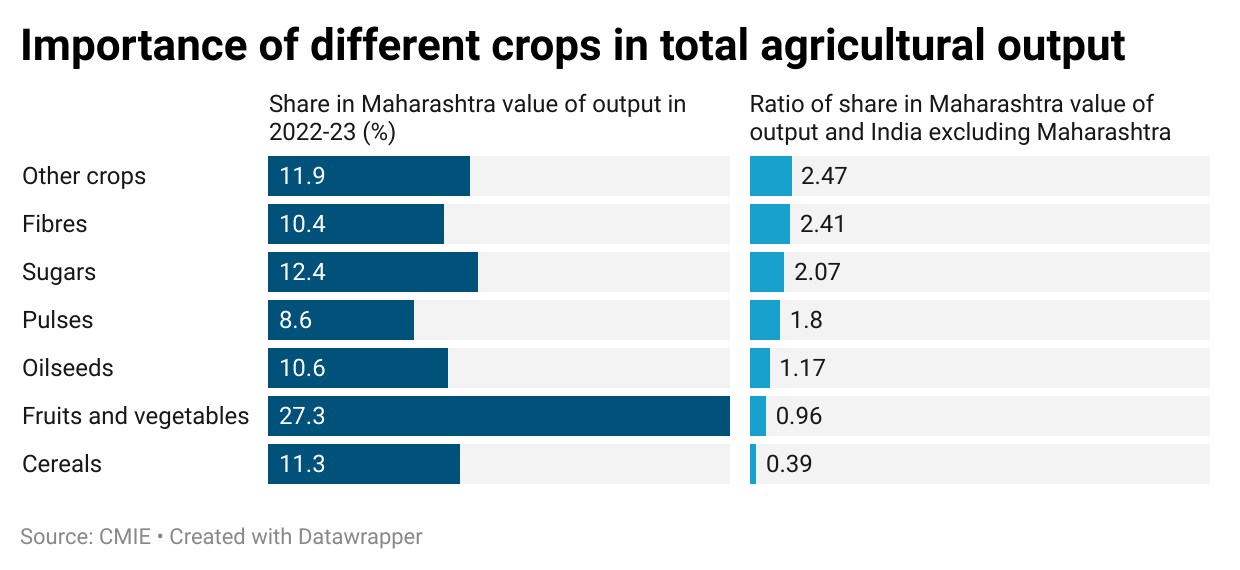
- Maharashtra’s agriculture production basket is very different from most major statesThe most important thing which distinguishes Maharashtra from most major Indian states is the lack of importance of cereals in its agricultural output. According to the Center for Monitoring Indian Economy (CMIE) database, cereals have a share of just about 11% in Maharashtra’s value of output in 2022-23, the latest period for which data is available. This number was 29% for India once Maharashtra is excluded. If one were to look at Maharashtra’s share in the amount of grain procured by the government, it is a negligible 2.2% for rice and zero for wheat. While Maharashtra and India are almost at par in the share of fruits and vegetables in value of output, it is significantly ahead in share of value of output of other crops such as fibres, oilseeds and pulses. To be sure, there are other important details beyond this broad classification of crops. For example, Maharashtra is the largest producer of onions in the country and among the biggest producers of cotton. Maharashtra’s dominance in commodities like onions also means that farm incomes suffer significantly become of government’s aggressive supply side interventions in open markets. It is worth noting that the government has not taken any such step despite retail inflation for onions being above 20% for the last 15 months. Prices and associated farm incomes for other crops such as cotton or soybean, to be sure, could depend more on global market conditions than domestic concerns such as inflation. For example, the government has been procuring soybean and has also put an import duty on edible oil imports given the crop’s political importance in states such as Maharashtra and Madhya Pradesh.
- And even within the state there is a great variation in agricultural outputFor example, the production of pulses and oilseeds is concentrated in the Latur and Amravati divisions. They produce around 60% of the state’s output (in quantity terms) of both pulses and oilseeds. However, these two regions account for just around 10% of the state’s cereal output. Similarly, Nasik, Pune, and Nagpur divisions produce around 60% of the state’s cereal output, but have just a 26% and 17% share in the output of pulses and oilseeds. Aurangabad division is more diversified in this respect while Konkan is not. The former has a 12%-13% share in cereals, pulses and oilseeds each, while the latter has an 8% share in Maharashtra’s cereal output, but less than 1% share in both pulses and oilseeds. These regional variations mean that farmer sentiment in the state could show a regional variation depending on which crop has done better on the production-price balance and which has not.