India is obsessed with its demographic dividend, which it often touts as its biggest future asset. How exactly we are doing justice, or rather injustice, to this dividend became clear once again last week when a young student at IIT-Bombay, perhaps the most pre-eminent engineering institute in this country, died by suicide. The circumstances of his death remain unclear. The institute has backtracked from its premature statement that he was caught cheating in an exam -- it says only an investigation can establish this -- and the student’s parents are alleging caste discrimination. The student was a Dalit.
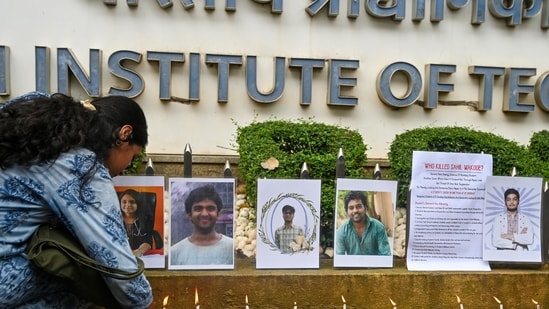
The public debate, barring a few exceptions, is now polarised. One side blames reservations, which allegedly bring students lacking so-called merit to cope with the pedagogical demands in institutes such as the IITs. The other side blames caste discrimination and outright institutional apathy or tacit endorsement of such acts for the tragedy.
The truth might never reveal itself. In yet another case at IIT-Bombay, another Dalit student had killed himself in 2023, and similar narratives were peddled from both sides.
There is, however, a larger point here.
Why should a civilised society only remember justice, or lack of it, when a young life is lost? What does it say about our civil and social contract when young students take their lives because they are either unable to cope with pressure while preparing to get into some of India’s best and professionally rewarding educational institutes or even after managing to get into them?
Without prejudice to allegations of caste discrimination in the current case, suicides seem to be a problem that spans the caste divide among IIT students, as was shown in a story by my colleague Sanjay Maurya. Official data on suicides in India shows that the share of students in total deaths by suicide has actually been increasing in the last two decades. The problem, which seems to elude many self-declared champions of merit and social justice warriors, is much larger than what they think it is.
{{/usCountry}}Without prejudice to allegations of caste discrimination in the current case, suicides seem to be a problem that spans the caste divide among IIT students, as was shown in a story by my colleague Sanjay Maurya. Official data on suicides in India shows that the share of students in total deaths by suicide has actually been increasing in the last two decades. The problem, which seems to elude many self-declared champions of merit and social justice warriors, is much larger than what they think it is.
{{/usCountry}}It is rooted in the asymmetry between democracy’s ability to deliver collective and individual justice. A bit of history is useful to build on this argument.
Indian society’s historical roots are entrenched in social inequality thanks to the caste system. It subjugated a large majority of this country’s population and barred it from accessing means of upward mobility including education. These barriers were gradually challenged with the advent of democratic representation even before independence . The dominant tendency, within the ranks of the socially discriminated, represented by B R Ambedkar, was to ask for rights along with segregation – in the form of separate electorate – rather than assimilation, and use it to argue for greater social and economic equality, which in Ambedkar’s cherished vision would have led to the annihilation of caste.
This was challenged by Gandhiji, who used his individual morality as the engine of destruction of caste discrimination, or rather its most grotesque form, untouchability. What followed was a pact between Ambedkar and Gandhi, which paved way for reservations for Dalits in the legislative rather than carving out a separate electorate for them. When India became independent and wrote its own constitution, where Ambedkar played a big role, it internalised the spirit of the Poona Pact between the two and rolled out reservations in both legislatures and government jobs.
Equality of representation in letter, however, did not translate into an equality of opportunity in the country in spirit. For many people who do not even register the role caste has played in bestowing privilege on them, personal histories of first-generation Dalit learners should be made compulsory reading. I am sure there are many such accounts in almost every Indian language. For the Hindi-speaking reader I would suggest reading Professor Tulsi Ram’s two-volume autobiography Murdahiya and Manikarnika to understand what it took for a poor Dalit boy from a village in eastern Uttar Pradesh to land up as a professor in Jawaharlal Nehru University.
The 2020s are not the 1950s for sure. Caste discrimination, while it still exists, has been contained to a large extent. The advantages of affirmative action are now available to a much larger cohort than just Scheduled Castes and Tribes, which is what the original constitutional contract provided for. Decades of reservations have made the organs of the state, both elected and non-elected, more socially representative, if not entirely equal, than they were when the country became independent. Almost every realistic assessment agrees that India cannot roll back its social justice contract without triggering a democratic upheaval.
Of course, all these advances do not mean that discrimination does not happen. In some cases, it is explicit, deliberate aggression. In many more, it acts as a pushing-against-the-wall strategy in the name of punishing so-called lack of merit. Tragedies such as the recent one in IIT-Bombay perhaps lie between these two realms. They might appear to the perpetrator as a safeguarding of merit against a person who is unable to meet the bar because of his or her endowment deficit in what passes off for accepted pedagogical abilities being considered merit. To the victim, every such assertion, often coupled with a reminder of the affirmative action favour, might come across as caste discrimination and humiliation for availing what is a constitutionally guaranteed right.
To pose this binary is not to indulge in equivocation. It is to underline a problem which electoral politics cannot solve. It has ensured equality of representation via reservations which can be provided with a de jure diktat. However, institutional empathy, which alone can ensure individual justice, cannot be ensured by a law on the books. Mainstream political actors are constrained in their ability to square the circle of representation into justice because of this asymmetry.
To be sure, they have also made various compromises in order to buttress their political fortunes. This often makes strange bedfellows in rabidly casteist and reactionary elements and those who claim to be fighting against caste discrimination. There are many such examples in Indian politics. An excellent analysis of India’s Dalit parties in the book Mobilizing the Marginalized: Ethnic Parties without Ethnic Movements by political scientist Amit Ahuja shows that even Dalit parties which invested in things such as social reform and progressive politics did worse than their more Machiavellian peers in the electoral game.
It is on this count that the pursuit of justice needs to be rescued from its existing vanguards. Justice in today’s India does not elude only those who have suffered the accident of birth in a certain caste. The growing aspirations of our younger population, our structural incapability to provide opportunities and our institutional failure to protect even those who manage to get through some of the toughest rejection processes in the world to land at institutes such as IITs, calls for a movement which pursues justice as a more universal project than just caste. To say this is not to make the latter insignificant, but to widen and strengthen solidarities and hold the system to account rather than allow it to use zero-sum alibis such as caste versus merit to evade responsibility. In many ways, this was also the spirit of the large student protests which happened recently.
Rabble rousing is not going to solve the problem. Institutional investment and empathy are what we need. A movement for this cause does not have to end up personally vilifying those running institutions. What it really needs to do is to question priorities and resource allocations along with challenging biases. India’s economic weight today is significantly larger than what it was in the past. State capacity, too, has increased, at least, in transactional terms. Our ability to build institutions, which are democratic, can show empathy to those who need it, and seek excellence without holding a grudge against the country’s democratic contract, has significantly deteriorated, unfortunately. Every young life lost is a damning indictment of this failure. Shame, not shrill debates, is what we need to even come close to solving this problem.