E-Paper



53 student deaths at IITs in 5 yrs, over 50% from SC, ST, OBC groups: Data
The figures – which include 45 suicides – are in line with student intake from these marginalised groups in the government-owned institutions.

 Prefer HTon Google


At least 53 students died across the Indian Institutes of Technology (IITs) between 2020-21 and 2024-25, with more than half of these deaths involving students from Scheduled Castes (SC), Scheduled Tribes (ST) and Other Backward Classes (OBC), according to official data accessed by HT.
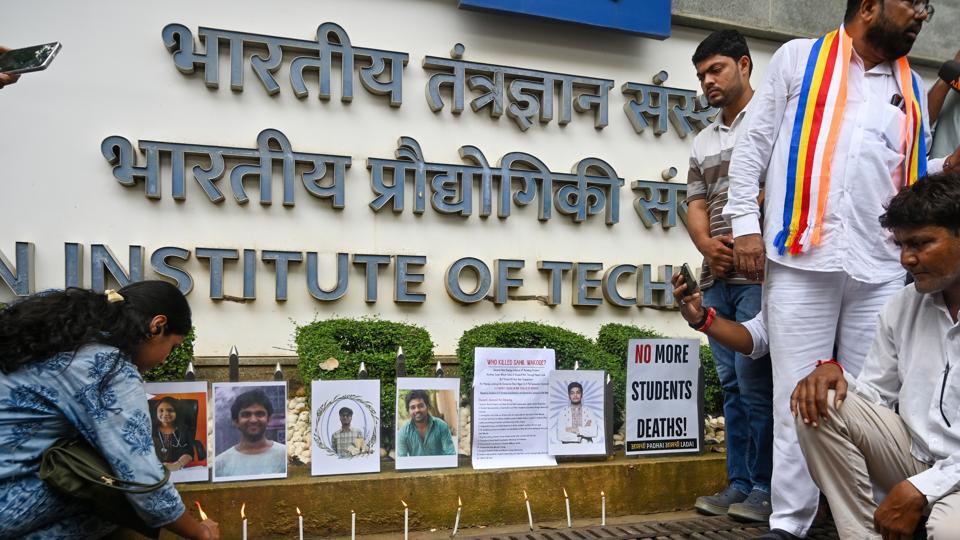
The figures – which include 45 suicides and eight unnatural deaths – are in line with student intake from these marginalised groups in the government-owned institutions.
Also read: Why is IIT Bombay on boil? A suicide, protests, a professor in focus, divided faculty
According to correspondence seen by HT, Nilesh Chandra Srivastava, under secretary in the department of higher education (DoHE), wrote to IITs on December 1, 2025 seeking information in response to a provisionally admitted Lok Sabha Starred Question (Diary No. 3682) scheduled for December 8, 2025. Although the ministry received the responses from IITs, the data was not tabled in Parliament. Congress MP KC Venugopal had asked the questions on December 8 last year related to student suicides in IITs and other central educational institutions.
Deep Dive

Also read: After suicide case, IIT Bombay students seek welfare reforms, focus on mental health
To be sure, the title of KC Venugopal’s unstarred question on the Lok Sabha website was “Enrolment in Post-Graduate and Ph.D. Programmes”. The question contained five parts. The first two sought data on enrolment in postgraduate and doctoral programmes and whether there was a decline in enrolment and completion rates among SC, ST and OBC students. However, the remaining three parts sought information on complaints of caste-based discrimination, suicides and unnatural deaths of students, and the implementation status of the UGC (Promotion of Equity) Regulations, 2012. Unlike parts (a) and (b), these questions did not specifically restrict the information sought to postgraduate and Ph.D. students.
The figures, based on the IITs’ own submissions to the ministry, reveal a sustained increase in student deaths across the country’s premier engineering institutions.
According to the data, IITs reported five student deaths in 2020-21, six each in 2021-22 and 2022-23, followed by 17 in 2023-24 and 19 in 2024-25. Suicides accounted for 84.9% of all deaths. The number of unnatural deaths also rose in the latest year, with six of the 19 deaths reported in 2024-25 falling in that category.
General category students accounted for 23 deaths (43.4%), followed by OBC students with 12 (22.6%), SC students with 10 (18.9%), ST students with seven (13.2%) and EWS students with one (1.9%). Taken together, SC, ST and OBC students accounted for 29 deaths, or 54.7% of the total.
The nature of deaths also varied across categories. Seven of the 23 general category deaths were classified as unnatural. All 12 OBC deaths, all seven ST deaths and the lone Economically Weaker Section (EWS) death were reported as suicides. Nine of the 10 SC deaths were suicides.
General category deaths climbed from zero in 2020-21 to four in 2021-22, three in 2022-23, seven in 2023-24 and nine in 2024-25. Deaths among OBC, SC and ST students also rose from 2023-24 onwards: their combined total stood at five in 2020-21, two in 2021-22 and three in 2022-23, before jumping to nine in 2023-24 and 10 in 2024-25.
Also Read | After the IIT Bombay death, student suicides in focus: The response so far, and the questions ahead
IIT Kharagpur, IIT Delhi and IIT Hyderabad reported the highest number of deaths, with seven each during the five-year period. IIT Kanpur and IIT (BHU) Varanasi recorded six each, while IIT Madras reported five. On suicides alone, IIT Hyderabad recorded the highest number with seven, followed by IIT Kharagpur, IIT Delhi and IIT Kanpur with six each. IIT (BHU) Varanasi and IIT Patna reported the highest number of unnatural deaths, with two each.
Thirteen of the 23 general category deaths were reported from IIT Kharagpur, IIT (BHU) Varanasi and IIT Delhi. Seven of the 12 OBC deaths occurred at IIT Roorkee, IIT Delhi and IIT Madras. Six of the 10 SC deaths were reported from IIT Hyderabad and IIT Delhi.
Earlier, the Union education ministry in July 2023 informed Parliament that 39 students died by suicide in the five years between 2018 and 2023 across IITs. According to an independent assessment, the number of deaths could be higher.
Academics and faculty members attribute the rise in student suicides at IITs to a combination of academic pressure, social isolation, inadequate faculty-student engagement and structural issues related to inclusion, arguing that campuses need stronger preventive support systems rather than a sole reliance on counselling.
Prof. V. Ramgopal Rao, vice chancellor of BITS Pilani and former IIT Delhi director, said the issue goes beyond availability of counsellors.
“Students today come from far more diverse backgrounds and face academic pressure, relative grading, isolation, limited faculty interaction and job-related anxiety. IITs need to move from crisis management to prevention, with wellbeing integrated into campus life and stronger faculty-student engagement,” Prof Rao said.
According to official data, IITs had 108 counsellors across 23 campuses as of December 1, 2025.