E-Paper



Number Theory | The last of the Mohicans: Breed of Test OGs depletes
Ashwin’s is not just a departure of an OG from the Indian dressing room. His is also a knock for OGs across Test cricket

 Prefer HTon Google


In his retirement announcement earlier this week, decorated Indian spinner R Ashwin made a reference to him and captain Rohit Sharma sitting alongside being the “last bunch of OGs, if we can say that, left out in the dressing room”. That slang has its origins in American gangster culture as “original gansta”, but has found a life in pop culture as someone who has been around a while. Ashwin had been there and done that. With 537 Test wickets, he finishes his 13-year career as a test cricketer ranked No 7 by wickets.
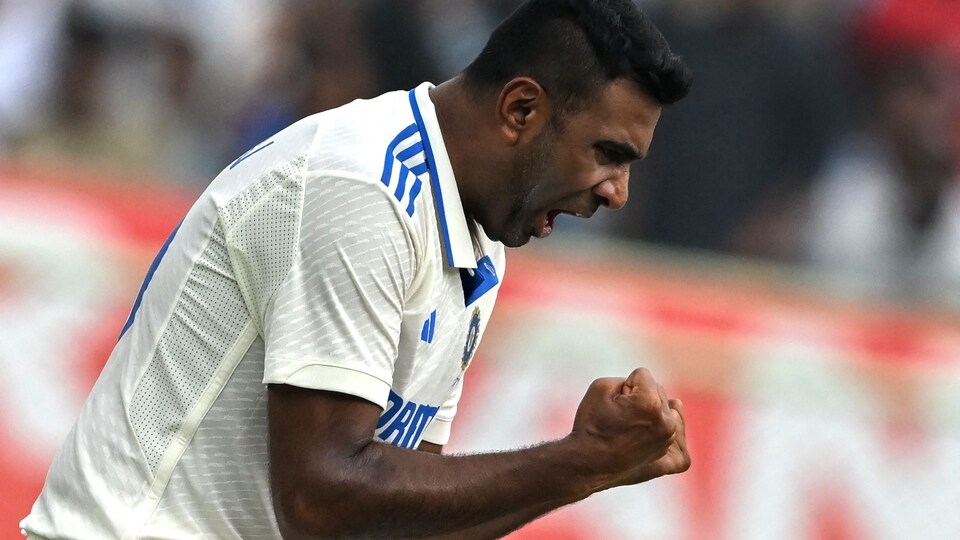
Ashwin’s is not just a departure of an OG from the Indian dressing room. His is also a knock for OGs across Test cricket — the ones who play for a long stretch, continuously and prolifically, and are in the conversation to end up at the top of batting and bowling lists. Those OGs are a diminishing breed, partly the result of test cricket itself being in the throes of change. While Joe Root, another of the remaining OGs, has a serious shot at the most test runs record of Sachin Tendulkar, there’s not much visible beyond him.
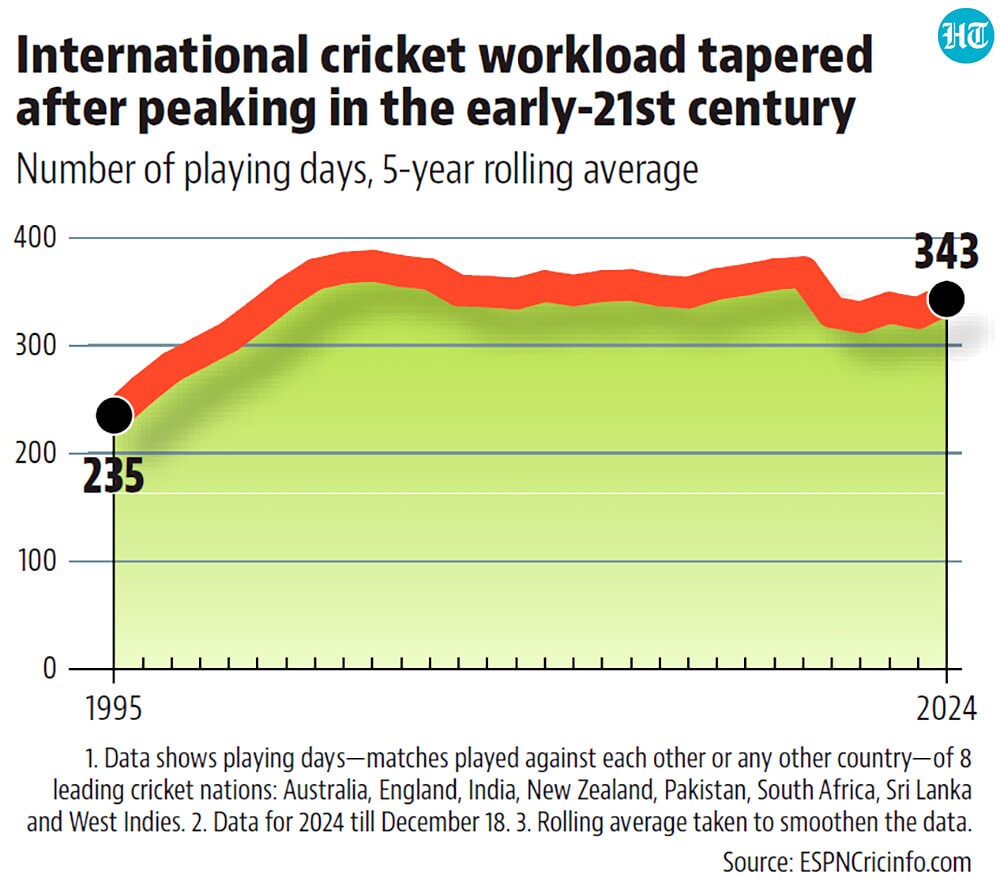
 Country and clubPlayers are playing more cricket than ever, but not international cricket. We looked at the number of days of international cricket, across all three formats, played by the eight leading cricket nations: in alphabetical order, Australia, England, India, New Zealand, Pakistan, South Africa, Sri Lanka and West Indies. This means matches played against each other or any other country. Further, we assigned five days for a Test match, and one day apiece for and one-day internationals (ODIs) and T20 cricket. Data since 1991, when South Africa was re-admitted to world cricket after a ban for practicing racial discrimination, shows the average workload of cricketers from these countries as a set steadily increased in the 1990s. It peaked in the early years of this century. As T20 club cricket set in, it declined marginally, and has stayed there largely, other than the Covid-induced drop for 2020 to 2024.
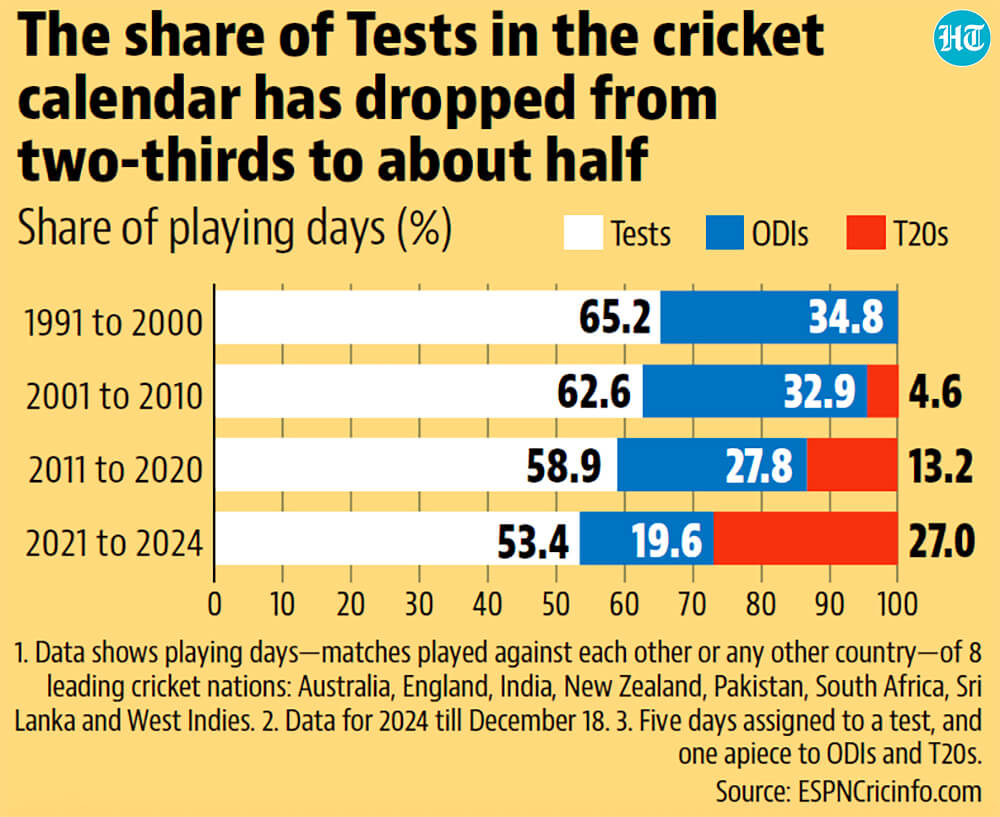
- T20s over TestsWhile the amount of international cricket played by this set of countries has not expanded, how those days are distributed across the three formats has changed. T20 is on the rise, and space for it is being created by ODIs in greater measure and tests in a smaller measure. In the 1990s and even the first decade of the 21st century, Tests accounted for nearly two-thirds of playing days. In this decade, this is down to roughly half. Given that the total number of international playing days is not increasing, it means fewer tests. T20s now account for more than a quarter of playing days of this leading set of cricketing nations. And ODIs is the format that is making way the most, followed by Tests.
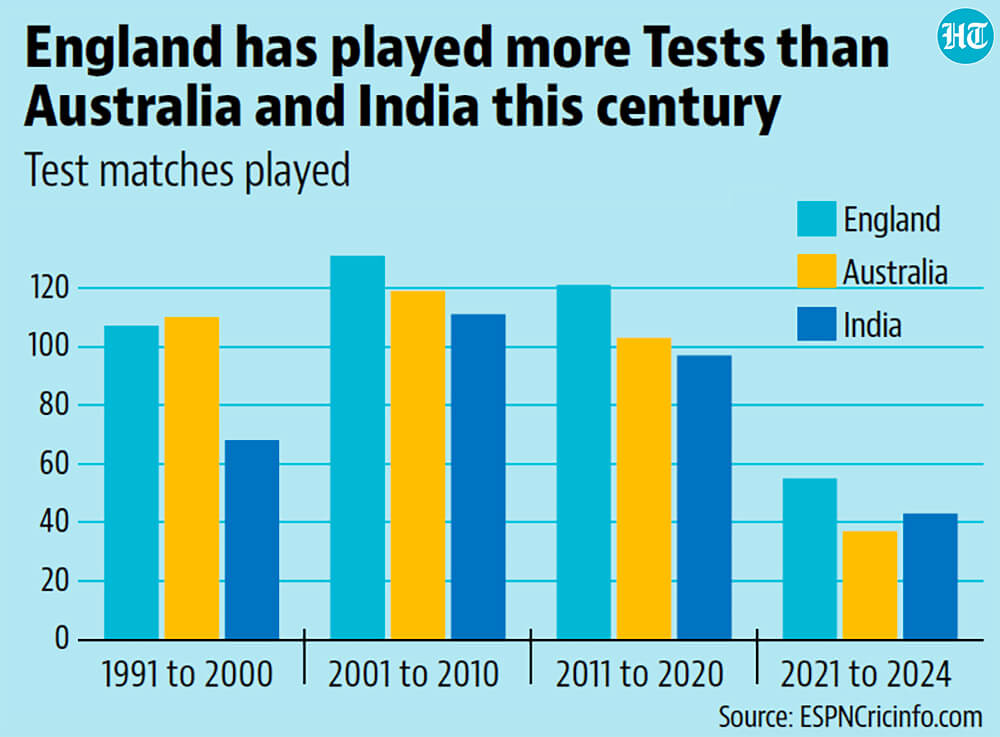
- Rooted in TestsAcross countries, this choice to create more space for T20s partly at the expense of test cricket is relative. This century, for example, England have consistently played far more Tests than both Australia and India — on average, 2-3 Tests more than India each year. England’s inclination towards more tests is one reason why Alastair Cook was the last batsman to be in serious reckoning to leapfrog Sachin Tendulkar as the leading run-getter of all time in Test cricket. It’s also part of the reason why Root has separated himself from the current pack of four leading batsmen — the other three being Virat Kohli, Kane Williamson and Steve Smith — and could even overhaul Tendulkar’s record. While the other three played their first Test in 2010 or 2011, Root debuted in 2012. Yet, Root has played 152 Tests, while the other three are at 105-121 Tests.
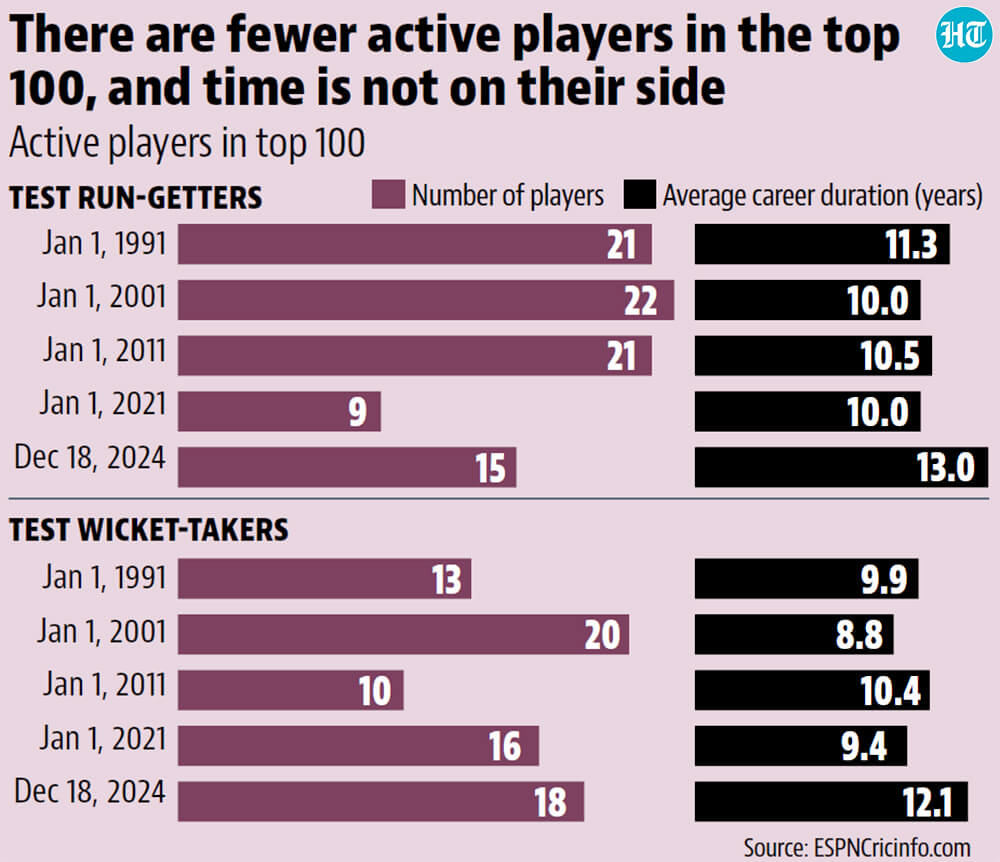
- Fewer ContendersThese four batsmen defined an era. Chances are, they are all in the back end of their international careers. But where’s the next lot that could challenge Tendulkar’s 15,921 runs or Muttiah Muralitharan haul of 800 wickets? That next lot is what is diminishing. During this period from 1991, while records were consistently being topped, there was always a decent pool of players on their heels. Chart 4 shows the breakup of the top 100 run-getters and wicket-takers in tests at four points in time. A noteworthy pipeline is a combination of a high count of players and low average career duration (implying they have a good number of years remaining). The current lot of active players are fewer in count and have logged in the maximum time. They are also, barring Root, far from the summit. Chances are, going forward, this will only get amplified.