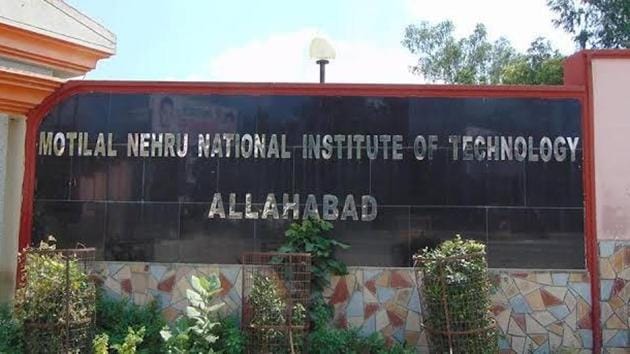
Motilal Nehru National Institute of Technology has increased its BTech and MTech seats by 14%. The increase will come in to effect from 2020-21 academic session, informed institute officials.
Motilal Nehru National Institute of Technology, Allahabad. (facebook/MNNIT Allahabad Master’s Community)
The step, introduced in light of central government’s decision to implement 10% reservation for students belonging to economically weaker section (EWS) of society, means that the 2020-21 session would witness MNNIT taking admission of 1018 students in its BTech courses instead of this year (2019-20) intake of 901 students and 595 students in its MTech courses as against 528 students in 2019-20, said Ashutosh Upadhyay, faculty in-charge (admissions).
{{^htLoading}} {{/htLoading}}
He said the proposal would be put before MNNIT’s Senate— the apex decision-making body of the institute— for a final go ahead and then the report would be sent to Joint Seat Allocation Authority (JoSAA), set up by Ministry of Human Resources Development (MHRD) to manage and regulate the joint seat allocation for admissions to over 100 institutes, including 23 IITs, 31 NITs, 25 IIITs and many Other-Government Funded Technical Institutes (Other-GFTIs), for 2020-21 session.Officials share that to ensure a 10% reservation, institutes’ need to increase seats by 25% so that the balance between different categories as per norms does not get disturbed.
For this, MNNIT had increased BTech seats by 11% in 2019-20 session. This is the reason why this year 901 students were admitted in BTech instead of the base admission figure of 814. Similarly at the MTech level also, against base admission capacity of 475, this session had witnessed admission of 528 students, officials said. Candidates get admission in NITs, including MNNIT-Prayagraj, through JEE (Mains) and the next edition of the (JEE) is set to be held between January 6 and 11, 2020.
K. Sandeep Kumar is Senior Assistant Editor and Bureau Head of Hindustan Times in Prayagraj, where he leads the newspaper's editorial coverage across the region. With more than 25 years of experience in journalism, he has built a reputation for credible, in-depth and impact-driven reporting on Uttar Pradesh's governance, politics, education, agriculture, science and technology, defence, infrastructure and development. Over the course of his career, Sandeep has consistently broken and tracked stories that have shaped public discourse, with a particular focus on policy, public institutions and issues that directly affect people's lives. His reporting combines rigorous fieldwork with data-backed analysis, making complex subjects accessible to a wide readership. He has also written extensively on human-interest stories that spotlight resilience, innovation and social change across urban and rural Uttar Pradesh. As Prayagraj Bureau Head, he mentors reporters, drives editorial planning and ensures comprehensive coverage of one of India's most politically and culturally significant regions. His work is marked by accuracy, balance and context, reflecting a commitment to public-interest journalism and high editorial standards. Through his reporting, Sandeep continues to chronicle the evolving social, economic and political landscape of Uttar Pradesh while delivering insightful and reliable journalism for Hindustan Times readers.
Stay informed with the latest updates on Education News also check NEET PG Result 2026 and Find tips to help you succeed in your academic journey and career planning on Hindustan Times.
Stay informed with the latest updates on Education News also check NEET PG Result 2026 and Find tips to help you succeed in your academic journey and career planning on Hindustan Times.