
Sign in

Close contest between Congress, BJP as early trends emerge in Himachal

According to the trends, ruling Bharatiya Janata Party was leading on 33, Congress 32, and independents on three seats

Published on: Dec 8, 2022, 10:18:27 IST
Share
Share via
  • facebook
  • twitter
  • linkedin
  • whatsapp
Copy link
  • copy link

Early trends in the counting of votes in Himachal Pradesh showed a close contest between the Congress and the ruling Bharatiya Janata Party (BJP) with the difference between leading candidates on many seats under 1,000 votes, meaning the results could swing either way.
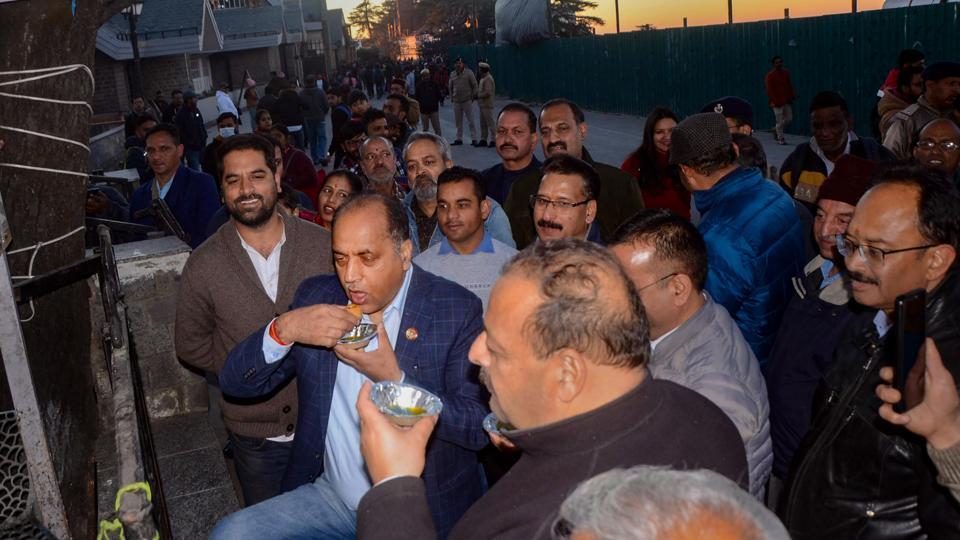
Himachal Pradesh chief minister Jairam Thakur in Shimla head of the election results. (PTI)

According to the trends, the BJP was leading on 33, Congress on 32, and independents on three seats. In Kangra district, which sends 15 lawmakers to the 68-member Himachal assembly, the Congress was leading on eight, the BJP on six and an independent in one constituency.

In chief minister Jairam Thakur’s Mandi district, it was neck and neck. The Congress and BJP were ahead on five seats each. The BJP was leading on three seats and Congress on two in Hamirpur, the home district of former chief minister Prem Kumar Dhumal and his son and Union minister Anurag Thakur. The Congress was leading on six seats, the BJP and an independent one each in Shimla.

Anticipating a close contest, the Congress was likely to shift its lawmakers to Chandigarh and then to Raipur if it is in the position to form the government. “We have told MLAs [members of legislative assembly] to be in touch with Haryana Congress leader Bhupinder Singh Hooda and he would be handling the arrangements,” said a Himachal Congress leader, requesting anonymity.

The plight of apple growers and the promise of the restoration of the old pension scheme were Congress’s two major poll issues. The BJP focussed on development works.

Apple production in Shimla, Kullu, Kinnaur, and parts of Mandi districts contribute 13.5% to the state gross domestic product with an annual turnover of over 6,000 crore. While it has grown by two to three percent per year in the past decades, the profitability has dipped due to rising input costs and falling market rates. Apple growers have influence in 17 of the 68 assembly seats.

Himachal has the highest percentage (3.5%) of the population in government services for any state and is considered a backbone of large sections of people in absence of significant industries and other job opportunities.

Government servants and apple growers are considered narrative setters in Himachal Pradesh elections as they are economically more influential and have the capability to swing polls. With a rising population and government hiring on a downward slide, experts said their influence is not as huge as it used to be.

In March, police used batons and water canons to disperse about 30,000 protesting government employees assembled at the state assembly in Shimla. Thereafter, the employees organised protests at all districts and blocks until October 14 when the November 12 polls were announced.

In August, the apple growers held a protest at the secretariat in Shimla demanding higher support prices and the reduction of the Goods and Services Tax on cartons and other supplementary goods.

  • Chetan Chauhan
    ABOUT THE AUTHOR
    Chetan Chauhan

    Chetan Chauhan is the National Affairs Editor looking into all aspects of news and features from across India. A Chevening scholar with over three decades of experience in reporting and news management, Chetan has extensively covered all important aspects of the social sector, political economy, environment and climate change nationally and internationally. He did a journalism course at the Reuters Institute of Journalism in Oxford and Digital Media training at Nanyang Technological University in Singapore. He started as a reporter with The Statesman in 1996 and joined the Hindustan Times in 2000 in the metro bureau covering environment, crime and Delhi politics. He covered hot local news, from the Jessica Lal murder case to the rebellion of Delhi Congress MLAs against then Chief Minister Sheila Dikshit, to the replacement of toxic vehicle fuel with cleaner compressed natural gas (CNG) in the national capital. Some of his stories on air pollution became part of the Supreme Court’s landmark MC Mehta versus Government of India case in the National Capital Region (NCR), forcing the government to take corrective measures. As part of the national political bureau since 2004, he covered important central sectors such as environment, education, social justice, labour, rural development, water resources, renewable energy, agriculture, broadcasting and the Planning Commission for more than a decade producing several exclusive and investigative breaking stories. His specialisation is the environment, having covered at least a dozen United Nations global conferences on climate change, biodiversity and wildlife including climate summits in Paris, Copenhagen and Bali. He also covered India’s two five-year plans ---11th and 12th and reported on drafting and execution of right based laws such as Right to Education, Right to Information and rural job guarantee law, MG-NREGA, now being introduced in new format as VG-RAM-G Act. He has in-depth knowledge of social sector issues. He was one of the first to report on tigers vanishing from Sariska and Panna wildlife reserves in 2004 and 2008, respectively, leading to the setting up of the National Tiger Conservation Authority (NTCA) and the introduction of stringent penal provisions for poaching. He has written extensively on the rising human-animal conflict in India and the degradation of India’s biodiversity hotspots because of mining and other activities. Since 2004, Chetan has covered Parliament comprehensively and participated in training on the nuanced coverage of Parliament proceedings. He has travelled extensively across India to cover national and provincial elections since 1998, especially in the Hindi heartland states, considered India’s road to power. He writes a regular column for Hindustan Times, Ecostani, on important national politics, economy, Himalayan ecology and environmental issues. His other responsibilities include providing inputs for edits and edit page articles for the publication, apart from managing news flow from across India.Read More