When Tamil Nadu votes to elect a new government on April 6, the elections will be happening in a huge void. Both M Karunanidhi and J Jayalalithaa, who shared the chief minister’s post between them for 32 out of the last 52 years, are dead now. If we include the term of M G Ramachandran, whose political legacy Jayalalithaa inherited, the chief minister’s post was held between the three people for 42 of the last 52 years.
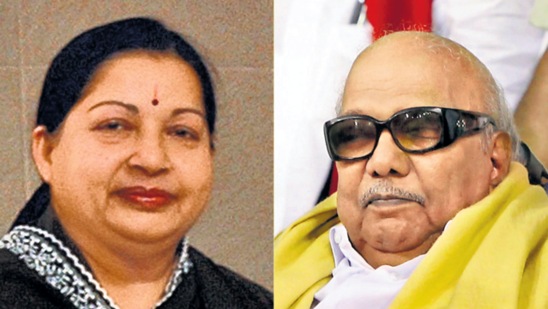
Karunanidhi’s Dravida Munnetra Kazhagam (DMK) is now headed by his son M K Stalin. Udayanidhi Stalin, Stalin’s son, is among the DMK candidates in the elections. The DMK was formed out of a split on the question of nepotism. Its founder C N Annadurai parted ways with his mentor E V Ramasamy “Periyar”, who headed the Dravidar Kazhagam, which itself was born of the Justice Party after Periyar decided to marry a young woman, Manimmai and named her as his political successor.
The All India Anna Dravida Munnetra Kazhagam (AIADMK), formed by MGR after he exited the DMK, is, meanwhile, trying to set its own house in order. It is trying to maintain a separate identity of its own without undermining its alliance with India’s current dominant political hegemon, the Bharatiya Janata Party (BJP).
Beyond these obvious changes, the 2021 elections will also be interesting as far as Tamil Nadu’s long-term political landscape is concerned. An HT analysis underlines at least three interesting trends, which have been developing in the state politics.
{{/usCountry}}Beyond these obvious changes, the 2021 elections will also be interesting as far as Tamil Nadu’s long-term political landscape is concerned. An HT analysis underlines at least three interesting trends, which have been developing in the state politics.
{{/usCountry}}Elections have become close contests
The AIADMK created history of sorts by retaining power for the second consecutive term in the 2016 assembly elections. Political power alternated between the DMK and the AIADMK since 1984. However, the 2016 elections were among the most closely contested elections -- especially in terms of median victory margins. A median gives the middle value in a distribution. The median victory margin, in terms of vote share, in the 2016 election in Tamil Nadu was 6.6%, the second lowest in Tamil Nadu since 1971, the earliest period for which data is available in the database maintained by the Trivedi Centre for Political Data (TCPD) at Ashoka University. A long-term look at victory margins also suggests that they have been declining in the post 1990 period.
The two main Dravidian parties had unprecedented support in 2016
While Tamil Nadu’s politics has been dominated by Dravidian parties, first the DMK and then its offshoot AIADMK for decades, they never had more than two-thirds of vote share between them until 2016. This changed in the 2016 elections, when their combined vote share crossed 72%. The Congress was the leading party in the erstwhile state of Madras. It is only in 1967 that the DMK won an election in the state, which was renamed Tamil Nadu later. Since then the Congress has undergone two phases of decline. The first major decline in its vote share came with the AIADMK contesting its first election in the state in 1977, when the Congress was pushed to the third spot. With members of the Congress and the DMK forming their own parties in the 1990s – such as the Tamil Maanila Congress (Moopanar) and the Marumalarchi Dravida Munnetra Kazhagam – the Congress vote share suffered another big decline in vote share. The left parties – Communist Party of India (CPI) and Communist Party of India (Marxist) or CPI (M), which did not see a decline in vote share with AIADMK’s entry in elections, have also seen their vote share reduce after the formation of many regional parties in the state. The BJP, so far, has been a marginal player in the state’s politics. The fate of all parties except the DMK and AIADMK is largely contingent on their alliance of lack of it with the two major parties.
Alliance is a tricky business for both the DMK and the AIADMK
The statistics discussed so far clearly underline the importance of alliances in Tamil Nadu. In a state where median victory margins are around 6% and the two major parties together, even at their peak have never crossed more than three-fourth of the total vote share, alliances matter a lot. However, both the DMK and the AIADMK are extremely cautious and reluctant when it comes to seat sharing. While the DMK has given just 25 assembly constituencies (ACs) to the Congress, its biggest alliance partner in these elections, the AIADMK has offered just 20 ACs to the BJP. A look at past election statistics explains the reluctance on part of the two major parties to offer more ACs to their alliance partners. Both the DMK and the AIADMK perform better against the alliance partners of their opponents than each other. In other words, the probability of a loss is higher in ACs which are given to alliance partners.