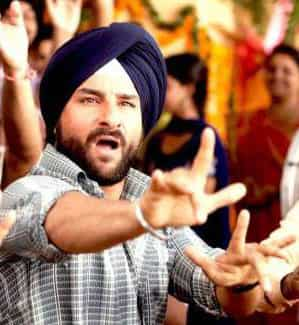
Remember that line from Jab we met? ‘Hum to Punjabi hain, humein to naachne ka bahaana chahiye!’ Truer words have never been spoken. And when Punjabis get to the dance floor, we need to verbally express our happiness.
A: Aahun Aahun
Remember that line from Jab we met? ‘Hum to Punjabi hain, humein to naachne ka bahaana chahiye!’ Truer words have never been spoken. And when Punjabis get to the dance floor, we need to verbally express our happiness. ‘Aaho aaho’ would mean ‘Yes, yes’, but since no one’s stopping us from inventing words, ‘Aahun aahun’ it is! (Happy count: 1)
B: Balle balle
Where there is bhangra, where there is joy, where there’s a party, and even where there’s not, there’s still some ‘balle balle’. The phrase could probably be the Punjabi version of, ‘Oh yeah!’ – an expression of complete and total happiness. (Happy count: 2)
C: Chak de phatte
The phrase literally translates to, ‘Pick up the wood’. But no, Shah Rukh Khan wasn’t asking his hockey players to become woodcutters for India. Because over time, the phrase has come to be slang for, ‘Keep it going/’Go for it’.
D: Dholna
Contrary to speculation, it does not mean, ‘Stop playing the bl**dy dhol’. Dholna is actually the unisexual term for beloved or lover. It does not discriminate between girlfriend and boyfriend and is equally used for either. (Beloved count: 1)
G: Gidda/Gabroo
When the guys do the ‘bhangra’, girls do the ‘gidda’. Gidda is what Punjabi girls break out into (at least the good dancers do!) when you turn up the music. It is a traditional dance form of women. G also stands for Gabroo, which means ‘a young masculine guy’, also known as ‘Dude’ in English.
H: Heeriye/Hadippa
When in love, young Punjabi ‘mundas’ (which means ‘boy’ - not to be confused with mundoo), call their girlfriends ‘Heeriye’ affectionately. It literally means ‘like a diamond’, but is usually meant ‘Heer-like’, from the love story of Heer-Ranjha (find out about that on your own, will you?). (Beloved count: 2) H also stands for Hadippa, and is another expression of joy, like ‘Yahoo’. (Happy count: 3)
I: Ik
Ik could well be the sound of a hiccup, but where Punjabi is considered, Ik is the number ‘one’, or ‘ek’. Used extensively with ‘vaari’, ‘ik vaari’ translates to ‘one time’. For inexplicable reasons, most lyric writers usually want the hero to get everything only one time!
J: Jee/jind
When Akshay Kumar sang ‘Ji karda’ in Singh is Kinng, he wasn’t referring to himself respectfully. ‘Jee’ is derived from ‘Jigar’, and both mean ‘heart’. When lyric writers get bored of using the word ‘dil’, they turn to ‘jee’. J also stands for ‘Jind’, which is a town in Pakistan. But when it comes to Bollywood songs, Jind means ‘life’, and is a derivative of ‘Zindagi’.
K: Kudi
K is for ‘Kudi’, or girl, but ‘M’ is not for ‘Munda’, or boy, because no one really writes about the ‘Munda’. Most Punjabi songs are about/in praise of/in want of a ‘kudi’, like most songs all over the world. The ‘Mundas’, as usual, are only incidental.
M: Maahi
If the guy who invented the word, would have been paid for every time it would be used in Bollywood songs, he could have bought out 10 Bollywoods, and still have money left for his next seven generations. The most used and abused word in Bollywood is not, in fact, an ode to Mahendra Singh Dhoni. Like most other often-used Punjabi words, ‘Maahi’ is an affectionate term like ‘Sweetheart’,that you call your loved one by. (Sigh) Yes, it does mean ‘beloved’ too. (Beloved count : 3) M also stand for ‘Makhna’. Like the many words before this, ‘Makhna’ is yet another term of endearment, and means someone who is like ‘makhan’ or butter. Yes, that’s supposed to be a good thing. (Beloved count: 4)
O: Oye hoye
In India, everyone from a waiter to your boss is an ‘oye’. When you have to express feelings that range from surprise to sarcasm, it would still be ‘Oye!’ But when it comes to Bhangra, ‘Oye hoye’ is in the league of ‘Balle balle’. It can mean anything you want it to be, because it makes you want to dance! (Happy count: 4)
R: Rabba
No, for those living under a rock, ‘Rab’ in ‘Rab Ne Bana Di Jodi’ did not stand for Aditya Chopra. Pathetic jokes apart, ‘Rab’ or ‘Rabba’ is the Punjabi word for God.
S: Soniye/Shava shava
‘Soni’ literally means ‘beautiful’, so Punjabi guys (and non-Punjabi guys who see a lot of Bollywood) call their girlfriends ‘the beautiful one’ or ‘Soniye’, out of love (and out of flattery). The few handsome men, who have songs dedicated to them, are ‘Soneya’s. S also stands for Shava shava, which is not to be confused with the Sanskrit meaning ‘corpse’. It is yet another expression for joy, (or a word filler, when lyric writers run out of poetry). (Happy count: 5. Phew! Punjabis are a happy lot!)
V: Ve
Clearly the ‘baap’ of all suffixes when it comes to Punjabi songs, ‘ve’ is a shout out, an exclamatory remark, or an affectionate call out to that beloved we’ve been talking about. ‘O!’ could very well be the English word for ‘ve’, while ‘re’ is its Hindi equivalent. (For those still struggling to put it together, ‘Jind mahi ve’ means, ‘O love of my life’)
Y: Yaara
Here’s some ‘gyaan’: When a ‘yaar’, or friend becomes more than just that, he/she becomes ‘yaara’. Greek apart, though ‘yaara’ is nevertheless referred to as a friend, more often than not, it is yet another word you can call the love of your life – the ‘beloved – by.
(Beloved count: 5. Yes, Punjabis are romantic).
J: Jee/jind
When Akshay Kumar sang ‘Ji karda’ in Singh is Kinng, he wasn’t referring to himself respectfully. ‘Jee’ is derived from ‘Jigar’, and both mean ‘heart’. When lyric writers get bored of using the word ‘dil’, they turn to ‘jee’. J also stands for ‘Jind’, which is a town in Pakistan. But when it comes to Bollywood songs, Jind means ‘life’, and is a derivative of ‘Zindagi’.
K: Kudi
K is for ‘Kudi’, or girl, but ‘M’ is not for ‘Munda’, or boy, because no one really writes about the ‘Munda’. Most Punjabi songs are about/in praise of/in want of a ‘kudi’, like most songs all over the world. The ‘Mundas’, as usual, are only incidental.
M: Maahi
If the guy who invented the word, would have been paid for every time it would be used in Bollywood songs, he could have bought out 10 Bollywoods, and still have money left for his next seven generations. The most used and abused word in Bollywood is not, in fact, an ode to Mahendra Singh Dhoni. Like most other often-used Punjabi words, ‘Maahi’ is an affectionate term like ‘Sweetheart’,that you call your loved one by. (Sigh) Yes, it does mean ‘beloved’ too. (Beloved count : 3) M also stand for ‘Makhna’. Like the many words before this, ‘Makhna’ is yet another term of endearment, and means someone who is like ‘makhan’ or butter. Yes, that’s supposed to be a good thing. (Beloved count: 4)
O: Oye hoye
In India, everyone from a waiter to your boss is an ‘oye’. When you have to express feelings that range from surprise to sarcasm, it would still be ‘Oye!’ But when it comes to Bhangra, ‘Oye hoye’ is in the league of ‘Balle balle’. It can mean anything you want it to be, because it makes you want to dance! (Happy count: 4)
R: Rabba
No, for those living under a rock, ‘Rab’ in ‘Rab Ne Bana Di Jodi’ did not stand for Aditya Chopra. Pathetic jokes apart, ‘Rab’ or ‘Rabba’ is the Punjabi word for God.
S: Soniye/Shava shava
‘Soni’ literally means ‘beautiful’, so Punjabi guys (and non-Punjabi guys who see a lot of Bollywood) call their girlfriends ‘the beautiful one’ or ‘Soniye’, out of love (and out of flattery). The few handsome men, who have songs dedicated to them, are ‘Soneya’s. S also stands for Shava shava, which is not to be confused with the Sanskrit meaning ‘corpse’. It is yet another expression for joy, (or a word filler, when lyric writers run out of poetry). (Happy count: 5. Phew! Punjabis are a happy lot!)
V: Ve
Clearly the ‘baap’ of all suffixes when it comes to Punjabi songs, ‘ve’ is a shout out, an exclamatory remark, or an affectionate call out to that beloved we’ve been talking about. ‘O!’ could very well be the English word for ‘ve’, while ‘re’ is its Hindi equivalent. (For those still struggling to put it together, ‘Jind mahi ve’ means, ‘O love of my life’)
Y: Yaara
Here’s some ‘gyaan’: When a ‘yaar’, or friend becomes more than just that, he/she becomes ‘yaara’. Greek apart, though ‘yaara’ is nevertheless referred to as a friend, more often than not, it is yet another word you can call the love of your life – the ‘beloved – by.
(Beloved count: 5. Yes, Punjabis are romantic).
Gaalis galore
Did you know that the Bollywood number you’ve been humming all along has a Punjabi ‘gaali’ as its catchword? Here’s what some recent chartbusters really mean:
‘Bhootni ke’ from Singh is Kinng, translated verbose, means ‘Son of a witch’.
‘Marjaani’ from Billu is often used as an affectionate scolding, as a metaphor for ‘Hope to get rid of you’. Used as an abuse, it means ‘Hope you die’.
‘Pyaar karke’ from Pyaar Ke Side Effects has a line where the singer goes ‘fitte munh’. The phrase means ‘shame on you’ or ‘you should be ashamed of yourself’, and is usually said after the person concerned does something wrong.
‘CC2C’ from Chandni Chowk To China has a line where the singer goes, ‘Kanjara’. The word literally translates to ‘scoundrel’.