Legendary actor B Saroja Devi died on Monday morning in Bengaluru due to an age-related illness. The 87-year-old is regarded as one of the most successful female stars in the history of Indian cinema, someone who transcended language barriers. She was a pan-India star before the term was even coined by 21st-century marketers. But to women in the south, she was also a style icon. Everything from her hair to sarees set the trend in the 60s and 70s. But Saroja Devi had entered the industry, not trying to be a fashion icon. In fact, the rules set by her mother almost ensured she would stay 'de-glam' almost her entire life.
Saroja Devi's entry into cinema
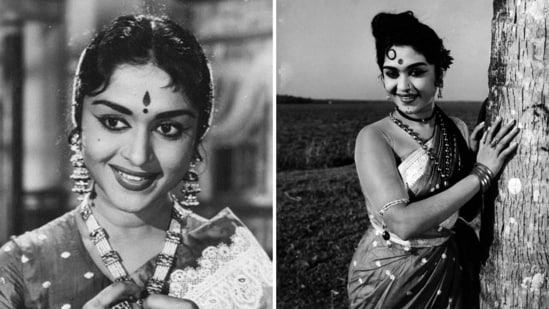
A young Saroja trained as a dancer and singer in her pre-teens, before she was spotted by director B.R Krishnamurthy when she was singing at a function, all of 13. Saroja's family declined the acting offer initially, before her father relented. The teenager was allowed to act in films, but her mother had strict rules for what she could wear on screen and in public: 'No swimsuits — not even sleeveless blouses' was the simple dress code. Saroja's debut film won the National Award (Mahakavi Kalidasa, 1955). And she never looked back. The success of Nadodi Mannan opposite MG Ramachandran made her one of the most popular stars in Tamil Nadu. A Bollywood debut opposite Dilip Kumar in the 1959 release Paigham followed. By the time the 60s rolled in, Saroja was one of the top stars in Kannada, Telugu, and Tamil films, and a known face in Hindi as well.
B Saroja Devi, the style icon
Saroja Devi's superstardom began in the mid-1960s with two blockbusters. MG Ramachandran's Tamil hits Enga Veettu Pillai (1965) and Anbe Vaa (1966) made her a household name. But more importantly, women began to copy her sarees and hairstyles from the film. Rediff noted years later that after Saroja Devi's stills were published in film magazines, the sarees and jewellery she wore became the fashion.
{{/usCountry}}Saroja Devi's superstardom began in the mid-1960s with two blockbusters. MG Ramachandran's Tamil hits Enga Veettu Pillai (1965) and Anbe Vaa (1966) made her a household name. But more importantly, women began to copy her sarees and hairstyles from the film. Rediff noted years later that after Saroja Devi's stills were published in film magazines, the sarees and jewellery she wore became the fashion.
{{/usCountry}}The screen queen
From 1955-84, Saroja Devi played the lead in 161 consecutive films, a record for Indian cinema. These included 26 back-to-back hits opposite MGR, 22 films with Sivaji Ganesan, 17 with Gemini Ganesan, and over a dozen each with NT Rama Rao and Dr Rajkumar. In Hindi cinema, she appeared in only a few films, but still managed to work with the top heroes of the time, including Dilip Kumar, Shammi Kapoor, Sunil Dutt, and Rajendra Kumar. She was infamously replaced by Vyjanthimala from Raj Kapoor's Nazrana after a conflict with the director CV Sridhar.
After her husband's sudden death in 1986, Saroja Devi stepped away from public life for over five years. She returned in 1993 but in supporting roles in films like Parambariyam, Anuraga Sangama, and Aadhavan. Her most recent work was Natasaarvabhowma, which was released in 2019.
Get more updates from Bollywood, Taylor Swift, Hollywood, Music and Web Series along with Latest Entertainment News at Hindustan Times.
Get more updates from Bollywood, Taylor Swift, Hollywood, Music and Web Series along with Latest Entertainment News at Hindustan Times.