ON NOVEMBER 17th Pope Leo was beamed into this year’s United Nations climate summit to urge that “floods, droughts, storms and relentless heat” were signs that “creation is crying out” for more to be done to tackle climate change. Torrential rain and floods had already disrupted the opening days of the conference, held in Belém, a Brazilian city perched on the edge of the Amazon. A few days later, the papal missive seemed even more prophetic when a fire ripped
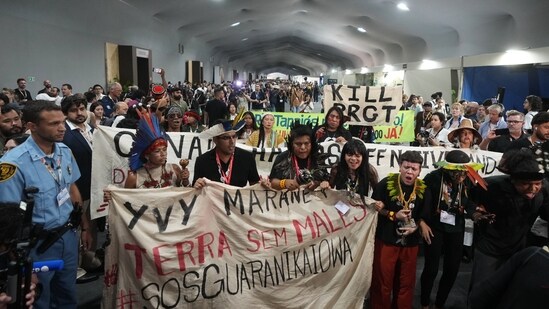
ON NOVEMBER 17th Pope Leo was beamed into this year’s United Nations climate summit to urge that “floods, droughts, storms and relentless heat” were signs that “creation is crying out” for more to be done to tackle climate change. Torrential rain and floods had already disrupted the opening days of the conference, held in Belém, a Brazilian city perched on the edge of the Amazon. A few days later, the papal missive seemed even more prophetic when a fire ripped through the venue and the delegates had to be evacuated. Michael Mann, a prominent American climate scientist, called it “a disturbingly apt metaphor” for the talks, which many say may no longer be fit for purpose.
The COP30 talks had a rough preamble. Two weeks earlier the UN’s “Emissions Gap” report finally confirmed what has been obvious for some time—that the steady increase in carbon emissions in the years since the Paris agreement means global temperatures will rise beyond 1.5°C above pre-industrial levels, and soon: probably in the next five years. That means the world has failed to meet the more ambitious of the Paris agreements’ two temperature targets, and has somewhat shifted the goalposts from merely halting global warming to some form of active global cooling as countries must now figure out how to limit the magnitude and duration of an overshoot.
Global cooling would mean more direct interventions into the climate system, either by removing large quantities of greenhouse gases from the atmosphere or through the use of “solar geoengineering”, a suite of proposals to reflect solar energy before it is able to warm the Earth’s surface, for instance by pumping aerosols into the upper atmosphere. Though ideas for the latter were barely mentioned, the conference included a number of discussions on how carbon removal technologies might be scaled up rapidly.
Questions around national efforts to adapt to the impacts of climate change made modest progress at the talks. A years-long process to draw up a formal set of indicators to measure “climate resilience” was concluded, and the final agreement calls for rich countries to triple the amount of money they funnel to poor ones for adaptation projects by 2035. Though she regards the development as representing real movement on adaptation, Natalie Unterstell, who leads Talanoa, a climate-policy think tank based in Rio de Janeiro, points out that it still falls well short of what is actually required. For one thing, she says, it makes no reference to what the figure is being tripled from, which she says means there is no chance of assessing or adjusting funding promises.The bulk of delegates’ time, however, was dedicated to a protracted row over how countries might move forward on their promise to move away from the use of fossil fuels in their energy systems, made at the 2023 edition of the talks, in Dubai. At the time, The Economist hailed that pledge as a “rare success for multilateralism”—both because it occurred in a petrostate, under the auspices of the chief executive of the United Arab Emirates’ state oil company, and because, for the first time in more than 30 years, the talks saw countries explicitly agree to wean themselves off the main source of emissions. Given the need for consensus and the staunch opposition of several oil-producing states, the outcome seemed remarkable, with some observers declaring it the “the beginning of the end of the fossil-fuel era”. Two years later, the Belém text makes no direct reference to fossil fuels at all. An initial draft had suggested that governments might commit to a “roadmap” for phasing out fossil fuels—or in true UN style at least commit to discussing one. What this meant was never clarified, but there were suggestions that it could lead to countries setting themselves timetables or milestones.
Opposition from oil-producing countries including Saudi Arabia, Russia and India, which still relies heavily on coal, expunged any mention of fossil fuels from the next draft. Repeated threats by a group of countries including Britain, the European Union (which negotiates as a bloc) and several Pacific island states that they would not accept any agreement unless it was reinstated did not work. A similarly vague proposal for setting up a roadmap to end deforestation was also cut. So too was any formal suggestion that countries should revisit their self-made plans for reducing emissions—the “Nationally Determined Contributions” which the Paris agreement mandates they submit every five years—more frequently in light of the failure to cut emissions quickly enough so far.
The lacklustre outcome does not preclude the possibility of countries making progress on any of these fronts under their own steam. Many vowed that they would: Brazil said it would pursue the idea of two roadmaps, including within the G20, while Colombia and the Netherlands jointly announced that they would host an international conference on roadmaps next year. Nor does it mean that nothing positive has come out of the past fortnight. One achievement was the launch of the Tropical Forest Forever Facility (TFFF) an investment fund that proponents say will raise as much as $125bn to pay countries directly for every hectare of tropical forest they preserve.
In the weeks before the summit, much was made of whether China would assume greater leadership in America’s absence—President Donald Trump declined to send a delegation. China did not seem keen to take on that role. Publicly, it avoided taking a strong position on most issues except for arguing that climate action should not be used as a justification for restricting trade. Together with Russia it also successfully opposed the inclusion of any provisions to do with critical minerals. The two countries together control most of the world’s supply.
Throughout the summit, the Brazilian hosts repeatedly used the term mutirão, an indigenous word they chose to translate as “collective effort” (the final political agreement was titled the “Global Mutirão”). Andre Correa do Lago, the Brazilian negotiator in charge, repeatedly cited mutirão as having made the Paris agreement possible, and what was now needed to properly implement it. But part of what made it possible for countries to reach a consensus in Paris was that the commitments that they made were voluntary.
One Subscription.
Get 360° coverage—from daily headlines
to 100 year archives.
Archives
HT App & Website