Ravaged by insurgents and rampant poaching for nearly two decades, Assam’s Manas National Park had no tigers twenty years ago. But it now boasts 48 members of the endangered species.
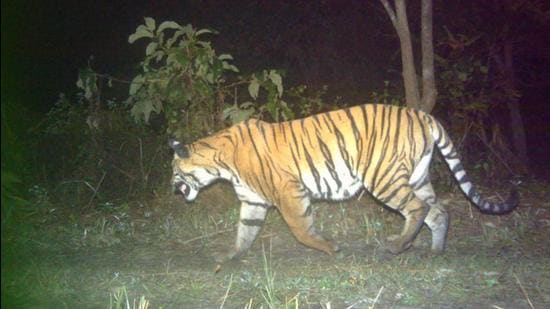
Results of the 12th annual camera trapping survey this year, which covered 876 sq km of the park and adjoining areas with cameras placed at 285 locations, revealed the presence of 48 tigers, of which 38 are adults, 3 sub-adults and 7 cubs.
The three-fold rise in the number of adult tigers from 10 in 2010 to 38 in 2021 is a record in tiger conservation in the country. In 2020, 30 adult tigers were recorded in the park.
Last year, Pilibhit tiger reserve in Uttar Pradesh had bagged an international award, TX2, for more than doubling the number of tigers in four years from 25 in 2014 to 65 in 2018.
“The findings have brought cheer to everyone in Manas and shows that the efforts at tiger conservation have borne fruit. We have already surpassed the World Wildlife Foundation and Global Tiger Forum’s goal of doubling tiger numbers by 2022,” said Amal Chandra Sarmah, field director, Manas Tiger Project.
“There were no tiger sightings in Manas between 2001 and 2004. In 2005, an image of one adult tiger was captured in the park in a camera trap. The present increase in population could also be attributed to the Covid-19 restrictions, which has brought down the number of visitors to the park,” he added.
{{/usCountry}}“There were no tiger sightings in Manas between 2001 and 2004. In 2005, an image of one adult tiger was captured in the park in a camera trap. The present increase in population could also be attributed to the Covid-19 restrictions, which has brought down the number of visitors to the park,” he added.
{{/usCountry}}The survey also recorded 37 leopards in Manas including 31 adults and 6 sub-adults. Five other species of wild cats, leopard cat, clouded leopard, marbled cat, golden cat and jungle cat, were also found in the park and adjoining areas.
“It is evident that tigers are flourishing in Manas and this significant recovery becomes a global example. Increase of breeding females and cubs signifies that Manas has proved to be a healthy breeding ground for tigers and its co-predators,” said Sarmah.
The survey also recorded 4 species of endangered, 9 species of vulnerable, 4 species of near threatened and 11 species of least concern mammals as per International Union for Conservation of Nature (IUCN) status.
Among them are Asian elephant, hog deer, hispid hare, wild buffalo, rhino, sambar deer, swamp deer, spotted deer, barking deer, Himalayan black bear, Himalayan serow, Goral, black panther and binturong.
“Better management and protection measures have resulted in an increase in tigers in Manas, which is a positive sign. But in coming years, focus should be given on management of the prey base, so that deaths due to infighting don’t take place,” said Bibhab Talukdar, CEO of Aaranyak, a wildlife NGO associated with the survey.
Few deaths due to infighting among tigers are recorded every year in Assam’s Kaziranga National Park and Tiger Reserve (KNPTR), which has a population of 111 tigers according to a 2017 census.