...
...
Next Story

Weather Bee | Skewed rain responsible for Himachal and Uttarakhand floods

One reason why parts of Himachal and Uttarakhand have flooded this monsoon is that there was a big surplus on particular days.

Published on: Aug 7, 2024, 17:53:29 IST
Advertisement

Parts of Himachal Pradesh (HP) and Uttarakhand flooded due to intense rain in the past week. This has also happened earlier in the season. Does this mean that there is a big surplus of rain this monsoon in these states? An HT analysis of India Meteorological Department’s (IMD) gridded data shows that this is not necessarily the case. In fact, HP has a deficit. The reason for the floods, data shows, is that rain so far has often been concentrated
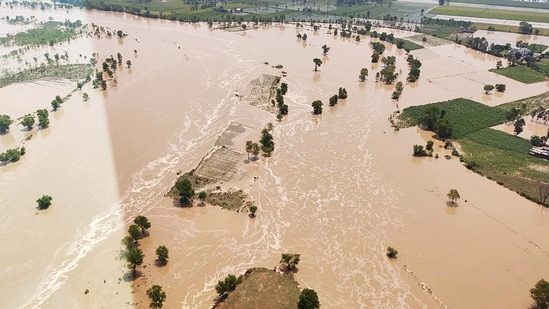
PREMIUMKumaon, Jul 09 (ANI): The Haldwani, Banbasa, Tanakpur, Sitarganj, Khatima and other flood affected areas  (ANI Photo) (ANI Picture Service)
Kumaon, Jul 09 (ANI): The Haldwani, Banbasa, Tanakpur, Sitarganj, Khatima and other flood affected areas (ANI Photo) (ANI Picture Service)

Uttarakhand has also received a big surplus of rain on particular days this season. This has also happened on more days in Uttarakhand than in Himachal Pradesh. This is why the state had a deficit only in June. In July, it had a surplus of 56%; and it has a 15% surplus so far this month. However, as the accompanying chart shows, the surplus in even these months has been built due to unusually high rain on particular days.

To be sure, in absolute terms, neither HP nor Uttarakhand has averaged more than 47 mm rain on any day of the season. If this amount was evenly spread across the state (meaning all places received 47 mm rain), the chances of floods would be lower. However, rain is hardly spread evenly over a large region. Therefore, the geographical concentration of surplus rain also has a role to play in the floods in the two states. This can be seen from the accompanying map. While the northern half of Uttarakhand has received a big surplus in August, parts of its southern half have big deficits. Similarly, only the southwestern parts of Himachal Pradesh have a surplus this month.

Rain's departure from normal in 2024 August 1-6

The trends seen in August in the two hilly states can also be seen for the season before August. For example, the southwestern parts of Himachal Pradesh were not deficient in either half of July even though the state did. Similarly, the excess rain in Uttarakhand in different parts of the season was due to excess rain in only parts of the state.

Rain's departure from normal in 2024

While this analysis is limited to the most recent occurrence of floods, similar trends can be seen in relation to other disasters. One big example is Assam, which has just an 11% surplus right now despite being ravaged by floods early in the season. This highlights how the overall performance of the monsoon is not tied to the occurrence of rain-related disasters in the ongoing monsoon season.

Abhishek Jha, HT’s assistant editor-data, analyses one big weather trend in the context of the ongoing climate crisis every week, using weather data from ground and satellite observations spanning decades.

Parts of Himachal Pradesh (HP) and Uttarakhand flooded due to intense rain in the past week. This has also happened earlier in the season. Does this mean that there is a big surplus of rain this monsoon in these states? An HT analysis of India Meteorological Department’s (IMD) gridded data shows that this is not necessarily the case. In fact, HP has a deficit. The reason for the floods, data shows, is that rain so far has often been concentrated in particular parts of the season and particular parts of these states.

PREMIUMKumaon, Jul 09 (ANI): The Haldwani, Banbasa, Tanakpur, Sitarganj, Khatima and other flood affected areas  (ANI Photo) (ANI Picture Service)
Kumaon, Jul 09 (ANI): The Haldwani, Banbasa, Tanakpur, Sitarganj, Khatima and other flood affected areas (ANI Photo) (ANI Picture Service)

It is not unusual to expect a big surplus in rain when there are floods due to it. However, for the monsoon season overall – it begins officially on June 1 – only Uttarakhand has a surplus among the two states. The state has a surplus of 27%, which is classified as “excess” by the IMD. However, Himachal, which has also been affected by floods, has a deficit of 26%, which is classified as “deficient” by the IMD. Clearly, the overall performance of the monsoon season cannot explain the disasters in these states.

One reason why parts of HP and Uttarakhand have flooded this monsoon is that there was a big surplus on particular days. This can be seen from the rainfall trends in individual months and days. Himachal, for example, had a deficit of 46% and 27% in June and July but has a 12.5% surplus in August so far. Even this surplus would not have been possible without the 33 mm rain the state received on August 1. This is more than half the rain the state has received this month. In fact, the state also received a similar amount of daily rain on July 6 (26 mm) but ended up with a deficit in the month because other days of the month were unusually dry.

Uttarakhand has also received a big surplus of rain on particular days this season. This has also happened on more days in Uttarakhand than in Himachal Pradesh. This is why the state had a deficit only in June. In July, it had a surplus of 56%; and it has a 15% surplus so far this month. However, as the accompanying chart shows, the surplus in even these months has been built due to unusually high rain on particular days.

To be sure, in absolute terms, neither HP nor Uttarakhand has averaged more than 47 mm rain on any day of the season. If this amount was evenly spread across the state (meaning all places received 47 mm rain), the chances of floods would be lower. However, rain is hardly spread evenly over a large region. Therefore, the geographical concentration of surplus rain also has a role to play in the floods in the two states. This can be seen from the accompanying map. While the northern half of Uttarakhand has received a big surplus in August, parts of its southern half have big deficits. Similarly, only the southwestern parts of Himachal Pradesh have a surplus this month.

Rain's departure from normal in 2024 August 1-6

The trends seen in August in the two hilly states can also be seen for the season before August. For example, the southwestern parts of Himachal Pradesh were not deficient in either half of July even though the state did. Similarly, the excess rain in Uttarakhand in different parts of the season was due to excess rain in only parts of the state.

Rain's departure from normal in 2024

While this analysis is limited to the most recent occurrence of floods, similar trends can be seen in relation to other disasters. One big example is Assam, which has just an 11% surplus right now despite being ravaged by floods early in the season. This highlights how the overall performance of the monsoon is not tied to the occurrence of rain-related disasters in the ongoing monsoon season.

Abhishek Jha, HT’s assistant editor-data, analyses one big weather trend in the context of the ongoing climate crisis every week, using weather data from ground and satellite observations spanning decades.

All Access.
One Subscription.

Get 360° coverage—from daily headlines
to 100 year archives.

E-Paper
Full
Archives
Full Access to
HT App & Website
Games
 
ABOUT THE AUTHOR
Abhishek Jha

Abhishek Jha is Assistant Editor-Data at Hindustan Times. He uses statistical programming to generate newsworthy insights from large datasets. He is part of the team that produces Number Theory, a daily data story feature of the paper’s print edition. Since March 2024, he has been writing Weather Bee, a weekly column for the Hindustan Times website. He is a chemical engineer by training, who specialises in stories related to weather, climate, and the environment. Jha has been at HT since 2018, where he offers data-driven perspective and analysis on politics, environment, weather, climate, economy and society. His work includes data coverage of elections in India and abroad, including the 2019 and 2024 Lok Sabha elections; the disasters and extreme weather resulting from changing climate, such as floods, droughts, heat waves, cold waves, and dwindling snow cap in the Himalayas; the factors that drive poor air quality in northern India; the changing patterns of land use; the Covid-19 pandemic and its impact on labour market conditions; the changing pattern of consumer spending seen in the new consumer spending surveys; and social norms seen in the surveys such as the National Family Health Survey.

SHARE THIS ARTICLE ON
Hindustantimes wants to start sending you push notifications. Click allow to subscribe