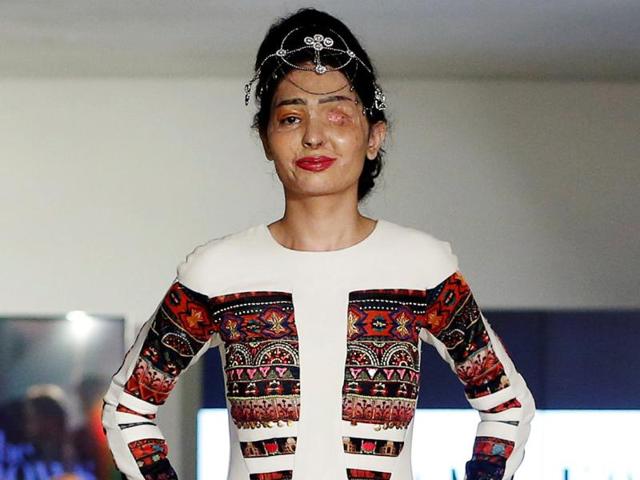
Last week, 19-year-old Reshma Qureshi, an acid attack survivor, created quite a stir when she walked the ramp at New York Fashion Week as the showstopper for Mumbai-based designer Archana Kochhar. Dressed in a full-sleeved white patch-work gown, Qureshi was a symbol of confidence as she strutted down the international runway.
“Reshma caught my attention a long time back with her ‘Make Love Not Scars’ campaign. That was a reality check for me. They (acid attack survivors) should get equal acceptance in the world. This was the motive behind roping in Reshma as my showstopper. I wanted to show the world that beauty should not be objectified. Walking that ramp in New York not only helped Reshma gain confidence, but it was also a moment of recognition for all the other survivors out there,” says Kochhar.
The recently concluded London Fashion Week also saw two acid attack survivors — Adele Bellis (24) and Laxmi (26) — join professional models on the ramp for a show that aimed to raise awareness about violence against women. In 2015, designer Rick Owen’s show saw models carrying other models as ‘human backpacks’. The idea, according to Owen, was to uphold the spirit of feminism, with the core philosophy of women supporting one another to make progress. In India, too, an increasing number of designers are making an attempt to create awareness about socially relevant issues through fashion shows.
In May, the Fashion Design Council of India (FDCI), in association with Tamana, an NGO that works with people with multiple disabilities, organised a show that was aimed at integrating the physically challenged into different fields, including the glamour industry. The show featured the creations of 10 designers, including Anju Modi, JJ Valaya, Rajesh Pratap Singh and Rohit Bal, among others.
{{/usCountry}}In May, the Fashion Design Council of India (FDCI), in association with Tamana, an NGO that works with people with multiple disabilities, organised a show that was aimed at integrating the physically challenged into different fields, including the glamour industry. The show featured the creations of 10 designers, including Anju Modi, JJ Valaya, Rajesh Pratap Singh and Rohit Bal, among others.
{{/usCountry}}Changing times
Designer Rocky S feels the perception of the fashion industry is changing radically. No longer is it considered just a field that promotes glamour. It has become a vital platform that also addresses and supports social causes. “Its reach has increased as compared to what it was a decade ago. Moreover, fashion now has a voice. Designers are ready and willing to express their thoughts, which directly enables various organisations to campaign and raise social awareness through fashion shows,” he says.
Designer Nachiket Barve agrees with Rocky, and says “fashion is intrinsically related to life, and therefore, acts as a mirror to society”. However, he insists that while using a theme with a social message, the show “must be meaningful and sincere, and not gimmicky”.
New approach
Designer Masaba Gupta Mantena, who will showcase her latest festive line in Bangalore next week, has collaborated with Hothur Foundation that works to uplift the economically backward by providing them with basic amenities. A part of the proceeds from the sale of her collection will also go towards the welfare of acid attack survivors. “To me, fashion is also an art, and art moves you. It makes for a creative medium to bring about change. Perhaps, it does so not as strongly, but it is definitely significant,” she says.
Issues galore
There are several issues that designers want to bring to the fore through fashion shows. Some feel violence against women is an issue that desperately needs to be addressed, as they call spreading awareness about gender equality the need of the hour. Others believe that a positive body image must be promoted under any circumstances.
“I believe that the world has become a smaller place because of technology. Reaching out to the masses has become easier. If fashion, as a platform, continues to be socially responsible, people will certainly take notice,” adds Rocky.
Shows that’ve made social statements in the past
1. In 2014, Karl Lagerfeld staged a feminist protest march for Chanel’s Spring/Summer 2015 show. Models such as Cara Delevingne and Gigi Hadid strutted down the ramp, chanting words of empowerment and holding signs that read “Ladies First”.
2. British-Turkish designer Hussein Chalayan’s Autumn/Winter 2000 collection, Afterwords, focused on the horrors people face when they have to undergo wartime displacement.
3. In 2013, designer Narendra Kumar used the ramp to lash out at the authorities that tried to suppress the protests that followed the brutal gang rape of a young woman in Delhi in 2012. Men clad in black uniforms, with ‘Thought Police’ written across their clothes, and carrying lathis, surrounded the ramp as models sashayed down the runway.
4. For his Autum/Winter 2015 Paris Fashion Week show, which was held almost two weeks after the Charlie Hebdo shootings, designer Walter Van Beirendonck presented a show to react to the act of terrorism. Male models walked down the ramp in creations with messages such as ‘Stop terrorising our world’ and ‘An eye for an eye only ends up making the whole world blind’, among others.
Catch your daily dose of Fashion, Taylor Swift, Health, Festivals, Travel, Relationship, Recipe and all the other Latest Lifestyle News on Hindustan Times Website and APPs.
Catch your daily dose of Fashion, Taylor Swift, Health, Festivals, Travel, Relationship, Recipe and all the other Latest Lifestyle News on Hindustan Times Website and APPs.