A debt consolidation loan is a personal loan used for one purpose. See how it works, when to apply directly and when a matching platform suits you better.
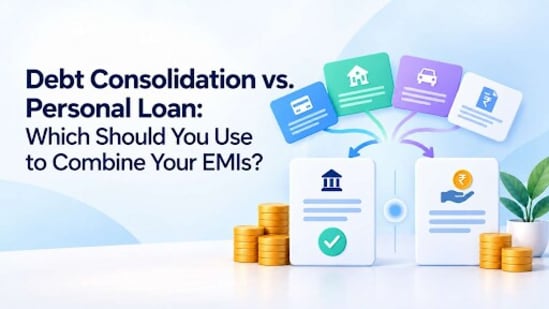
A debt consolidation loan and a personal loan aren't two separate products. Debt consolidation is one specific use of a personal loan: clearing the debts you already have, so you pay one EMI instead of four.
So the choice in the title isn't really between two loans. It's about how you get that personal loan, who arranges it, and which route suits the debts you're carrying. This piece clears up the difference and helps you pick.
Is a Debt Consolidation Loan Different From a Personal Loan?
The loan itself is the same kind. What changes is the purpose, the way it's arranged and what the lender asks to see.
| Personal Loan (general purpose) | Personal Loan Used for Debt Consolidation |
| Can be used for any purpose: travel, medical bills, home repairs | Used specifically to pay off existing debts |
| Disbursed to your bank account | Disbursed to you, or sometimes straight to the banks you owe, depending on the lender |
| You arrange and apply for it yourself | Often arranged through a platform that matches you to a suitable lending partner |
| No need to list your existing debts | The application usually asks for a full list of the loans and cards being paid off |
When the money goes directly to your existing lenders, there's no chance of it getting spent elsewhere before the old debts are cleared. That one detail is often the biggest practical difference.
How a Personal Loan Actually Works for Debt Consolidation
Personal loan debt consolidation follows a simple sequence. You borrow an amount that matches your total outstanding debt and use it to clear every loan and card in one go. After that, you pay one EMI, to one lender, on one date.
{{/usCountry}}Personal loan debt consolidation follows a simple sequence. You borrow an amount that matches your total outstanding debt and use it to clear every loan and card in one go. After that, you pay one EMI, to one lender, on one date.
{{/usCountry}}List every balance before you apply, since the loan is sized to cover all of it. Leave one card out and it keeps charging at the old rate while you're paying the new EMI.
It helps most with credit card debt. Unpaid card balances typically carry 36% to 45% a year, while a personal loan for consolidation usually runs between 10.5% and 24%, depending on your profile.
Shifting a balance from the first range into the second can cut your interest cost sharply. How much depends on the rate you're offered. Rates shown here are indicative, and the final rate is always set by the lender.
Applying Directly vs Going Through a Matching Platform: Which Should You Choose?
This is the choice that matters most.
Going straight to a bank or NBFC suits you if your CIBIL score (the 300 to 900 number lenders check) is strong, you have one or two debts, and you've got time to compare a few offers. You stay in full control of which lender you pick. Direct can also be easier if your salary account is with a bank that already knows your repayment record, since the paperwork is often lighter.
A matching platform suits a messier picture, say 3 credit cards and 2 personal loans spread across different lenders. Approaching each bank yourself means a hard inquiry (a lender pulling your credit report to judge your file) with every application, and offers that are hard to compare side by side. A platform replaces that with one application instead of several to track.
A platform looks at your full profile first, then matches you to one lending partner for consolidating your debts. Neither route wins for everyone. The number of debts you carry is usually what decides it.
When a Personal Loan for Consolidation Isn't the Right Fit
The math has to work first. Add the processing fee (a one-time charge, usually 1 to 3% of the loan, deducted upfront) and compare the result with your weighted average rate, which is the blended rate across all your debts, with bigger balances counting for more.
If the new loan isn't clearly cheaper, you're swapping one cost for a similar one. Watch the repayment period too: a longer one brings the EMI down but pushes total interest up. A single, fairly priced loan gains little from consolidating too. A balance transfer, which moves that one loan to a bank offering a lower rate, is usually simpler.
And if EMIs have already been missed, a new loan is unlikely to be approved. It's also the wrong tool for that situation, which calls for a different conversation.
How FREED Helps With Debt Consolidation
FREED, a Gurugram-based loan management platform founded in August 2020, runs the matching-platform route through its Loan Consolidation Plan. It has counselled 20 lakh+ borrowers and manages ₹3,200 Cr+ in debt.
- FREED reviews your full financial profile, every loan and card, not only the ones a single bank's offer happens to cover.
- It matches you to a suitable lending partner based on your EMI-to-income ratio (how much of your monthly income goes to EMIs), so you aren't applying bank by bank and collecting hard inquiries along the way.
- The lending partner's new loan pays off all your eligible debts at once, leaving one EMI, one lender and one due date.
- The final loan amount and interest rate come from the lending partner's own assessment.
- If one partner turns the file down, FREED tries others that match your profile.
FREED doesn't charge you a fee for consolidation. And before you choose either route, you can check your EMI Scoreto see how much room your income and savings leave for a new loan.
So, Which Route Should You Take?
A debt consolidation loan is a personal loan with a clear job to do. The real decision is who arranges it: you, going bank by bank, or a platform built to match people with several debts to the right lending partner.
One or two debts and a strong score? Direct usually works. More than that, and matching saves time and inquiries. For help working out which fits, you can start at freed.care.
Note to readers: This article is part of HT's paid consumer connect initiative and is independently created by the brand. HT assumes no editorial responsibility for the content, including its accuracy, completeness, or any errors or omissions. Readers are advised to verify all information independently.