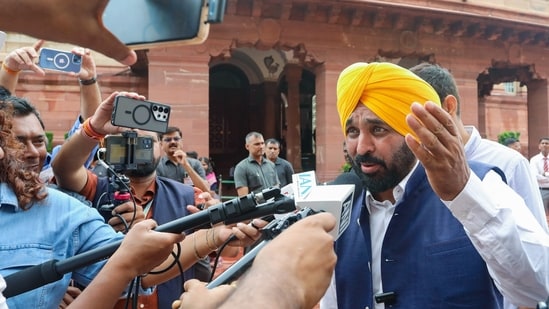
The Punjab cabinet, chaired by chief minister Bhagwant Singh Mann, on Wednesday, August 5, 2026, approved a series of legislative and administrative proposals covering education, employment, governance, rural development and environmental protection.
Among the key decisions was the approval of the Punjab Regulation of Fee of Un-aided Educational Institutions (Amendment) Bill, 2026, which seeks to regulate fee increases by private unaided educational institutions. The cabinet also approved the Punjab State Outsourced Personnel Transition to Contractual Engagement Bill, 2026, cleared the establishment of three private digital open universities, and approved amendments to the Punjab Goods and Services Tax Act and the Punjab Panchayati Raj Act, 1994.
According to the chief minister's office, the fee regulation amendment has been proposed following complaints of arbitrary annual fee hikes by some private unaided schools, which the government said had increased the financial burden on students and parents. The amendment proposes changes to the Punjab Regulation of Fee of Un-aided Educational Institutions Act, 2016; its 2019 amendment; and the associated rules to regulate fee revisions.
New Bill for outsourced employees, digital universities cleared
The cabinet approved the Punjab State Outsourced Personnel Transition to Contractual Engagement Bill, 2026, under which eligible outsourced personnel who have completed five years of continuous service would be considered for direct contractual engagement. For personnel working in notified hazardous categories, the qualifying period has been fixed at three years. The remuneration of contractual employees will be determined by the Finance Department and cannot be lower than the minimum wages prescribed under applicable law. The proposed legislation will replace the Punjab Ad Hoc, Contractual, Daily Wage, Temporary, Work Charged and Outsourced Employees' Welfare Act, 2016.
{{/usCountry}}The cabinet approved the Punjab State Outsourced Personnel Transition to Contractual Engagement Bill, 2026, under which eligible outsourced personnel who have completed five years of continuous service would be considered for direct contractual engagement. For personnel working in notified hazardous categories, the qualifying period has been fixed at three years. The remuneration of contractual employees will be determined by the Finance Department and cannot be lower than the minimum wages prescribed under applicable law. The proposed legislation will replace the Punjab Ad Hoc, Contractual, Daily Wage, Temporary, Work Charged and Outsourced Employees' Welfare Act, 2016.
{{/usCountry}}The cabinet also approved the Punjab Private Digital Open Universities Policy, 2026, paving the way for the establishment of Cloud University in Bohan (Hoshiarpur), MS Digital University in Fatehpur (Patiala), and Physicswallah Digital University in Nandpur Kesho (Patiala).
In another decision, services of 449 veterinary pharmacists and 451 safai sewaks deployed across 582 veterinary hospitals have been extended for one year, from April 1, 2026 to March 31, 2027.
GST, panchayati raj and tree protection, among other decisions
The cabinet approved the creation of Block Tarsika in the Amritsar district by carving out 64 gram panchayats from the Jandiala Guru block. It also cleared direct recruitment for 19 Draftsman (Civil) posts in the Public Works Department (PWD) to address long-pending vacancies.
The council of ministers further approved the Punjab Protection of Trees Bill, 2026, which proposes an institutional framework for tree conservation, ecological protection and compensatory measures against tree felling. The government has set a target of increasing the state's forest and tree cover from about 5.92% to 7.5% by 2030.
The cabinet also approved amendments to the Punjab Goods and Services Tax (Amendment) Bill, 2026, aimed at simplifying GST compliance, reducing litigation and facilitating post-sale discount adjustments and export-related refunds.
Additionally, it approved amendments to the Punjab Panchayati Raj Act, 1994, to merge the cadres of Panchayat Secretaries and Gram Sewaks into a new Panchayat Development Secretary cadre. Existing Panchayat Secretaries opting for the merger will be placed at the end of the current seniority list of Gram Sewaks upon submission of a self-declaration, while those who do not opt in within the prescribed period will continue in the existing cadre, which will be treated as a dying cadre.