A scholarship they don't know exists. A legal document they don't know how to obtain. An application deadline they discover too late. And often, no mentor to guide them through college choices, applications and what comes next. For students whose parents have never been through this process, higher education often stalls at a government office, well before any entrance exam. In many cases, scholarships exist, but students struggle to access them. Pune-based Samavesh works to close this gap.
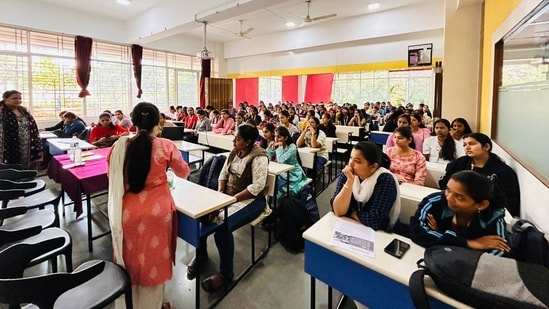
Since 2011, Samavesh has reached more than 5,000 school and college students and helped them secure ₹13 crore in scholarship funding for higher education. More than 1,000 students have received sustained mentoring and counselling, and another 800 have been helped to obtain the legal documents needed for education and government entitlements.
What "out of reach" looks like
For first-generation learners, one gap often leads to the next. A student who doesn't know they are eligible never starts the paperwork. One who starts late may find that a certificate takes longer to arrive than the deadline allows. Decisions about which college, course or entrance exam to choose are often made without anyone at home who has made them before. Without timely information, documents and mentoring, many eligible students miss out.
Samadhan Galande, from Marathwada, was the first in his family to go to college. His main obstacle was a lack of information. India has hundreds of scholarships, and it is difficult to know which ones apply to a student and when to apply. With Samavesh's mentoring, he completed a Master's in Agribusiness Economics at Pune's Gokhale Institute, earned a VSM Scholarship, and later received a fully funded place on Ashoka University's Young India Fellowship.
{{/usCountry}}Samadhan Galande, from Marathwada, was the first in his family to go to college. His main obstacle was a lack of information. India has hundreds of scholarships, and it is difficult to know which ones apply to a student and when to apply. With Samavesh's mentoring, he completed a Master's in Agribusiness Economics at Pune's Gokhale Institute, earned a VSM Scholarship, and later received a fully funded place on Ashoka University's Young India Fellowship.
{{/usCountry}}Selective institutions also have their own requirements, from statements of purpose and recommendation letters to interviews. Samavesh's mentoring continues over several months, using a platform that lets mentors track each student from entrance preparation to their first job. "I learned to belong in places that I thought were out of reach," Galande says.
Why access matters
India's gross enrolment ratio in higher education is 30 per cent. For Scheduled Caste students it is 27.8 per cent, and for Scheduled Tribe students 22.8 per cent, according to the government's latest AISHE survey. The gap is wider at the country's top institutions. In December 2023, the Ministry of Education told the Lok Sabha that 13,626 SC, ST and OBC students had left central universities, IITs and IIMs over five years, including 3,542 from IITs. The ministry attributed most of these exits to students moving to other institutions or to personal reasons.
These institutions offer a route into professional careers and leadership roles, so who enrols and who completes a degree there matters for the next generation as well. For this reason, Samavesh's Mobility Index looks beyond admission. It tracks whether students go on to a different institution, a scholarship, a professional network or a job.
Where the idea came from
Pravin Nikam's parents migrated from rural Maharashtra in search of work, leaving farming for factory jobs in the Khed–Chakan industrial belt near Pune. His mother cooked and sold food to add to the family's income. They made sure he stayed in school, and he later studied at the London School of Economics on a Chevening Scholarship. Growing up, he saw young people around him miss scholarships they had never heard of and abandon admissions because they lacked a document. "The young people we work with do not lack aspiration or ability," he says. "What is often missing is the institutional architecture around them." Nikam is a 2026 Ford Global Fellow, has received national and state youth awards, and is a member of the committee drafting Maharashtra's State Youth Policy. Sidharth Hendre joined Samavesh as Head of Operations in 2024 and works on team capacity, government and partner relationships, programme design, and monitoring and evaluation.
The next stage
"Our ambition is to move from changing individual trajectories to changing the systems that shape those trajectories," Nikam says. After being incubated by The/Nudge, Samavesh joined the^delta's first accelerator cohort in July 2026. Over the coming 12 months, the team will work with the^delta's mentors and ecosystem partners, for portfolio assistance, to develop their strategy and model, to prepare for the next phase of growth.
the^delta is seeking to support early-stage teams that have identified barriers to scaling India's formal economy and are willing to build solutions for the long run.
Learn more at www.thedelta.org.in
Note to the Reader: This article is part of Hindustan Times' promotional consumer connect initiative and is independently created by the brand. Hindustan Times assumes no editorial responsibility for the content.