Located on Chakrata Road at the 16th Milestone in Dehradun, the nine-storeye d Graphic Era Institute of Medical Sciences has become an important healthcare facility for patients across the city and surrounding areas. But this year marks a significant new chapter for the institution , with a series of milestones placing it firmly in the spotlight of medical education and healthcare in Uttarakhand. Graphic Era Institute of Medical Sciences (GEIMS) has been approved by the National Medical Commission for 250 MBBS seats for the 2026-27 academic session, a sharp rise from its earlier intake of 150 and a scale of expansion only a few private medical colleges in North India can claim.
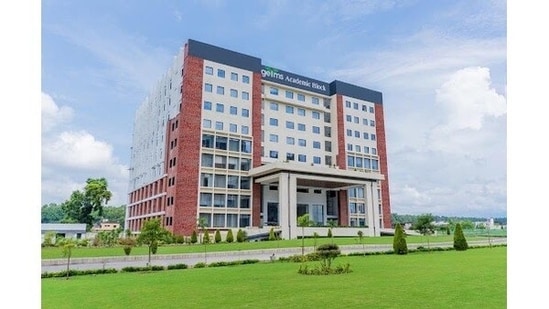
A jump from 150 to 250 MBBS seats is about more than accommodating another 100 students. It is a measure of whether an institution has the academic, clinical and infrastructural capacity to train doctors at that scale. The National Medical Commission ties every additional seat to concrete benchmarks, including faculty strength, bed capacity, laboratory infrastructure and clinical caseload. Crossing from 150 to 250 seats in a single admission cycle therefore reflects GEIMS’ expansion across the very foundations that underpin medical education.
Graphic Era’s story goes back three decades, beginning with a modest computer training centre in Dehradun and growing into two universities across four campuses. Today, Graphic Era (Deemed to be University) is based in Dehradun, while Graphic Era Hill University has campuses in Dehradun, Bhimtal and Haldwani. This long academic journey now extends into medicine through GEIMS and Graphic Era Hospital, bringing the group’s experience in education into a healthcare setting focused on patient care, clinical training and medical education.
The institute’s vision centres on extending accessible, high-quality patient care while building the infrastructure and medical education needed to support it. In practice, that means bringing together advanced healthcare facilities, clinical expertise and strong academic training to create an environment where patient care and medical education reinforce each other. That approach gained significant institutional validation this year. Graphic Era Hospital became India’s first medical college hospital to receive NABH 6th Edition Accreditation , assessed against more than 600 parameters covering patient safety, clinical quality, infection control and the integration of academic training into hospital practice. The latest edition represents a step up from the 500-parameter benchmark of the previous edition, making the achievement particularly significant and placing GEIMS among a select group of institutions where standards of patient care are independently assessed.
{{/usCountry}}The institute’s vision centres on extending accessible, high-quality patient care while building the infrastructure and medical education needed to support it. In practice, that means bringing together advanced healthcare facilities, clinical expertise and strong academic training to create an environment where patient care and medical education reinforce each other. That approach gained significant institutional validation this year. Graphic Era Hospital became India’s first medical college hospital to receive NABH 6th Edition Accreditation , assessed against more than 600 parameters covering patient safety, clinical quality, infection control and the integration of academic training into hospital practice. The latest edition represents a step up from the 500-parameter benchmark of the previous edition, making the achievement particularly significant and placing GEIMS among a select group of institutions where standards of patient care are independently assessed.
{{/usCountry}}There is plenty for students to learn beyond the medical curriculum. GEIMS functions under the aegis of Graphic Era, a deemed university ranked 48th in India by NIRF this year, placing it among the country’s top 50 universities across disciplines. Its A+ NAAC accreditation adds another mark of academic credibility. For a NEET aspirant choosing a medical college, this brings together two important advantages: a focused medical education and the academic standing of an institution already recognised among India’s leading universities.
The infrastructure tells the same story. A 3 Tesla MRI machine and a 128-slice CT scanner give the hospital some of the most advanced diagnostic imaging available anywhere in the country, while a robotic surgery unit brings a level of surgical precision few teaching hospitals in the hills can offer. Students move through more than twenty clinical and pre-clinical departments, from anatomy and pathology to emergency medicine and radiodiagnosis, guided by faculty who combine academic depth with active clinical practice. Research runs alongside the training, with dedicated opportunities for students to work on projects that feed directly back into patient care.
The hospital's footprint already stretches well beyond Dehradun, serving patients from as far as Yamunotri near the China border, and it works with CGHS, ECHS, Ayushman Bharat and every major private insurer to keep that care within reach. Graphic Era has laid out plans to expand the hospital to 1,250 beds in the coming years, a scale that would place it among the larger teaching hospitals anywhere in North India.
Admissions for the 2026-27 MBBS session at Graphic Era Institute of Medical Sciences are open through MCC's All India Counselling, under the General and NRI quota, at 16th Milestone, Chakrata Road, Dehradun, Uttarakhand.
Note to readers: This article is part of HT's paid consumer connect initiative and is independently created by the brand. HT assumes no editorial responsibility for the content, including its accuracy, completeness, or any errors or omissions. Readers are advised to verify all information independently.