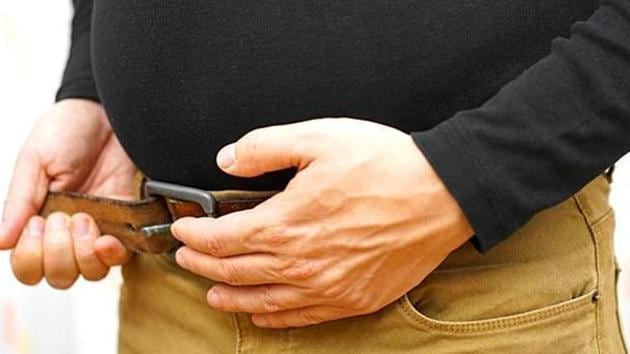
Next time you feel like making fun of your obese friends for not sticking to their gym routines, think twice. Because obese people may have altered dopamine receptors, causing them to have little motivation to exercise, according to a new study which may explain why some overweight people find it difficult to stick to exercise programmes.
Researchers from the US National Institute of Diabetes and Digestive and Kidney Diseases (NIDDK) fed the mice either a standard or a high-fat diet for 18 weeks. Beginning in the second week, the mice on the unhealthy diet had higher body weight. By the fourth week, these mice spent less time moving and got around much more slowly when they did move.
Mice on high-fat diet moved less before they gained the majority of the weight, suggesting that the excess weight alone was not responsible for the reduced movements. The researchers looked at six different components in the dopamine signalling pathway and found that the obese, inactive mice had deficits in the D2 dopamine receptor.
“There are probably other factors involved as well, but the deficit in D2 is sufficient to explain the lack of activity,” said Danielle Friend, a postdoctoral fellow at NIDDK. “We know that physical activity is linked to overall good health, but not much is known about why people or animals with obesity are less active,” said Alexxai V Kravitz from NIDDK.
“There is a common belief that obese animals do not move as much because carrying extra body weight is physically disabling. But our findings suggest that assumption does not explain the whole story,” said Kravitz. He hypothesised that the reason the mice were inactive was due to dysfunction in their dopamine systems. “Other studies have connected dopamine signalling defects to obesity, but most of them have looked at reward processing - how animals feel when they eat different foods,” said Kravitz.
{{/usCountry}}“There is a common belief that obese animals do not move as much because carrying extra body weight is physically disabling. But our findings suggest that assumption does not explain the whole story,” said Kravitz. He hypothesised that the reason the mice were inactive was due to dysfunction in their dopamine systems. “Other studies have connected dopamine signalling defects to obesity, but most of them have looked at reward processing - how animals feel when they eat different foods,” said Kravitz.
{{/usCountry}}The team also studied the connection between inactivity and weight gain, to determine if it was causative. By studying lean mice that were engineered to have the same defect in the D2 receptor, they found that those mice did not gain weight more readily on a high-fat diet, despite their lack of inactivity, suggesting that weight gain was compounded once the mice start moving less. “In many cases, willpower is invoked as a way to modify behaviour,” said Kravitz. “However if we do not understand the underlying physical basis for that behaviour, it is difficult to say that willpower alone can solve it,” he said.
If we begin to decipher the physiological causes for why people with obesity are less active, it may also help reduce some of the stigma that they face, researchers said. The study was published in the journal Cell Metabolism.
Catch your daily dose of Fashion, Taylor Swift, Health, Festivals, Travel, Relationship, Recipe and all the other Latest Lifestyle News on Hindustan Times Website and APPs.
Catch your daily dose of Fashion, Taylor Swift, Health, Festivals, Travel, Relationship, Recipe and all the other Latest Lifestyle News on Hindustan Times Website and APPs.