E-Paper



Wellbeing @ Work: How is your office pitching in?

 Prefer HTon Google


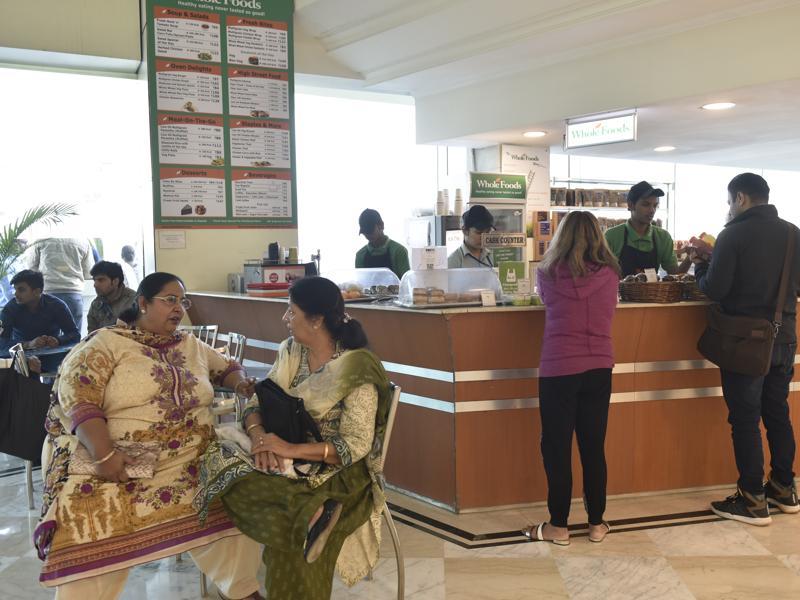
Companies are holding counselling sessions, using apps and e-platforms to ease stress among employees.
Stressed? Highly likely, if you spend your days juggling long hours at work, unending commutes, ATM queues, air pollution, family dynamics, rising prices, less time for friends and loved ones, irritable colleagues and surly strangers.
“Physical and mental stress touch every aspect of life,” says Dr Anoop Misra, chairman of the Fortis C-DOC Hospital for Diabetes, Endocrinology and Allied Multispecialities. “And such stress has links to hypertension, obesity, diabetes, heart disease, erectile dysfunction, low libido, loss of bone and muscle mass, dementia, cancers, accelerated ageing and early death.”
One in two employees in the IT sector in India suffers from chronic stress-related disorders such as hypertension, obesity, frequent infection, insomnia and diabetes, with absenteeism from chronic stress increasing by 300% over the past two decades, Dr Misra pointed out, speaking at the 5th Healthy Lifestyle Symposium, titled Wellbeing at the Workplace and held in New Delhi this past week.
Read: 12 ways to make your workspace healthier
The first step to lowering workplace stress is acknowledging it. “In a typical office, one in five people has a mental disorder during their most productive years [20s to 40s], and one in 20 experiences burnout,” says Dr Samir Parikh, director of the department of mental health and behavioural sciences at Fortis Healthcare.
GOING DIGITAL
Corporate houses are increasingly using web-based programmes to improve employee wellbeing by taking wellness beyond bands and apps that simply track activity, calories and sleep patterns.
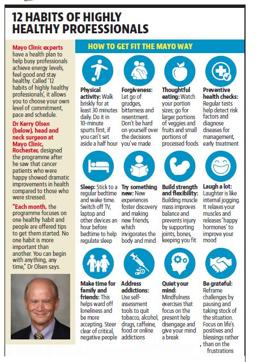
Investment in corporate wellness programmes works for both employees and employers. “A meta-analysis of studies showed that medical costs fall by $3.27 and absenteeism costs by $2.73 for every dollar spent by employers on wellness programmes,” says Dr Misra.
Increasingly, HR companies are using digital initiatives to improve the health and quality of life of their workforce. “Mobile apps can help measure, monitor and create a roadmap for improved mental and physical wellness and provide scientific guidance on prevention and nutrition,” says Janez Uplaznik, director of 24alife, a website developed to promote employee wellness, in partnership with Mayo Clinic, the world’s largest non-profit medical institution.
“Workplace-based counselling works because most people spend more waking hours at work than at home and it presents a captive audience for interventions,” Uplaznik says.
Read: 7 companies that have amazing healthy office perks
Wellbeing needs to be audited as much as everything else, Dr Parikh adds. “The workplace should not be an unemotional robotic place; social interaction while working is equally important. Identifying early signs of stress works only if there are solutions — we must bring counselling to the workplace.”
HAVING THE TALK
Digital workplace counselling helps employees lose weight, boosts fitness levels, lowers cardio-metabolic risk factors like high blood pressure and cholesterol, keeps motivation high and optimises output, found a study by Centre for Public Health, India.
For the study, 180 people at two sites were given active intervention for six months and maintenance support for three months, while another 180 were control subjects with delayed intervention. All 360 people were followed for
18 months.
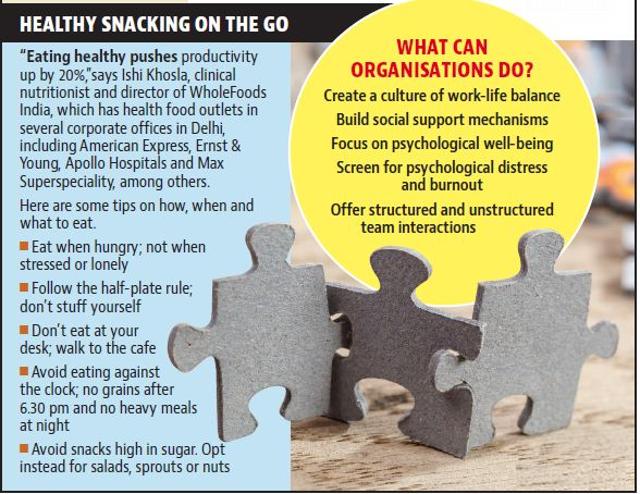
Once people registered, they were encouraged to post queries, take up challenges, give feedback and get immediate expert advice on nutrition, fitness and wellbeing. “Biochemical tests and physical exams done before and after showed improvement in all health parameters, including fall in weight, blood pressure, bad cholesterol, triglycerides and improved blood glucose control,” says Dr Misra, who was the principal investigator of the study.
“Health promotion and social security are key to employee loyalty, as are opportunities for skilling, training, continuous learning and opportunities for feedback,” adds Sanjay Singh, principal resident representative at Tata Sons, who cited the example of the 26/11 attack in Mumbai.
All 600 employees inside the Taj Mahal Palace hotel when the attack began chose to stay back to help guests after they were told staying back was voluntary. Eleven died in the four-day terror siege.
“Companies need the number of motivated employees to grow and this can happen only if they have a healthy environment to operate in,” says Solomon Ravikumar, head of human resources at the Volvo group in India.