
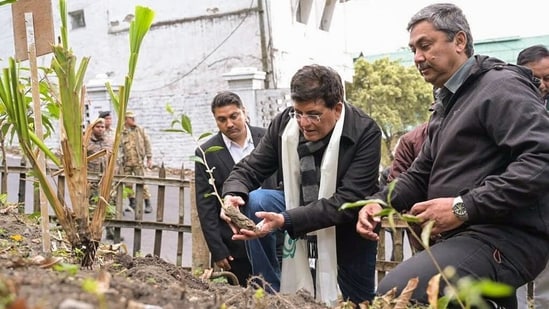
Union commerce and industry minister Piyush Goyal said last week the government was working to restore the glory of Darjeeling tea – the first Indian product to win a geographical indication (GI) tag – at a time when the hills are growing less tea than they did a generation ago and the industry is struggling.
The GI tag, granted in 2004, reserves the Darjeeling name for tea grown and processed in the region's 87 registered gardens. But, even with that designation, the industry has lost ground over the past decade, as harvests have shrunk and planters say cheaper tea has been sold under Darjeeling’s name.
Goyal made his remarks in the presence of tea industry stakeholders gathered at Makaibari Tea Estate in Kurseong on Sunday, November 22. The hill town was where the first tea plantations began commercial production 170 years ago.
Earning its name
Darjeeling’s tea industry may have begun as an experiment by a colonial administrator. In 1841, Dr Campbell, a doctor in the Indian Medical Service who had been sent from Nepal to run the new hill station as its superintendent, planted a few seeds grown in Kumaon from Chinese stock, according to the 1907 Bengal District Gazetteer for Darjeeling, an official British record.
Popular retellings also credit Robert Fortune, a Scottish botanist who collected tea seed in China, as the source of Darjeeling’s first plants. The gazetteer mentions Fortune’s mission to China “in search of tea seed”, but it says Campbell’s Kumaon-grown seed was the first to be planted.
{{/usCountry}}Popular retellings also credit Robert Fortune, a Scottish botanist who collected tea seed in China, as the source of Darjeeling’s first plants. The gazetteer mentions Fortune’s mission to China “in search of tea seed”, but it says Campbell’s Kumaon-grown seed was the first to be planted.
{{/usCountry}}The experiment, nonetheless, had its sceptics. An administration report in 1852 recorded the doubts of the British botanist Joseph Hooker, who thought Darjeeling town, at about 2,100m, had “too much moisture and too little sun” for tea to pay on a large scale. (The report added that the objection did not apply to lower sites such as Kurseong.)
Planters went ahead, and once commercial planting began, the gardens multiplied quickly. The gazetteer dates the start to 1856, when the Kurseong and Darjeeling Tea Company opened the Alubari garden. Other accounts give different dates. The Tea Board of India says the tea was first planted “in the early 1800”, and the Indian Tea Association (ITA), the planters' industry body, dates the start of commercial cultivation to around 1852–53. By the gazetteer’s count, Darjeeling had 39 gardens a decade after commercial planting began and 148 by 1905 across the district, including the plains, by which time a third of its people lived on tea estates.
As the gardens spread, so did the tea’s reputation. "Darjeeling tea is famous for its peculiarly fine flavour," the gazetteer recorded in 1907, adding that the best of it was made from the second growth of the season, “just before the advent of the monsoon rains”, and again at the end of the season. Prices swung widely with the season, and tea made in one month could sell for double, and occasionally four times, the price of tea from the same estate two months earlier or later.
More than a century later, the Tea Board of India secured legal protection for the name abroad. In 2011, the European Union registered Darjeeling as a protected geographical indication, reserving the name across its member states for tea from the defined area. The board also has certification trade marks for the Darjeeling name and logo in the UK, the US, Australia and Taiwan.
Also read: Darjeeling tea industry is in peril. Here’s how to fix it
The flavour
Darjeeling’s tea differs from the strong brew most Indians drink, partly because of the plant.
In 1907, the gazetteer noted that most of Darjeeling's gardens were planted with the small-leaved China variety of the tea plant, along with hybrids. A later case study published by the United Nations’ Food and Agriculture Organization (FAO) found the bushes were still largely a “Chinese hybrid”. Assam's gardens, by contrast, grow the large-leaved variety.
The gardens also lie higher, at altitudes between 600m and 2,000m above sea level. The gazetteer noted that bushes on the upper slopes yield less, but that the quality of their tea was “distinctly better”.
The leaf is handled differently once it is picked, too. Darjeeling makes only “orthodox” tea, in which workers pluck two leaves and a bud that are withered and rolled, then oxidised and dried more or less whole. Most of India's tea, 88% of it in 2025, is CTC, short for crush, tear, curl, a machine process that chops the leaf into small granules for a quick, strong cup.
The pre-monsoon crop that the gazetteer praised is now known in the trade as the “second flush”, and its flavour as “muscatel”, after the muscat grape.
Research has linked the flavour to two kinds of sap-sucking insect, jassids and thrips. In 2012, scientists at the Tea Research Association's institute at Tocklai, in Assam's Jorhat, found that leaves attacked by thrips switched on more of the genes involved in making aroma compounds, in a study published in the journal Plant Molecular Biology.
Goyal also drew the contrast in an article on his official website in May. “The delicate muscatel flavour of Darjeeling tea from the Himalayan foothills, the strong and malty Assam tea from the Brahmaputra plains…” the article titled India’s Tea Triumph: A Legacy Brewed Through Centuries read.
Small harvest, high price
For all its fame, Darjeeling is a tiny producer by Indian standards.
India grew nearly 1.4 billion kg of tea in 2025, according to the Tea Board. Assam grew about half of it, the West Bengal plains about 30% and the south about 17%, with the rest from smaller growing states. The Darjeeling hills produced 5.60 million kg, roughly 0.4% of the country's total.
Most of India’s tea is consumed within the country. India exported 282.11 million kg of tea in 2025-26, according to the commerce ministry, about a fifth of what it produced that year. But Darjeeling depends far more on buyers abroad, though a chunk of its crop is still sold at home.
In 2022, Rishi Saria, director of the Gopaldhara and Rohini tea estates, told HT: “The export of Darjeeling tea is 3 to 4 million kg and the production stands at around 7 million kg per annum. Basically, close to 3 to 4 million kg has to be sold within India.”
The hills have long made up for their small size with high prices. At auctions in 2025, Darjeeling tea fetched an average of ₹437.85 a kg, more than twice the national average, according to the ITA.
Also read: I’m not sure that GI has helped Darjeeling tea, says Tea Board chairman
Losing ground
The harvest has shrunk over the years. Darjeeling grew 14.49 million kg of tea in 1990, according to the ITA, more than two and a half times its 2025 crop. The sharpest fall came in 2017, when a 104-day strike for a separate Gorkhaland state disrupted work in all 87 gardens from mid-June to the end of September. Output fell to 3.29 million kg in 2017-18, the government told the Rajya Sabha.
Some workers left for jobs in Nepal, and HT reported at the time that Nepalese tea had begun to take Darjeeling’s place in Bengal’s market.
Prices have stalled too. Darjeeling’s average auction price in 2025 was about what it had been in 2017, according to ITA data, while the national average rose by about 39% over the same period.
Planters say they have been squeezed from the other side as well. In a white paper seeking government support, the ITA estimates that a kg of Darjeeling tea now costs ₹650 to ₹750 to make, above both its average auction price and the average price of its exports, ₹550 a kg.
Planters also face competition from other countries, including Nepal, which grows orthodox tea in hills much like Darjeeling’s. Planters in north Bengal told HT as far back as 2017 that the tea in Nepal cost nearly half as much to produce. They have alleged in the past that some of the tea from hills beyond India ends up being sold as Darjeeling.
The Tea Board has tried several ways to protect the label and the gardens. It has run a compulsory certification system for Darjeeling tea since 2000, and issued certificates of origin for Darjeeling exports. In November 2021, it told importers to state the origin of imported tea on their invoices and banned the blending of imported teas with GI-tagged ones. But some planters said the ban cost them their largest buyer, a company that had blended Darjeeling into packs that were not not sold as Darjeeling tea. In October 2022, the board amended the order to allow such blends, as long as the pack does not claim to be GI tea.
The gardens face problems of their own. Asked about the decline in the Lok Sabha in April 2025, Jitin Prasada, minister of state for commerce and industry, pointed to "old and senile tea bushes" and the effects of climate change. He said that gardens converting to organic tea were getting lower yields as well
Pests have been another problem in recent years, with the Tea Research Association telling HT in 2025 that a sap-sucking green fly had cut yields in gardens in West Bengal and Assam between 11% and 55%.
Some gardens have shut altogether. Eight Darjeeling tea estates remain closed, according to the ITA’s July 2026 white paper. Across West Bengal, including the plains, more than 30 gardens are now shut. The Darjeeling gardens still employ more than 55,000 permanent workers, the ITA says.
The revival plan
For now, the government's plan deals mostly with sales and exports. It offers exporters help with freight costs and a global marketing campaign, while the Tea Board studies a demand from growers to sell all their tea at public auction. The Centre will also clear old dues owed to tea research institutes and extend tea research services to small growers. Further, it has earmarked ₹312 crore for the education of tea workers’ children and healthcare for their families in West Bengal.
“The Centre is working seriously to restore the glory of Darjeeling tea worldwide,” Goyal said, adding that the plans would be discussed with planters before any decisions were announced.
ABOUT THE AUTHOR
Prerna Madan leads the explainers and immersives team at Hindustan Times, bringing more than eight years of editorial experience across India's three largest English-language newsrooms — Hindustan Times, The Times of India and The Indian Express. Her career spans the full range of modern news journalism: digital-first production, print news desks covering metro, national, and front-page, and editorial decision-making at the planning and commissioning stage. From managing coverage of Assembly elections and the Union Budget to steering the reporting, editing and production of in-depth reporting into the Delhi-NCR’s pressing issues, Prerna has honed journalistic storytelling that spans genres, topics and formats. Running through her current work is a facility for complexity — translating consequential, difficult material in the fields of policy, science, environment and politics into rigorous, accessible journalism that sets out to answer two critical questions: why it matters, and what happens now. Prerna holds a degree in English Literature from the University of Delhi and a postgraduate diploma from the Indian Institute of Mass Communication.
Prakriti Deb is a journalist at Hindustan Times Digital, where she is part of the US Desk. She works on stories related to American politics, crime, sports, entertainment and weather. She particularly enjoys covering political developments that have global ripples. Through her work, she aims to break down complex events in a way that feels simple and understandable. Before joining the Hindustan Times, she worked with The Indian Express Digital, where she covered world affairs. She holds a postgraduate degree in Mass Communication with a specialisation in Journalism, along with a bachelor’s degree in English Literature. Outside the newsroom, Prakriti enjoys travelling and stepping out of her comfort zone. She finds her sense of being through storytelling in all its forms, including conversations, painting, theatre, dance and photography. She appreciates discussions that challenge her perspective and help her see the world a little differently.