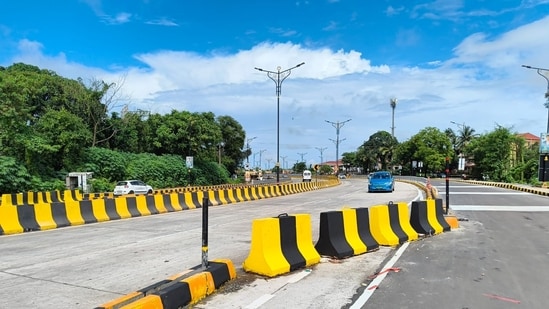
On September 12, a 5.15-km elevated corridor built in Goa along the Mumbai-Kanyakumari highway to decongest traffic witnessed its first fatal accident, barely 24 hours after it opened to the public.
A speeding car careened into a scooter, sending it crashing into a truck and killing two people. Satish Vengurlekar, the 41-year-old father of two young girls, and car passenger Amita Salgaocar, a resident of Siolim in north Goa, died of their injuries.
Stung by criticism, the Goa government barricaded the motorway’s main exit leading to the state capital, Panjim, within the next 24 hours, a move that would have a cascading impact on commuters—residents and tourists alike.
Atal Setu and the Porvorim elevated corridor—both supposed to serve as chokepoint bypasses—run one after another along the Mumbai-Kanyakumari highway. Atal Setu, a signature bridge over the Mandovi River that opened in 2019, allows traffic to bypass Panjim, while the elevated corridor allows it to bypass Porvorim, a collection of suburban villages north of the capital. Between the two is the interchange that was closed after the accident.
The shuttering of this key interchange meant motorists could use the two links only if they wanted to bypass both Panjim and Porvorim. Those travelling to either town cannot use them, rendering the two structures largely useless for most local commuters. In other words, the two links will remain out of bounds for many of those wishing to travel to the coastal state's popular north Goa beach belt. Panjim and Porvorim are the biggest sources of traffic along the stretch.
{{/usCountry}}The shuttering of this key interchange meant motorists could use the two links only if they wanted to bypass both Panjim and Porvorim. Those travelling to either town cannot use them, rendering the two structures largely useless for most local commuters. In other words, the two links will remain out of bounds for many of those wishing to travel to the coastal state's popular north Goa beach belt. Panjim and Porvorim are the biggest sources of traffic along the stretch.
{{/usCountry}}The move has compounded the traffic chaos in the area, sparked widespread discontent among residents, made commutes longer for holidaymakers on the key Panjim-Calangute and Panjim-Mapusa stretches in the state known for its tourism, and prompted the Public Works Department (PWD)—the department responsible for the construction and upkeep of the ₹641-crore elevated corridor—to issue a riposte to allegations of faulty design.
A senior PWD official told HT that all issues would be resolved soon, though he did not spell out a timeline. His department has described the corridor's closure as a temporary measure “to assess and monitor the actual traffic movement, pattern, congestion levels and operational performance”.
But residents criticised authorities for the traffic mess, complaining that their commutes have become more difficult and lengthier, especially due to the restrictions on Atal Setu. The elevated corridor, during the mere two days it was accessible to residents of Panjim and Porvorim, cut peak-hour commute times from 45-60 minutes to 15-20 minutes.
"This is the height of ridiculousness. Previously, I could take the Atal Setu bridge when the two old [Panjim] bridges were overcrowded, and get off before the Neo Majestic [a hotel in Porvorim that is also a key traffic intersection] to drive to my home in Porvorim. Now, I am forced to go home by the old bridges,” Sigmund de Souza, a resident of Porvorim, said.
Another Porvorim resident, Sanjeev Naik, summed up the extent of the traffic woes: “Atal Setu approach for locals is blocked at Majestic. Now even Porvorkars are banned from using the access that connects their homes to Atal Setu. What's the point then?"
Previously, Panjim, which lies on the southern bank of the River Mandovi, was connected to the north via two parallel bridges, which would often be congested due to the jostling of office-goers, tourists, passenger buses as well as cargo trucks. Atal Setu, which served as a third bridge over the Mandovi, helped ease the traffic. Cargo trucks running along the Mumbai-Kanyakumari highway, as well as tourist taxis plying between Goa’s Dabolim airport and the tourist destinations of the north, no longer needed to use the two old bridges.
Also read: Heavy vehicles banned on Mumbai-Goa highway during Ganeshotsav
The party that turned sour
The elevated corridor, inaugurated with much fanfare by Union Minister of Road Transport and Highways Nitin Gadkari, was sold as a solution to traffic bottlenecks in the area.
According to government projections, the corridor was to carry between 75,000 and 80,000 vehicles a day, or around 60% of the traffic that uses the route. A majority of this traffic is rush-hour traffic of office-goers heading to or from Panjim, or tourists travelling between the heritage attractions of the city and the north Goa coastal belt dotted with the popular Calangute, Candolim and Anjuna beaches. The drive between Panjim and Mapusa, a market town towards the north, was to reduce to a mere 15 minutes from the 45 minutes it currently takes.
But the fatal accident hours after its inauguration brought a premature halt to the big plans. Motorists, activists and opposition politicians alleged that faulty design at the corridor’s exit, where multiple lanes converge into a narrow entry and exit point, made the stretch dangerous.
Prabodh Shirwaikar, the Goa traffic superintendent of police, warned in July that opening the flyover without a traffic plan in place would leave motorists confused, and that crisscrossing traffic at the exit points would mean traffic from the elevated corridor and the existing road would converge near Hotel Majestic before proceeding towards Atal Setu. The resulting crisscross movement, he said, could increase the risk of accidents.
"The PWD does not seem to have the mood to work with the local administration,” he said back then.
Roland Martins, a member of the North Goa District Road Safety Committee—a multi-disciplinary statutory district body—said the fiasco is “symptomatic of the larger malaise afflicting Goa’s Public Works Department”. He said PWD "fails to coordinate" on design-related issues with departments such as the traffic police and transport department.
“They had ample time to put up signages, hold a presentation for users on the entries and exits and invite suggestions from the traffic police on how traffic will flow much before reopening the flyover. Now, they need to explain what went wrong, why and what they are going to do to remedy the situation,” Martins said.
Also read: Nitin Gadkari ‘ashamed’ of Mumbai-Goa Highway expansion delays, says won't join inauguration
'Issue will be resolved soon’
Dattaprasad Kamat, chief engineer for PWD’s National Highways division, said the restrictions currently in place were a temporary measure until the department could put broader safety measures in place.
“The accident [on September 12] was primarily caused by a speeding vehicle that approached the down ramp at high speed, when the notified limit is around 65 kmph. The incident has upset us as well and the entrances will not be reopened until the measures are in place,” Kamat said.
He, however, insisted that there was no problem with the design of the exit itself, as it was built “as per national highway specifications”.
“We will draw up a solution keeping the interests of the people and traffic movement in mind before reopening it again,” he said, adding that he wouldn’t be able to offer a time frame for when the process will be completed.